The blue-headed earthen pigeon [1] ( lat. Starnoenas cyanocephala ) is the only species in the monotypic genus Starnoenas [2] . The species name comes from the Greek "cyanocephala" - blue head, generic: "starna" - partridge, "oenas" - pigeon.
| Blue-headed earthen pigeon |
|
| Scientific classification |
|---|
| No rank : | Bilateral symmetrical |
| Gender: | Blue-headed earthen pigeons ( Starnoenas Bonaparte , 1838 ) |
| View: | Blue-headed earthen pigeon |
|
| International scientific name |
|---|
Starnoenas cyanocephala
( Linnaeus , 1758) |
| Security status |
|---|
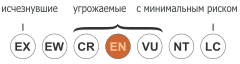
Endangered speciesIUCN 3.1 Endangered : 22690970 |
|
It lives in Cuba . This species is found in the lower tier (undergrowth) of flat forests, including in marshy areas, but sometimes in mountain forests. Estimated abundance: only 1,000 to 2,400 birds.
Food is seeds, berries and snails collected on the ground in a dense forest, and sometimes on forest paths. Usually found in pairs. Reproduction occurs mainly from April to June, nests are located on the ground or close to the ground, often among the roots of trees or in the cavities of stumps, or slightly higher, on a horizontal branch 2.5-8 m above the ground. In clutch there are 2 white eggs [3] . The voice is a protracted "ooo-oooh."
About 30 cm in length [4] , average weight 225 grams [5] . Sexual dimorphism is absent. The upper part of the head is metallic blue.
Before the arrival of Columbus and the moment of its appearance on the island, judging by the chronicles of that time, apparently, it was very numerous. Hunting and intensive deforestation for the development of the sugar industry have led to a significant decrease in numbers. Like all birds nesting on the ground, the species depends on the presence of introduced mammals (pigs, cats, mongoose dogs and rats). Places where the species is still numerous are natural parks of the national system of conservation areas. Hunting for him is prohibited. There are examples of captive breeding.