Collared cobra [1] ( lat. Hemachatus haemachatus ) is a poisonous snake from the family of aspids ( Elapidae ). The only species of the genus Hemachatus .
| Collared cobra |
 |
| Scientific classification |
|---|
| No rank : | Bilateral symmetrical |
| Infraclass : | Lepidosauromorphs |
| Infrastructure : | Caenophidia |
| Gender: | Collared Cobras ( Hemachatus Fleming , 1822 ) |
|
| International scientific name |
|---|
Hemachatus haemachatus Bonnaterre , 1790 |
| Security status |
|---|
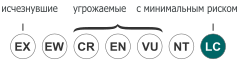
Least ConcernedIUCN 3.1 Least Concern : 177556 |
|
The total length varies from 90 to 110 cm [2] . The main difference is that she has no teeth on her upper jaw behind the poisonous fangs. The head is small, slightly rounded, the body is slender. The back has a grayish color, along which intermittent skew-cross strips are scattered. Very often there are very dark snakes. The head is always black, the bottom of the neck is also black, and below the belly there are several wide black and white transverse stripes, which are clearly visible when the cobra becomes in a threatening pose. She, like real cobras, extends her neck, spreading the neck ribs to the sides, but her “hood” is quite narrow.
He loves grassy, rocky terrain near swamps and lakes. Active at night. Leads a secretive lifestyle. It feeds on small mammals, toads, lizards.
Viviparous snake. The female in late August - early September gives birth to 20 to 35 (maximum 65) cubs 18 cm long [3] .
It lives in South Africa (Zimbabwe, Lesotho, Swaziland, South Africa), where it received the name "spitting snake" for its tendency to "spit" poison. She exclusively uses this insidious trick. However, in addition to such an active defense, it often uses a passive means, turning on its back and pretending to be dead.