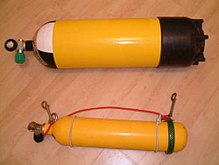
Balloon (for scuba diving) - steel, aluminum or composite (thin-walled metal flask, reinforced with carbon fiber) vessel of cylindrical or, more rarely, spherical shape, used for storing and transporting gas under high (up to 300 atm ) pressure. The balloon is part of scuba .
Gas from the cylinder goes to the swimmer through the regulator . Gas in cylinders is usually contained under a pressure of from 186 to 300 bar (from 2700 to 4300 psi , or from 18.6 to 30.0 MPa ), and a typical tank volume is from 1.5 to 18 liters , which allows you to have a gas supply of 300 to 3600 liters under normal conditions (30 to 120 ft³ (cubic feet )).
Gas cylinders are also used for various surface tasks, including the storage of gas for oxygen first aid in the treatment of diseases associated with diving, in the breathing apparatus of firefighters and are used as a gas storage in compressor stations; There are also various non- diving applications.
Device
The composition of the cylinder, in general, includes:
- The flask is actually the gas storage itself. Usually made from forged aluminum or steel .Cylinders made of composite materials are used in fire-fighting breathing apparatus, but are rarely used for diving due to their high positive buoyancy. Aluminum cylinders have a lower density than steel, which is an advantage in technical diving, because it reduces negative buoyancy in cases where the diver must carry many cylinders. However, there is the flip side of the coin: when diving with one or two aluminum cylinders, the addition of weights will be required to create the negative buoyancy necessary for the dive.
- Shut-off valve - a unit connecting the flask of the cylinder with the regulator. The task of the valve is to control the gas flow from and to the cylinder and create a tight connection with the regulator. The valve also includes a safety disc, which will collapse from overpressure before the balloon ruptures due to exceeding the permissible pressure.
- Y-shaped shut-off valve . Most often, shut-off valves having one output and one valve are found. The Y-shaped valve has two outputs and two valves, which allows you to connect two regulators to the cylinder. If one regulator goes into free-flow mode (the most common type of failure), its valve can be closed and breathing from the second regulator can continue.
- The rubber O-ring is a seal between the shut-off valve and the regulator. Fluoroplastic O-rings are used with cylinders designed to store oxygen-rich gas mixtures to reduce the risk of fire.
- Reserve lever . Until the 1970s , before pressure gauges began to be installed on the regulators, a mechanism was often used to warn the swimmer about the depletion of the gas mixture. The gas supply was automatically stopped at the moment when the pressure in the cylinder reached a certain value. To use the reserve, the diver pulled the lever and completed the dive before the reserve was spent.
- Shoe - serves to protect the cylinder from excessive impacts on the ground, as well as to ensure that the cylinder can be installed in an upright position. It is a plastic cup in which the bottom of the bulb is inserted. It is used mainly with steel cylinders.
Types of Shut-Off
Currently, there are four foreign types of valves:
- A-clamp (or English Yoke (yok) - clamp) - ensures tightness of the connection by pressing the regulator to the cylinder valve with a clamp. This type of connection is simple, cheap and very widely used throughout the world. It is designed for a maximum pressure of 232 bar, and the weakest part of the connection, the O-ring, is not well protected from excess pressure.
- 232 bar DIN (5 turns, G 5/8 "pipe thread) - the regulator is screwed into the valve, which provides a reliable fixation of the O-ring. They are more reliable than A-clamps because the O-ring is well protected, but in many countries DIN equipment is not used universally on compressors, so the diver will have to take an adapter during the trip.
- 300 bar DIN: (7 turns, pipe thread G 5/8 ") - similar to the previous type of valve (232 bar), but designed for operating pressures up to 300 bar. It is possible to use regulators designed for 300 bar in cylinders designed for pressure 232 bars, but not vice versa .
- EN 144-3: 2003 The European standard describes a new type of connection that looks similar to DIN 232 or 300, but it uses the metric thread M26 × 2. A compound of this type is intended for use with mixtures in which the oxygen content is higher than in the atmosphere , that is, with hyper-toxic gas mixtures .
According to the rules of the European Union, since August 2008, all equipment used for diving using nitrox or pure oxygen should meet the new standard.
In addition to imported standard valves in the CIS, a large number of cylinders with Soviet standards for connecting threads are also used. The most popular are cylinders with a VK-200 valve, the connecting thread of which is also used on the Ukraine-2 and Young's (ASV) devices. In addition, there is the AVM-5 connector (AVM-7) and the AVM-1 connector. To install imported regulators, as well as regulators with other thread standards, adapters are installed on such cylinders:
- "Ukraine-2" and cylinders with valve VK-200 to the DIN regulator.
- “AVM-5”, “AVM-7” on the DIN regulator.
- "AVM-1", "Submariner-1" on the DIN regulator.
- "AVM-5", "AVM-7"; "Podvodnik-2", "Podvodnik-3" on the regulator YOKE.
- "AVM-1", "Podvodnik-1" on the AVM-5 regulator.
Cylinder material
Cylinders are made of steel , aluminum, composite material of steel and carbon fiber. In addition, each option has both pros and cons.
- Steel cylinders . They have a high negative buoyancy, which allows to reduce the number of cargoes, but puts a limit on the maximum number of simultaneously transported cylinders.
- Aluminum cylinders . Despite the lower density of the metal, aluminum cylinders are heavier due to an increase in the thickness of the flask walls compared to steel. At the same time, in some diving federations , aluminum cylinders are mainly used for stages, since, unlike steel cylinders, their weight in water is close to zero. They have a limit on the maximum working pressure in the vessel - 210 bar.
- Composite cylinders . They have a small weight, which when used in water leads to the need for an additional set of goods. Very fragile.
| Balloon | Air | Surface weight | Weight in water | |||||
|---|---|---|---|---|---|---|---|---|
| Material | Volume, l | Pressure bar | Volume, l | Weight, kg | Empty kg | Full, kg | Empty kg | Full, kg |
| Steel | 12 | 200 | 2400 | 3.0 | 16,0 | 19.0 | −1,2 | −4,3 |
| 15 | 200 | 3000 | 3.8 | 20.0 | 23.8 | −1,4 | −5,2 | |
| 2 × 7 | 200 | 2800 | 3.5 | 19.5 | 23.0 | −2.0 | −5,6 | |
| eight | 300 | 2400 | 3.0 | 13.0 | 16,0 | −3.5 | −6,5 | |
| ten | 300 | 3000 | 3.8 | 17.0 | 20.8 | −4.0 | −7,8 | |
| 2 × 4 | 300 | 2400 | 3.0 | 15.0 | 18.0 | −4.0 | −7.0 | |
| 2 × 6 | 300 | 3600 | 4.6 | 21.0 | 25.6 | −5.0 | −9,6 | |
| Aluminum | 9 | 203 | 1826 | 2.3 | 12.2 | 13.5 | +1.8 | −0.5 |
| eleven | 203 | 2247 | 2.8 | 14.4 | 17.2 | +1.8 | −1,1 | |
| 13 | 203 | 2584 | 3.2 | 17.1 | 20.3 | +1.4 | −1.7 | |
Purpose of Cylinders
Divers often use several types of cylinders. Each cylinder has its own purpose.
Recreational divers often have the following cylinders available:
- The main cylinder is used during the dive, the capacity is usually from 10 to 18 liters.
- bail out or bale out - a balloon used only as an emergency air reserve, a “reserve parachute” of a diver. Usually has a volume of 0.4 to 1 liter.
- pony balloon - a small balloon that is used as a reserve.
Technical divers often use several types of breathing mixtures, each of which is in separate cylinders for all stages of the dive:
- travel mixture or transport mixture (from the English travel gas ) - the cylinder contains gas for use during the dive - it is usually nitrox with an average partial pressure of oxygen in the mixture.
- bottom mixture (from English bottom gas ) - the cylinder contains gas for use at depth - it is usually a helium- based gas mixture with a low oxygen content - heliox or trimix .
- stage (from the English stage ) - the cylinder contains gas for decompression procedures , usually nitrox with a high partial pressure of oxygen or pure oxygen.
Small capacity cylinders (1–3 liters) are used in rebreathers :
- Oxygen rebreathers have an oxygen bottle
- Semi-closed loop freezers have a diluent balloon that contains air, nitrox, or a helium-based mixture.
- closed-loop rebreathers have oxygen and diluent balloons that contain air, nitrox, or helium-based mixture.
Capacity
The most frequently asked question looks like this: "How long can I stay under water using a particular balloon?" The question consists of two parts:
How much gas can contain a cylinder? The capacity of the container depends on two indicators:
- operating pressure: 200 to 300 bar
- internal volume: it usually ranges from 3 to 18 liters
- Thus, a 3-liter cylinder with a working pressure of 300 bar can contain up to 900 liters of gas.
How much gas does a swimmer consume? Two factors affect gas consumption:
- submariner breathing rate: in normal conditions, this value is from 10 to 25 liters per minute; during hard work or panic, air consumption can increase to 100 liters per minute.
- ambient pressure: surface pressure is 1 bar (1 atmosphere); every 10 meters of depth increases the pressure by 1 bar.
- So, a swimmer consuming 20 liters of air per minute on the surface (1 bar), at a depth of 30 meters (4 bars) will consume four times as much - 80 liters per minute. If a scuba diver has only a three-liter balloon under pressure of 300 bar for breathing, then the gas in the balloon will end after 11 minutes and a little.
Gas consumption is also affected by the rate of oxygen consumption by the body ( metabolism ), exercise, and psychological state. Strictly speaking, the last two factors influence the air flow not on the straight line, but through the respiration rate. Since it is known that, depending on the physical load, the body's consumption of oxygen increases, and as a result, the volume of the mixture consumed and respiration rate increase. The psychological state (stress, arousal, calmness) also has a noticeable effect on the flow rate of the breathing mix. It is logical to assume that gas consumption is more if the diver is nervous or excited.
Reservations
It is highly recommended to reserve some of the gas used to increase safety. A reserve may be needed to make longer decompression stops than the dive plan provided, or to provide additional time to deal with the consequences of incidents underwater.
The size of the reserve depends on the likelihood of a contingency occurring during the dive. Deep-sea or decompression diving requires a larger reserve than a shallow-water or decompression-free dive. In recreational dives, it is recommended to plan the dive in such a way that when leaving the surface, the gas remains at a pressure of 50 bar or 25% of the initial capacity. In technical dives (diving in overhead environments or deep sea diving), scuba divers plan dives with increased safety limits using the rule of thirds: one third of the gas is planned for diving, the second third is for access to the surface and the third is reserve. Moreover, more stringent recommendations have recently appeared, which are based on an analysis of incidents: to leave in reserve half (two quarters), or even more, of the gas reserve. These recommendations relate to a greater extent to people involved in penetrating underwater caves, shipwrecks, and other head-mounted environments with limited freedom of maneuver.
Typical cylinder sets
Here, scuba gear is understood as a set of a cylinder and a regulator - the minimum set that allows you to breathe under water.
To ensure safety, divers often take an additional reserve scuba gear to reduce the likelihood of a “no-air” situation. There are several uses for cylinders and regulators:
- Single scuba (no redundancy): consists of one large cylinder and one regulator. This configuration is simple and cheap, but it is just one system. If the aqualung refuses, then the swimmer will be in a situation "without air." This design is not recommended for use in all dives where there is a “ head-mounted environment ” that may interfere with emergency ascent: ice or cave diving, penetration of sunken objects.
- Basic scuba plus pony balloon with regulator : this configuration uses a large, main scuba diving along with an independent smaller scuba diving called a pony. The diver has two independent systems, but the complete system is now heavier and more expensive to purchase and maintain. The pony balloon has a small capacity and, thus, can provide an air supply for shallow diving. Another type of stand-by air source is a micro-scuba gear : a portable 0.5-liter bottle with a regulator mounted directly on the bottle. This "microqualang" allows you to take a few breaths and make the ascent from a depth of 20 meters.
- Stage : a type of independent scuba diving used in technical diving. Their goal is not to provide gas in the event of a scuba failure, but to store gas mixtures used at various stages of the dive.
- Independent twin (set Independent twin set ): consists of two independent scuba diving. Such a system is more difficult, expensive with the purchase, maintenance, charging cylinders. Also, the swimmer must remember the timely change of regulator, so that there is always a reserve supply of air in the tanks, so that in the event of failure of one of the scuba gears, not be in a “no air” situation. Independent sparks do not work well with air-integrated computers .
- Spark with a manifold and one regulator : two cylinders are combined using a manifold , but only one regulator is connected. This option is simple and cheap, but does not have a backup breathing system, just increasing the gas supply.
- Spark with a manifold and two regulators : consists of two scuba gears connected by a manifold with valves that can be shut off in case of an accident. This design during an accident allows you to save the remainder of the gas in the remaining cylinder. The pros and cons of this configuration are similar to pros and cons in an independent pairing. In addition, the positive qualities include the lack of the need to change the regulators under water. However, there is a danger of losing the entire supply of the gas mixture if at the moment of air leakage the valves on the manifold cannot be shut off, moreover, the manifold is expensive and is another potential point of failure.
Charging cylinders
Tanks should only be charged with air on compressors or other breathing gases using gas mixing methods. Both of these services should be provided by reliable organizations, such as scuba stores. The use of industrial compressed gases for breathing can be fatal, because high pressure increases the effect of any impurities in them.
Special measures to be taken when working with gas mixtures other than air:
- High concentrations of oxygen can cause fire or corrosion.
- Oxygen must be pumped from one container to another very carefully, and only using cleaned and labeled cylinders.
- Gas mixtures with an oxygen content other than 21% can be extremely dangerous for divers who do not know the percentage of oxygen in them. All cylinders must be applied composition of the mixture.
Breathing contaminated air at depths can be fatal. Common pollutants: carbon monoxide - a by-product of combustion, carbon dioxide - a product of metabolism, oil and grease, trapped from the compressor.
An explosion caused by the sudden release of high-pressure gas from a cylinder can be very dangerous if handled improperly. The greatest risk of explosion exists during charging of the container and the first minutes after the end of charging and increases due to a decrease in the thickness of the walls of the bulb of the container due to corrosion. Another reason is damage or corrosion of the thread and the neck of the cylinder in the place of the valve fastening.
If charging comes from a powerful compressor without pre-cooling the compressed air, the cylinder warms up, and after charging it cools down, while the air inside is still hot. The stresses in the metal are complemented by thermal stresses. This at critical pressure can bring the situation to ruin. Therefore, cooling in the first minutes after driving is the most dangerous time.
Хранение баллона под давлением уменьшает вероятность загрязнения внутренней части баллона коррозийными или токсичными агентами: морской водой, парами нефти, бензина, дизельного топлива, ядовитыми газами, колониями грибов или микроорганизмов.
Производство и тестирование
В большинстве стран требуется регулярная проверка баллонов. Обычно она включает в себя визуальную проверку внутренней поверхности и гидростатический тест (опрессовку). В США визуальная проверка должна проводиться каждый год, а гидростатический тест — каждые пять лет. В ЕС визуальная проверка должна проводиться раз в два с половиной года, а гидростатический тест — каждые пять лет. В Норвегии гидростатический тест (и визуальная проверка) должен проводиться через три года после производства баллона, а затем — каждые два года.
Законодательство в Австралии требует, чтобы баллоны были гидростатически проверены каждые двенадцать месяцев.
Гидростатический тест включает доведение давления в баллоне до испытательного (поверочного) давления и измерение объёма баллона до и после теста. Постоянное увеличение объёма, характеризуемое коэффициентом остаточного расширения, выше допустимого уровня обычно 10 %, означает, что баллон не выдерживает тест и должен быть уничтожен. Коэффициент остаточного расширения это отношение остаточного изменения объёма баллона после сброса поверочного давления, к полному, при поверочном давлении, зачастую выражается в процентах.
При производстве баллона его параметры, включающие рабочее давление , тестовое давление , дату производства , материал , ёмкость и вес , штампуются на поверхности колбы.
При проведении тестов дата текущего тестирования или дата проведения следующей проверки в некоторых странах, например, в Германии , штампуется на плечиках колбы для облегчения проверки в любой момент.
Большинство операторов компрессорных станций проверяют эти сведения перед зарядкой баллонов и могут отказать в случае наличия нестандартных или просроченных баллонов.
Цветовое кодирование баллонов
В соответствии с EN 1098-3 в ЕС вводится в использование цветовое кодирование газовых смесей в баллонах.
Раскраска горловин [3] :
- Воздух , найтрокс — белые и чёрные четверти, расположенные противоположно.
- Гелиокс — белые и коричневые четверти, расположенные противоположно.
- Чистый кислород — белая горловина.
- Чистый гелий — коричневая горловина.
- Тримикс — горловина раскрашена секторами белого, чёрного и коричневого цвета.
Во многих дайв-центрах по всему миру, где воздух и нитрокс являются стандартно используемыми газами, найтроксные баллоны имеют следующую цветовую маркировку: зелёная полоса на жёлтом основании. Обычным цветом алюминиевого баллона является серебристый. Стальные баллоны окрашиваются во избежание коррозии, главным образом, в жёлтый или белый цвет, что позволяет улучшить заметность. В некоторых промышленных стандартах маркировки баллонов жёлтый цвет означает наличие в баллоне хлора , а в Европе жёлтый цвет означает ядовитое или корродирующее содержимое, однако для подводного плавания это не имеет никакого значения, так как арматура и оборудование не совместимо.
Marking
В Европейском союзе баллоны должны быть промаркированы в соответствии с их содержимым. Ярлык должен содержать сведения о типе дыхательной смеси в баллоне.
Баллоны, предназначенные для использования обогащённых кислородом газовых смесей также требуют наличия маркировки «подготовлено к использованию с кислородом», означающей, что они подготовлены для использования в обогащённой кислородом среде.
Notes
- ↑ 1 литр воздуха при атмосферном давлении и температуре 10 °C весит 1,247 г.
- ↑ Gas Diving Архивировано 24 сентября 2015 года.
- ↑ Горловина — верхняя часть баллона, ближайшая к вентилю.
Links
- Сравнение вентилей DIN и YOKE (рус.)
- Чертежи переходников для различных моделей вентилей (рус.)
- Баллоны и баллонные блоки. «Акваланг и подводное плавание». Орлов Д. В., Сафонов М. В. (рус.)
- Выбор баллона. Советы. Хранение. Repairs. (Rus.)
- К. Федоренко. Проведение гидростатических испытаний баллонов (рус.)