The thick-billed cuckoo [1] ( lat. Pachycoccyx audeberti ) is the only representative of the monotypic genus Pachycoccyxx of the family Cuculidae [2] . It can be easily distinguished from other cuckoos, nesting parasites, from the subfamily real cuckoos (Cuculinae) by its thick beak, which in proportion resembles the beaks of birds of prey.
| Thick-billed cuckoo |
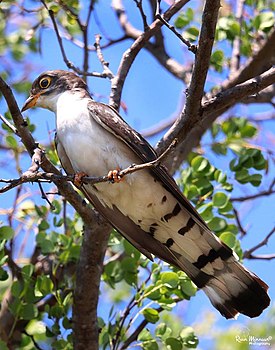 |
| Scientific classification |
|---|
| No rank : | Bilateral symmetrical |
| Gender: | Thick-billed Cuckoos ( Pachycoccyx Cabanis , 1882 ) |
|
| International scientific name |
|---|
Pachycoccyx audeberti ( Schlegel , 1879) |
| Security status |
|---|
Least ConcernedIUCN 3.1 Least Concern : 22683823 |
|
A specific Latin name is given in honor of the German naturalist Joseph Peter Odber (1848-1933) [3] .
The thick-billed cuckoo lives in humid (humid), sub-humid, and gallery forests from Guinea in the northwest to Mozambique in the southeast, but it does not have vast territories in the Congo Basin [4] [5] . Previously, it was found in tropical forests in the north-east of Madagascar, but it has not been noted on this island since 1922 [6] . In the southern part of its range, the thick-billed cuckoo is a partially migratory bird and spends the dry season of the southern hemisphere in East Africa [7] .
In terms of behavior, this is a typical cuckoo. It feeds on hairy caterpillars, but can also have significant preference for grasshoppers and praying mantises [8] . The thick-billed cuckoo is a specialized nesting parasite of forest shrikes [5] . It parasitizes almost exclusively on several species of this genus - on the red- faced spectacled shrike ( P. scopifrons ) in the eastern part of the range and on the red-bellied spectacled shrike ( Prionops caniceps ) in West Africa . In the well-studied case of the red-billed spectacled shrike, the thick-billed cuckoo caused perhaps the most significant decrease in nesting success among all nesting parasites; some spectacled shrikes failed to feed their own chicks for five years with ten attempts at breeding [5] , with an average infection percentage of 35 up to 55% of nests. The extinct subspecies of Madagascar, almost certainly, parasitized on the wangs [6] , which are related to the magpie. The parasitism of this species on spectacled shrikes can be compared with the parasitism of a similarly sized black cuckoo , which throws eggs exclusively into the nests of shrub shrikes .
- Host species of chubby cuckoo
Red-bellied Spectacled Shrike ( Prionops caniceps mentalis ) (foreground)
Red-faced Spectacled Shrike ( Prionops scopifrons kirki )