
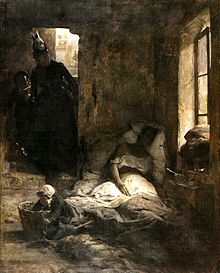
Love (in the New Testament the Greek word " agape ", Greek. Αγάπη , Latin. Caritas ) is a Christian virtue : love without foundation, reason, self-interest, capable of covering up any shortcomings, misdeeds, and crimes. One of the three main virtues of Christianity, along with faith and hope, and the main one.
The church teaches that love (mercy) is love for God (amore dei) and at the same time love for one's neighbor (amore proximi), and the second without the first is not worth much [1] .
Content
Entity
In essence, it resembles the fatherly (maternal) love for the child, whom the parent continues to love and participate in his fate no matter what.
But, unlike parental love, Christian love does not depend on kinship, as well as on age, gender, difference in social status, etc.
It encourages a person to serve, there is a desire to help, protect, fill every need, regardless of their own interests.
“For God so loved the world, that he gave his only begotten Son, that whosoever believeth in him should not perish, but have everlasting life” ( John 3:16 ) “I give you a new commandment, love one another; as I have loved you ” ( John 13:34 ) Christian love for man is given from above, it cannot be fully experienced without the supernatural influence of the Lord Jesus Christ (hence the name).
The concept of Christian love is also closely related to charity , tolerance and the pursuit of truth .
| Love is patient, merciful, love is not jealous, love is not exalted, not proud, not outrageous, not looking for her, not annoyed, does not think evil, does not rejoice in untruth, but rejoices in the truth; He covers everything, believes everything, hopes everything, transfers everything. Love never fails, although the prophecies will cease, and the tongues will be silenced, and knowledge will be abolished. ( 1 Cor. 13: 4–8 ) |
The concept of divine love
In Christianity, God is love. Absolutely perfect love can only be between three Persons of the Holy Trinity . Angels and people are called to imitate this love and grow endlessly in it. Human love after the fall is regarded as imperfect, for it is infected with sin.
Divine love is one of the fundamental and most important concepts of Christianity . It is inextricably linked with the basic principle of God the Creator - the principle of freedom. God the Creator, who created the universe, created everything in it free , that is, having the right to determine its will . Thus the world was created, including man (the act of creation is described in the first book of the Bible - “Being” ). Freedom is grace, the gift of God the Creator to every creature that has the right to be (exist) independently of the Creator, and at the same time uniting with Him. This form of connection (co-creation) is called Divine love . Divine love is the striving to be (to exist) not for personal good, but for the good of another, and therefore Divine love is inseparable from freedom , because an act of Divine love is manifested in free choice .
According to Christian doctrine, adherence to the fundamental principles of “love your enemy,” “love your neighbor as yourself” leads a person to divine love.
Christ said: “He who loves father or mother more than Me is not worthy of Me; and who loves a son or daughter more than Me is not worthy of Me. " ( Matt. 10:37 ), and also: " If anyone comes to Me and does not hate his father and mother and wife and children, brothers and sisters, and and in his own life, he cannot be My disciple. ” ( Luke 14:26 ).
Concepts of Christianity related to the concept of divine love
| Christian life Christian portal | |
Christian | |
Christian theology | |
According to Christian doctrine, God is love . ( 1 John 4: 8 )
Sublime love has nothing to do with sinful carnal passion. The Apostle Paul writes a wonderful hymn of pure Christian love:
| If I speak with the languages of men and angels , but I have no love, then I am a ringing copper or a cymbal sounding. If I have the gift of prophecy, and I know all the secrets, and I have all knowledge and all faith, so that I can rearrange the mountains, but have no love, then I am nothing . And if I give away all my possessions and give my body to be burned, but I have no love, there is no use for me in that. Love is patient, merciful, love is not jealous, love is not exalted, not proud, not outrageous, not looking for her, not annoyed, does not think evil, does not rejoice in untruth, but rejoices in the truth; He covers everything, believes everything, hopes everything, transfers everything. Love never ceases, although the prophecies will cease, and the tongues will be silenced, and knowledge will be abolished. ( 1 Cor. 13: 1-8 ) |
Christianity calls upon its followers, first of all, to love God (with all their being) as much as possible, without limitation; and to love all people, first of all our neighbors, but only as oneself (it is unacceptable to deify any of the people, to be man-pleasing) ; and love yourself as the creation of God and His image .
Man's love for God
Love for God is a feeling of love for God and deeds of love towards God, expressed in obedience to God, keeping His commandments , glorifying Him and worshiping Him. Christians consider working at the Creator with Christ in the Holy Spirit to be the pinnacle of love for God: “I no longer call you slaves, for the slave does not know what his lord is doing; but I called you friends, because I told you everything that I heard from My Father. ”(John 15:15)
The feeling of Love for God can begin to develop on the basis of gratitude to God, when a person realizes how the Lord loves him, what God has done for him personally and for all of humanity as a whole:
| This is love, that we did not love God, but He loved us and sent His Son to be the propitiation for our sins. Beloved! if God so loved us, we too must love one another. ( 1 John 4: 10-11 ) |
Love for God is inextricably linked with love for neighbor:
| We love Him because He first loved us. He who says, “I love God,” but hates his brother, is a liar: for he who does not love his brother, whom he sees, how can he love God, whom he does not see? ( 1 John 4: 19-21 ) |
Love for God and neighbor is the fruit of the Holy Spirit :
| The fruit of the spirit: love, joy , peace , long-suffering , goodness , mercy , faith , meekness , temperance . ( Gal. 5: 22,23 ) |
Love of God in the Bible
| Listen Israel: the Lord our God, the Lord is one; and you shall love the Lord your God with all your heart and with all your soul and with all your strength. ( Deut. 6: 4-6 ) |
| Therefore love the Lord your God , and keep what you are commanded to keep, and his ordinances and his laws and his commandments all the days. ( Deut. 11: 1 ) |
| Teacher! what is the greatest commandment in the law? Jesus said unto him, Thou shalt love the Lord thy God with all thy heart, and with all thy soul and all thy mind. ( Matthew 22: 36-40 ) |
| Every believer that Jesus is the Christ is born of God, and everyone who loves the One who gave birth also loves the Begotten of Him. That we love the children of God, we learn from when we love God and keep His commandments. ( 1 John 5: 1-3 ) |
Philosophy
The true essence of love is to give up the consciousness of oneself, to forget in another “I” and, however, in this disappearance and oblivion for the first time to find oneself and possess oneself.
- Hegel [2] [3]
In art
Love (Mercy) was allegorically simpler to portray as love for one's neighbor than love for God [1] :
- Gothic art: the figure of a woman doing six works of mercy - to quench your hunger, thirst, provide shelter, clothe, heal, comfort in captivity.
- Providing a tattered garment: a beggar standing next to the figure of Mercy (she can hold a knot with her belongings) puts a shirt over her head.
- XIII century: Saint Bonaventura developed the concept of divine love into the concept of light, burning fire. This metaphor is easily expressed by means of visual arts. Since then, in Italian art, the figure of Mercy is depicted with a flame (usually in a vessel, a vase), which she holds in her hand; also with a candle.
- XIV century: a figure can hold a heart high, as if offering it to God. Sometimes attributes of earthly mercy are added (cornucopia or fruit basket).
- In the Middle Ages, art was opposed to Stinginess (a figure has a bag of money or a purse, or fills a forged chest with money). In the Renaissance (since Giotto) greed is replaced by Envy, tormented by a snake. Later - Cruelty in the form of a woman attacking a baby.
- 1st floor XIV century: a woman feeding two babies. Initially connected with the image of a fiery heart and a candle. Later becomes dominant in European art. Later the number of babies increases, one at the breast.
- Pelican feeding its young with its own blood.
Notes
- ↑ 1 2 J. Hall. Dictionary of plots and characters in art. M .: Kron-press, 1996. p. 360
- ↑ Georg Wilhelm Friedrich Hegel . Aesthetics. In 4 tt / Per. B. G. Stolpner. - M .: Art, 1969. - T. 2. - p. 253.
- ↑ B. Bratus. Love as a psychological presentation of a human nature // Philosophy Questions : Journal. - RAS , 2009. - № 12 .
Literature
- Sollier J. Love (Theological Virtue) . // The Catholic Encyclopedia . Vol. 9. New York: Robert Appleton Company, 1910.
Links
- New Testament of Love (Orthodox love message) . The appeal date is May 23, 2011. Archived on February 22, 2012.
- Definitions of Love . The appeal date is March 31, 2010. Archived February 22, 2012.