Philip Henry Sheridan ( English Philip Henry Sheridan ; March 6, 1831 , Albany ( New York ) - August 5, 1888 , Bristol County ( Massachusetts )) - an American military commander who shortly before his death received the highest military rank - Army General .
| Philip Henry Sheridan | |
|---|---|
| Philipp Henry Sheridan | |
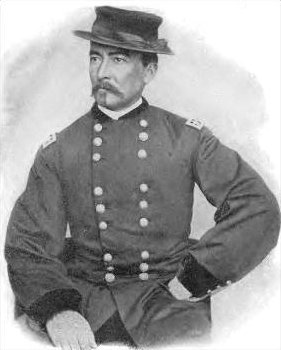 | |
| Nickname | “Little Phil”, “American Murat” |
| Date of Birth | March 6, 1831 |
| Place of Birth | Albany , NY |
| Date of death | August 5, 1888 (57 years old) |
| Place of death | Nosquitt, Bristol County, Massachusetts |
| Affiliation |  USA USA |
| Type of army | cavalry |
| Years of service | 1853-1888 |
| Rank | Army General (USA) ( June 1, 1888 ) |
| Commanded | Cavalry Corps of the Potomac Army ( April 4 - August 2, 1864 ), Shenandoah Army ( August 6 - October 16, 1864 ; October 19, 1864 - February 28, 1865 ), Cavalry Command F. Sheridan ( March - April 1865 ), US Army (from November 1 1883 ). |
| Battles / wars | US Civil War :
|
| Autograph |  |
Content
Early years
Sheridan is believed to have been born in Albany, NY, and became the third child (out of six) to the family of John and Mary Mino Sheridan, Cavan immigrants in Ireland . He grew up in Somerset ( Ohio ). He was always notable for his short stature, being no higher than 165 centimeters high, which is why he was nicknamed Little Phil. As a child, he worked in warehouses and shops, and in 1848, one of his clients, Congressman Thomas Ritchie, helped him get a job at West Point Military Academy. In her third year of study, Sheridan had a fight with his classmate , for which he was left in his second year. He graduated from the Academy of 34th academic performance in the class of 1853, and was assigned to the infantry in the interim rank of second lieutenant [1] .
After graduating from the Academy, Sheridan served in the Newport Barracks in Kentucky , then at Fort Duncan in Texas . November 22, 1854 he received the permanent rank of second lieutenant and served in the 4th Infantry Regiment. In 1854 - 1855 he served at Fort Columbus in New York, and in 1855 he served at the frontier , accompanying a topographic expedition that went from Sacramento to the Columbia River. March 1, 1861 Sheridan received the rank of first lieutenant.
Civil War
When the Civil War broke out , Sheridan joined the federal army and distinguished himself, commanding a division, in the battles of Murfreesboro ( December 31, 1862 and January 1, 1863 ), Chicamog ( September 19, 1863) and Chattanooga in 1863.
In 1864, he was appointed Ulysses Grant commander of the cavalry , and for his fearlessness he soon received the nickname "American Murat." He made a successful movement in the rear of the army of Lee , defeating Jeb Stewart at the Battle of Yellow Tavern , penetrated the first line of Richmond fortifications and on May 15 approached the James River and Butler’s army. After joining Grant, Sheridan made a successful attack on Gordonsville, defeated the enemy at White House ( June 24, 1864) and won a number of brilliant victories over the troops of Generals Earley and Longstreet near Winchester, Fisherville ( September 22 ) and Cedar Creek ( October 19) )
Produced as a major general , Sheridan defeated Airlie near Fisherville, then went to the besieged Petersberg , where Grant was, and received command of the fifth corps and the entire cavalry. On April 1, 1865, at the Battle of Fawkes, he took possession of the key to the enemy’s position, which facilitated Grant’s victory, after which Petersberg surrendered. Chasing Lee’s army, Sheridan cut off her retreat, forcing Lee to lay down his arms, and thus ended the war in the east. After the conclusion of peace, Sheridan ruled Louisiana and Texas . In 1867, President Andrew Johnson , dissatisfied with Sheridan's great popularity, transferred him to Missouri .
In 1883, Sheridan was appointed Commander-in-Chief of the US Army, in place of William Sherman .
In May 1888, Sheridan suffered a severe heart attack [2] . Upon learning of Sheridan's disease, Congress awarded him the title of four-star general. He spent the last months of his life in a seaside cottage in Massachusetts. Buried at Arlington National Cemetery .
He left interesting memoirs published in 1888 in New York under the title "Personal Memoirs".
Personality Assessment
Sheridan, undoubtedly, is one of the best commanders of the northerners. In a number of battles, he proved himself as a brave soldier and a talented commander. His soldiers loved and respected their commander. After the war, Sheridan was a supporter of a ruthless struggle with the Indians. It was he who authored the famous saying “A good Indian is a dead Indian” (or rather, the phrase was as follows: “Of all the Indians I met, only dead Indians were good”).
For the sake of fighting the Indians, Sheridan encouraged the mass extermination of bison in the United States, aimed at undermining the economic way of life of the Indian tribes . He said: “The bison hunters have done more in the past two years to solve the acute problem of the Indians than the entire regular army in the past 30 years. They destroy the material base of the Indians. Send them gunpowder and lead, if you like, and let them kill, flay the skins and sell them until they destroy all the buffalo! ” [3] . Sheridan later said in Congress that a medal should be instituted for "skinhunters", on one side of which to knock out the image of a dead bison, and on the other - a dead Indian [3] .
Notes
- ↑ Cullum's Register
- ↑ Philip Henry Sheridan, Sr (1831-1888 ) . Find A Grave Memorial .
- ↑ 1 2 Mowet F. The End of the Bison Trail . Around the World, No. 7 (2574), July 1988.
Literature
- Sheridan, Philippe-Henry // Brockhaus and Efron Encyclopedic Dictionary : 86 volumes (82 volumes and 4 additional). - SPb. , 1890-1907.
- Davies, “Life of general Phil. Sheridan ”( New York , 1895 ).