
The soborial diploma of the clergy of the Orthodox Orthodox Church of the East, affirming the tsar for the Grand Duke John IV Vasilievich, 1561 - a document compiled on behalf of the Council of Constantinople in 1561, led by the Greek Ivan Vasilyevich to the kingdom.
In the XV century , significant changes took place in Byzantium . On July 6, 1439, the Greek Orthodox clergy signed a union with the Catholics in Florence , and the papal legate Metropolitan Isidore was appointed and sent to Russia, who was to introduce and approve the union among the Russians. The union was met with hostility in Russia, the Grand Duke Vasily arrested Isidore. Convened on this occasion in 1441 in Moscow, the Council of Bishops of North-Eastern Russia , condemned Metropolitan Isidore as a heretic and apostate and rejected Unia. The Moscow Cathedral of 1448 , convened by the Grand Duke Vasily, on December 15, appointed Bishop Jonah of Ryazan to the Russian Metropolitanate without coordination with the Uniate Patriarch of Constantinople (the Patriarch of Constantinople and the Emperor were in the Union until the Turks took Constantinople, until May 29, 1453), with the title “ Metropolitan of Kiev and All Russia. " [1] and the Russian Church has become autocephalous since that time.
In 1453, Constantinople was taken and the Byzantine Empire ceased to exist. After standing on the Ugra in 1480, the Mongol-Tatar yoke came to an end and the Russian state became independent not only in fact, but also formally.
After these historical events in Russia, the idea of tsarist rule of Moscow princes arises. This idea was based on facts: the Russian state maintained the purity of Orthodoxy and independently. One of the first who formulated a new idea was Metropolitan Zosima . In the essay, "The Presentation of Easter," served to the Moscow Cathedral in 1492, he emphasized that Moscow became the new Constantinople thanks to fidelity to God. God himself set Ivan III - “the new tsar Constantine to the new degree to Constantine - Moscow and all Russian land and to many other lands of the sovereign”. [2] . Joseph Volotsky made a significant contribution to the ideological substantiation of the rights of Moscow rulers to the imperial title. In his letter to Basil III, he proved the thesis about the divine origin of royal power: “the king, by nature (body), is like the whole man, but like power is the supreme (supreme) God” [3] . A major role in substantiating the succession of Byzantium Rus was played by “The Legend of the Princes of Vladimir”. According to him, the Kiev prince Vladimir Monomakh received the royal crown (" Monomakh hat ") and other regalia from his grandfather, Emperor Constantine Monomakh. The next in the series of ideological foundations of the proclamation of the Russian state as a kingdom was the message to Vasily III of the Pskov monk Eliazarov Monastery Filofei, who put forward the well-known thesis " Moscow is the third Rome ." As R. G. Skrynnikov points out, the concept of Filofei was based on the idea of a certain “Unbreakable Roman Empire”: the collapse of two kingdoms, the Roman Empire and Byzantium, cleared the place for the Moscow Orthodox kingdom [4] .
Ivan IV , brought up on a new idea, decided to implement it and, according to the decision of the church council, was crowned king on January 16, 1547 by Metropolitan Macarius .
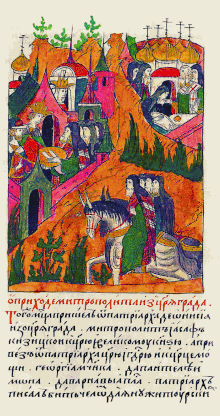
In 1556, from the , metropolitan Jozaphos of Eugripe and Kizic came to Moscow for alms. On January 30, 1557, Ivan IV sent an embassy to Constantinople, along with Metropolitan Joasaph, the former archimandrite of the Spaso-Euthymius Monastery Theodorite was sent in order to receive a blessing for his royal dignity from the Eastern Orthodox Church, to receive an assertive letter from the patriarch to the emperor in the dignity of the king. Patriarch Joasaph II sent an affirmative letter to Ivan the Terrible in 1562 . Metropolitan Joasaph brought her. Together with the letter, Patriarch Joasaph II sent a private letter in which, although he recognized the royal wedding of Ivan the Terrible and gave a blessing, he claimed that only two could crown the kingdom: the pope and the patriarch of Constantinople. In the same letter, Patriarch Joasaph II suggested that Ivan the Terrible repeat the royal wedding; the patriarch invited the sovereign to do so by Metropolitan Joasaph, his patriarchal name. Ivan the Terrible left a letter to himself, but refused a second wedding. According to E. Golubinsky , in this way the patriarch in the East wanted to play the role of the Pope, who in the West distributed the crowns to the sovereigns [5] .
The letter is written on a large sheet of parchment , a lead seal is attached below on a crimson silk ribbon. On the press: on one side - the image of the Virgin with the baby Christ in her arms, on the other side - the inscription: dr. "Ἰωάσαφ, ἐλέω Θεοῦ, ἀρχιεπίσκοπος Κωνσταντινουπόλεως, νέας Ρώμης καὶ οἰκουμενικός πατρτοιο Church of Rome, Archbishop of Rome, Constantinople, The signature is signed by the patriarch, 32 metropolitans , 1 archbishop and 3 bishops .
The letter indicates that the genealogy of Ivan the Terrible originates from the sister of Emperor Vasily Bagryanorodny Anna , the personal qualities of Ivan the Terrible are in every way exalted and, ultimately, a blessing for royal dignity is given in the name of God. The document is currently stored in the RSL .
Ivan the Terrible wrote a reply letter to Patriarch Joasaph in September 1563 , in which he asked the patriarch to give alms to signatories. The Patriarch - 270 rubles, five metropolitans - 50 rubles each, six metropolitans - 40 rubles each, the rest metropolitans and the archbishop - 30 rubles each, three bishops - 20 rubles each [6] .
Patriarch Joasaph II ruled the Church of Constantinople autocratically, not gathering a church council in 1561, but on behalf of the council he drew up a document that blessed Ivan the Terrible to the kingdom. The patriarch counted on a rich royal reward and forged the signatures of the hierarchs, and took the tsar’s alms to himself. On January 15, 1565, the patriarch gathered a large cathedral of Greek hierarchs from 50 metropolitans and one bishop, Joasaph wanted to issue formidable decrees and punish clergymen disobedient to him. But the cathedral, contrary to the expectation of the patriarch, turned against himself [7] . At the cathedral, this ugly act with the diploma of the patriarch Ivan the Terrible, like many other unauthorized actions of Joasaph, was exposed; Joasaph was accused of simony , deprived of the patriarchate and exiled to Athos [8] .
Notes
- ↑ Golubinsky E. E. The History of the Russian Church: Volume 2. From the Mongol invasion to Metropolitan Makarios inclusive / 1st half of the volume: second period, Moscow. - M .: University printing house, 1900. - S. 484
- ↑ Skrynnikov R.G. , 1997 , p. 198.
- ↑ Skrynnikov R.G. , 1997 , S. 224−225.
- ↑ Skrynnikov R.G. , 1997 , S. 241.
- ↑ Golubinsky E. History of the Russian Church. Volume 2. Part 1 p. 846
- ↑ The clergy letter of the clergy of the Orthodox Eastern Church, confirming the dignity of the king for Grand Duke John IV Vasilievich 1561 / ed. K. M. A. Obolensky st. 42
- ↑ Lebedev A.P. History of the Greek-Eastern Church under the rule of the Turks. From 1453 to the present Ed.2. 1903 p. 265
- ↑ R. Aubert (2000). "Joasaph II." Dictionnaire d'histoire et de géographie ecclésiastiques 27. Paris: Letouzey et Ané. 1389-90. ISBN 2-7063-0210-0 .
Literature
- Ulyanov O. G. The wedding of the kingdom of St. Vladimir and the approval of the royal title of Ivan the Terrible in a letter from the Patriarch of Joasaph II of Constantinople // Historian and Society. Historical fact and political controversy. Collection of articles / Resp. ed. M.P. Aizenshtat. M.: IVI RAS, 2011.S. 80-97
- Skrynnikov R.G. Russian History. IX-XVII centuries .. - M .: Publishing house "The whole world", 1997.
- N.F. Kaptereva The nature of Russia's relations to the Orthodox East in the 16th and 17th centuries, p. 29
Links
- Cathedral letter of the clergy of the Orthodox Eastern Church, approving the dignity of the king for Grand Duke John IV Vasilievich, 1561
- Cathedral letter of the clergy of the Orthodox Eastern Church, approving the dignity of the king for Grand Duke John IV Vasilievich, 1561
- The Charter of Constantinople in 1561 - a conciliar decision of the Church of Constantinople on the recognition of the Tsars of Moscow