
Sign “P” (“pi”) is a special distinctive sign, which, by order of the Nazis, should have been worn by Poles hijacked to forced labor in Germany ( civilian workers ) after the occupation of Poland by Germany [1] [2] .
On March 8, 1940, the Nazi government introduced laws against Polish workers ( German: Polenerlasse ) who were forcibly hijacked to work in Germany. Laws determined the working and living conditions of the Poles. Among other requirements, the Poles were ordered to wear a sign with the Latin letter “P”, designed to ease the determination of the nationality of the worker. Initially, the symbol was introduced for use as a patch, but later began to be used in official stamps and leaflets [3] .
The civillarbeiter patch was a yellow rhombus with a side length of five centimeters and a purple trim about half a centimeter wide. In the center of the patch was the letter “P” of violet color two and a half centimeters long [4] [5] . The patch was worn on the right side of the chest. Those who disobeyed the order to wear it were fined 150 Reichsmarks and could be arrested for up to six weeks [6] .
The patch with the letter “P” was the first sign introduced by the Nazis to designate people of a certain nationality in the territory of the Third Reich. The more famous " yellow star " worn by the Jews was introduced in the occupied territories in the autumn of 1939, but its wearing was not extended to Germany until September 1941 [3] [5] . In January 1945, the General Directorate of Imperial Security proposed a new sign design for the Poles: a yellow corncob on a red-white background, but this design was not approved [5] .
The sign itself was humiliating in nature, as its owners were deprived of many rights [7] [5] [8] .
- Examples of using
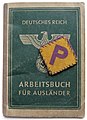
Patch with the letter “P” on the background of a foreigner's work book ( German: Arbeitsbuch Fur Auslander ), issued to the Polish civilian in 1942
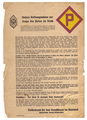
Anti-Polish leaflet printed in Gdansk, East Prussia
Notes
- ↑ Friedlander, Henry. Archives of the Holocaust: an international collection of selected documents / Henry Friedlander, Sybil Milton. - Garland, 1989. - P. 725. - ISBN 978-0-8240-5483-0 .
- ↑ Herbert, Ulrich. Hitler's Foreign Workers: Enforced Foreign Labor in Germany Under the Third Reich . - Cambridge University Press, 1997. - P. 8. - ISBN 978-0-521-47000-1 .
- ↑ 1 2 Ulrich (1997), p. 72.
- ↑ Studia ślas̨kie : [] . - 1966. - P. 282.
- ↑ 1 2 3 4 The letter “P” . Porta Polonica. Date of treatment 2015-0701.
- ↑ Maszewski, Waldemar To był pierwszy prawdziwy "widoczny znak" (Polish) (neopr.) ? . stary.naszdziennik.pl . Nasz Dziennik (March 9, 2009). Date of treatment June 15, 2015.
- ↑ Ulrich Herbert. Hitler's Foreign Workers: Enforced Foreign Labor in Germany Under the Third Reich . - Cambridge University Press, 1997. - P. 321. - ISBN 978-0-521-47000-1 .
- ↑ D'Ancona, Jacob. The city of light. - New York: Citadel, 2003. - P. 23-24. - "But the wearing of a badge or outward sign - whose effect, intended or otherwise, successful or not, was to shame and to make vulnerable as well as to distinguish the wearer ...". - ISBN 0-8065-2463-4 .
Literature
- Bartosz, Julian. Ludzie ze znakiem P.: [] . - ZakŁad Narodowy im: Ossolińskich, 1969.
- Koziełło-Poklewski, Bohdan. Ze znakiem "P": relacje i wspomnienia z robót przymusowych w Prusach Wschodnich w latach 2 wojny światowej: [] / Bohdan Koziełło-Poklewski, Bohdan Łukaszewicz, Ośrodek Badań Naukowych im. Wojciecha Kętrzyńskiego w Olsztynie. - Ośrodek Badań Naukowych im. Wojciecha Kętrzyńskiego, 1985.