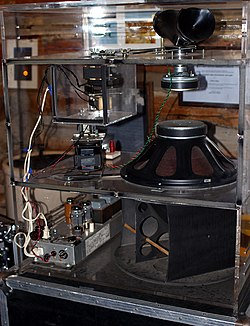
Leslie (“Leslie speaker”, Leslie speaker, “Leslie effect”, depending on the design and usage, “rotating sound”) is a device for creating a sound effect consisting in a smooth rotation of the oscillation phase of the original signal according to a law close to sinusoidal , with a frequency of several hertz and the addition of the received signal with the original. The original Leslie speaker is a bi-directional speaker with a rotating horn in front of each speaker . During the rotation of the system of horns in the horizontal plane, the phase and amplitude of the sound wave coming to the listener periodically change as a result of the addition of the waves emitted by each socket of the horn. The sound is enriched by the modulations characteristic of a classical organ — it vibrates and “overflows”; the sound stage of a monophonic instrument is complicated by the moving interference pattern. The effect has become popular and recognizable in the world through the use of such a device as part of the Hammond organ , which largely determined the classic sound of rock music of the late 60s. Electronic analog and digital simulators of the acoustic Leslie-effect are known, to some extent approaching in sound to the original mechanical device.
History
The loudspeaker with a rotating horn was created by American engineer Donald Leslie in the late 30s. Leslie worked at this time in the Hammond organ sales and repair company, an early electro-mechanical keyboard instrument, originally designed to be a cheap and compact alternative to the traditional church organ available to any poor parish. Having found the sound of the electric organ is much less expressive and voluminous than that of the wind instrument , the inventor began searching for a way to enrich the sound of the instrument.
The sound of a traditional organ is rich in infra-low-frequency modulations resulting from the pulsation of the air flow supplying the organ, the beating between the oscillations of the unison and octave tubes; sound is also influenced by the significant spatial separation of the organ pipes. In an effort to bring amplitude and phase modulation into the sound of an electronic instrument, Leslie went the most accessible way - creating mechanical oscillations of a radiating loudspeaker.
This design did not require changes in the original instrument, representing a separate acoustic unit. A similar device in a fully electronic version (low-frequency broadband adjustable phase shifter) in the 30-40s would have turned out to be unnecessarily complex, heavy and energy-intensive. After going through many design options for the radiator, Leslie stopped at a rotating double horn, to the base of which oscillations from a fixed speaker were brought, and the orifices were directed in opposite directions from the axis of rotation. This design gives an expressive sound, is mechanically balanced and does not require devices for current supply to the moving head.
In 1940, Leslie offered a completed sample to Lawrence Hammond’s firm, but the author of the organ design rejected this improvement. In 1941, Leslie began his own production, supplying apparatuses under various names, of which Leslie Vibratone is the most well-known, which became the only one since 1947. Versions were produced for organs of different manufacturers, joined with them as an element of the corps, and Leslie himself did not try to single out “Hammond "Among other compatible tools.
In 1965, Leslie sold the business to CBS , which also owned the Fender guitar brand. In 1980, the Leslie brand was finally overbought by Hammond [1] . As a result of the subsequent resale, the names Hammond and Leslie were transferred to Suzuki , which is now producing new vehicles.
Leslie Loudspeaker Device
The classic Leslie speaker consists of high-frequency and low-frequency dynamic heads (blue and yellow in the figure) working for the corresponding rotating horns (the low-frequency horn is red), each driven by its own engine (purple and orange), the rotational speed of which can be adjusted by the performer (the regulator is near the high-frequency horn motor). It may contain a built-in terminal amplifier, in the original - a tube amplifier (in the picture - green). The regulator can change the frequency of rotation of the horns from ultra-low, corresponding to the unison beats of the wind organ, to several revolutions per second, corresponding to the “performing tremolo ”.
Electronic Leslie Effects
An effect similar to the purely mechanical implementation of Leslie's dynamics can be obtained using an electronic phase modulator controlled by a sinusoidal signal with an adjustable frequency from a fraction to several hertz. Analog implementations of such a circuit contain several consecutive phase-shifting cascades, as a rule, a simplified circuit design, which is why they are often narrow-band, noisy and complex, without having all the richness of the acoustic Leslie sound. Leslie digital effects as part of various signal processing devices, such as guitar processors , can quite accurately emulate the mechanics of mechanical Leslie, but the quality of the final sound is decisively affected by the specific sound of the existing sound equipment and the room characteristics, and even more strongly by the carefulness of the algorithm development. and the electronic part of the processor itself. As a result, many performers still tend to use Leslie’s mechanical loudspeakers, and listeners most often easily distinguish the sound of an electronic emulator from a traditional device.
Home-made Leslie devices
Leslie's loudspeaker, created at the level of the equipment of the 30s, is not very complex in design and can be made relatively easily with the help of home carpentry tools with minimal knowledge of electronics. Horn, especially the woofer, most often performed in the form of glued partitioned boxes of flat parts. There are many samples created by amateurs - from desktop with speakers of 1-2 watts [2] to structures with a capacity of hundreds of watts and weighing tens of kilograms [3] .
Electronic Leslie consoles, as well as others with similar circuitry ( flanger , phaser ), became popular among home builders from the turn of the 1970s and 1980s, with the propagation of field-effect transistors as the basis of a phase-shifting cascade. Currently there are several repeatable Leslie-pedals circuits, exclusively analog; However, these devices are quite complex, their sound is not as original as that of the mechanical Leslie, and among fans they are not very popular compared to simpler and more vibrant flangers and phasers. Digital devices of this class require expensive DSPs that are difficult for amateur programming, and while homemade digital effects (including Leslie) are rare.
Notes
- ↑ http://hammondorganco.com/products/leslie/ Section of the official Hammond site dedicated to Leslie
- ↑ https://www.youtube.com/watch?v=QxdrGlA_VkI Compact Homemade Mechanical Leslie
- ↑ http://www.organforum.com/forums/showthread.php?11271-Leslie-212s-to-Passive-cab-Return-of-Son-of-DIY-Leslie-Project Self-made Lesley unit with 15-inch low-frequency speaker.