The Socialist Soviet Republic of Abkhazia (abbreviated SSR Abkhazia , SSRA ; Abkh. Soviet Socialist Republic of Aәsny ; March 4, 1921 - February 19, 1931 ) - the former independent Soviet socialist republic, after the signing of a special treaty with the Soviet Socialist Republic of Georgia on December 16, 1921 [ 1] Autonomous [2] Soviet Socialist Republic of the SSR of Georgia [3] . Through the Soviet Socialist Republic of Georgia, it was part of the ZSFSR [4] .
| Historical state | |||||
| Socialist Soviet Republic of Abkhazia | |||||
|---|---|---|---|---|---|
| abh. Soviet Socialist Republic of Aҧsny | |||||
| |||||
| Motto : “Workers of all countries, unite! Aproletartsa atәylaa ӡegy rҿy iҟou, әҽheidyshkyl! ” | |||||
| Anthem : The International | |||||
 SSR Abkhazia in 1921 | |||||
←   → →March 4, 1921 - February 19, 1931 | |||||
| Capital | Sukhum | ||||
| Largest cities | Sukhum , Gagra | ||||
| Languages) | Abkhazian Russian ( de facto ) | ||||
| Population density | 23.4 people / km² | ||||
| Area | 8600 km² | ||||
| Population | 201,000 (Score 1926; mainly Georgians , Abkhazians , Armenians , Russians, and Greeks ) | ||||
| Form of government | Socialist Soviet Republic | ||||
| Official language | |||||
| Chairman of the Council of People's Commissars | |||||
| • | Lakoba, Nestor Apollonovich | ||||


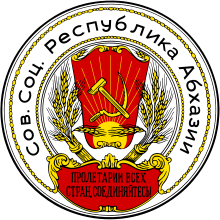
Subsequently, it was called " Autonomous Socialist Soviet Republic of Abkhazia " ( February 19, 1931 - December 5, 1936 ) [5] , or " Contractual Abkhaz Soviet Socialist Republic " ( April 17, 1930 - December 5, 1936 ) [6] . On December 5, 1936 it was renamed the " Abkhaz Autonomous Soviet Socialist Republic ." July 23, 1992 renamed the " Republic of Abkhazia ."
Content
- 1 History
- 1.1 Establishment of Soviet power
- 1.2 Entry into Georgia
- 1.3 Abkhaz ASSR
- 2 Resorts
- 3 Coat of arms
- 4 Sources
- 5 Links
- 6 See also
History
Establishment of Soviet Power
On March 4, 1921, Soviet power was established in Abkhazia. At a meeting of senior officials of Abkhazia, the question of what it should be like was considered, and delegates unanimously agreed to this opinion:
- Abkhazia should be declared a Socialist Soviet Republic;
- Soviet Abkhazia should be a direct member of the All-Russian Federation;
- general policy in Abkhazia should be moderately cautious in relation to the bourgeoisie and the peasantry.
Guided by the Declaration of the Rights of the Peoples of Russia, on March 26, 1921, at an expanded meeting of the Organizing Bureau of the RCP (B.) And the Revolutionary Committee of Abkhazia, it was decided to declare Abkhazia the Soviet Socialist Republic. The Independent Soviet Socialist Republic of Abkhazia was proclaimed on March 31, 1921. The protocol of the Batumi meeting on the structure of Soviet power and the Communist Party in Abkhazia read:
Listened: On the structure of Owls. authorities and the Communist Party in Abkhazia. Resolved: Prior to the congress of the Soviets of Abkhazia, the question of the federation of Soviet Abkhazia with the RSFSR or SSR, Georgia remains open, and Abkhazia is declared the Socialist Soviet Republic.
The party organization before the conference is called the organizing bureau of the RCP in Abkhazia and operates under the directives of the Bureau of the Central Committee of the RCP . The Organizing Bureau is taking effective measures to overcome the ethnic hatred sown by the Mensheviks between the peoples of Georgia and Abkhazia.
But on May 21, 1921, the Revolutionary Soviet Socialist Republic of Georgia recognized the independence of the Soviet Socialist Republic of Abkhazia and adopted the Declaration of the Revolutionary Committee of the Socialist Soviet Republic of Georgia on the independence of the Socialist Soviet Republic of Abkhazia. Here are excerpts from the text of this document:
The Menshevik government, being essentially the power of the Georgian bourgeoisie, along with the oppression of the working people of Georgia, with particular force suppressed any manifestation of the revolutionary activity of national minorities, which created terrible antagonism between the individual nationalities of Georgia, nationalities that have lived on this territory for centuries.
Soviet power, on the other hand, opposes the principle of oppression with equality and the fraternal union of all working people, without distinction of nations. She considers the right of nations to self-determination proclaimed by the Great October Revolution to be the only true means of eliminating national prejudices and consolidating a real union of workers.
On this basis, the Revolutionary Committee of the Socialist Soviet Republic of Georgia recognizes and welcomes the formation of the independent Socialist Soviet Republic of Abkhazia ... Revolutionary Soviet Socialist Republic of Georgia.
On October 5, 1921, at an expanded meeting of the Plenum of the Organizing Bureau of the RCP (b) in Abkhazia and senior officials of the Revolutionary Committee , a resolution was adopted on the independence of the SSR of Abkhazia:
Proceeding from the RCP program on the national question, from the new economic policy approved by the V Congress of the RCP, on the one hand, from the facts of the national relations between the Georgian and Abkhaz peoples during the Menshevik rule, on the other, the meeting fully approves the resolution of the Batumi Conference of 28 March s. g. and the declaration of Gruzrevkom of May 21 on the independence of the SSR of Abkhazia.
At the same time, taking into account, along with the disproportionate economic power of Abkhazia, the small size of its population, which is customary and historically associated with the Georgian people, on the one hand, the commonality of the economy and the corresponding economic policies of Georgia and Abkhazia , on the other, the meeting finds it necessary to establish close ties between the Soviet Socialist Republic of Georgia and Abkhazia, and in view of the forthcoming Sovietization of both republics in the near future, the meeting considers it necessary now to formalize the indicated connection between Georgia and Abkhazia by means of an official agreement and two equal republics of the Union.
Entering Georgia
On December 16, 1921, the Soviet Socialist Republic of Abkhazia and the Soviet Socialist Republic of Georgia as subjects of international law signed the Union Treaty, according to which there was a union with the Republic of Georgia on a federal contractual basis. On December 13, 1922, through it, Abkhazia entered the Transcaucasian Federation [7] .
According to paragraph 1 of the Union Treaty between the Socialist Soviet Republic of Georgia and the Socialist Soviet Republic of Abkhazia of December 16, 1921, the Socialist Soviet Republics of Georgia and Abkhazia entered into a military, political and financial-economic union. Moreover, to achieve these goals, the parties declared a number of areas united, which thereby became areas of joint jurisdiction. Thus, state-legal relations between Abkhazia and Georgia arose on a contractual basis, and at the time of the signing of the aforementioned Union Treaty, Abkhazia and Georgia were legally unrelated equal rights. In paragraph 4 it was said that Abkhazia enters the Transcaucasian Federation through Georgia, which provides it with one third of its seats.
This treaty was ratified in February 1922 by the First Congress of Soviets of Abkhazia, where it provoked serious controversy. The leaders of Abkhazia, who were under pressure from the central Bolshevik bodies, were forced to convince delegates that the treaty did not threaten the independence of Abkhazia. So, the chairman of the Council of People's Commissars N. Lakoba in his speech, reassuring the delegates to the congress, said:
Georgia does not take away the independence of Abkhazia. If Georgia takes away, we appeal to the headquarters of the revolution of the RCP, the All-Russian Central Executive Committee, comrade To Lenin. The independence of the working people of Abkhazia will not be able to take away as long as Soviet power exists.
At the same time, although a number of powers of the Republic of Abkhazia were transferred to joint jurisdiction with Georgia, the sovereignty of the Abkhaz SSR was preserved, as well as its territorial integrity.
Abkhaz ASSR
On February 19, 1931, the Soviet Socialist Republic of Abkhazia was transformed into an autonomous republic . The lowering of the status of the republic was carried out under the slogan "reorganization of the state apparatus of the autonomous republics and regions." In April 1930, at a session of the CEC of Abkhazia, the question of the Union Treaty between Abkhazia and Georgia was considered and it was concluded that the treaty itself had lost its significance, except for one question - the unification of Abkhazia with Georgia.
Resorts
Cities and settlements of the Soviet Socialist Republic of Abkhazia: Sukhum , Gagra, Gudauta , New Athos (Psyrtsha), Gulripsh , Ochchira are resorts .
Coat of Arms
State emblem of the Soviet Socialist Republic of Abkhazia 1925:
The state emblem of the Soviet Socialist Republic of Abkhazia consists of an image of a gold sickle and a hammer against the background of the landscape of Abkhazia with the inscription in the Abkhaz language - "SSR Apsny" ( abkh. "SSR Abkhazia" ). At the top is a red five-pointed star in the sun. The emblem is framed by an ornament depicting a wreath of corn , tobacco and grapes , and is surrounded by a red border with the inscription in the Abkhaz language: “ Aproletarcea ateylakua zegy rchy ikou, shecheidyshekyl! "(" Workers of all countries, unite! ")
- The Constitution of the Soviet Socialist Republic of Abkhazia of 1925, chapter XXI, article 115
Sources
- ↑ Georgian Constitution of 1927. Chapter V: On the Treaty Socialist Soviet Republic of Abkhazia [1]
- ↑ USSR Constitution of 1924. Education contract. Chapter IV Note. The Autonomous Republics - Adjara and Abkhazia - and the autonomous regions - South Ossetia, Nagorno-Karabakh and Nakhichevan - are sent to the Council of Nationalities one representative.
- ↑ 1927 Constitution of the SSR of Abkhazia: The Republic of Abkhazia is a socialist state of workers and labor peasants, which, by virtue of a special treaty, enters into the Socialist Soviet Republic of Georgia and through it into the Transcaucasian Socialist Federative Soviet Republic. [2] Archived October 13, 2017 on the Wayback Machine
- ↑ Georgian Constitution of 1927. Article 83: The Socialist Soviet Republic of Abkhazia, by virtue of a special treaty, enters into the Socialist Soviet Republic of Georgia and through it into the ZSFSR [3]
- ↑ Handbook of the History of the Communist Party and the Soviet Union 1898-1991.
- ↑ A. G. Vinogradov. The population of Russia and the USSR from ancient times to the present: DEMOGRAPHY. Page 127.
- ↑ History of the Soviet Constitution in documents, 1917-1956. M., 1957.P. 339.
Links
- Abkhazia Legal foundations of statehood and sovereignty
- Abkhazia on Chronos
- Symbols of Abkhazia
- Abkhazian SSR (Article from the Lesser Soviet Encyclopedia )
See also
- Abkhaz ASSR
- Abkhazia