German Zuderman ( German: Hermann Sudermann ; 1857 - 1928 ) - German fiction writer and playwright .
| Herman Suderman | |
|---|---|
| Hermann Sudermann | |
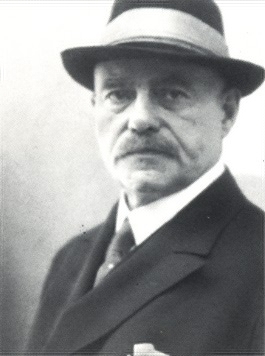 | |
| Date of Birth | September 30, 1857 |
| Place of Birth | village Matsikai (now Shilutsk district , Lithuania ) |
| Date of death | November 21, 1928 (71 years old) |
| A place of death | Berlin |
| Citizenship | Germany |
| Occupation | writer, playwright |
| Language of Works | Deutsch |
Biography
German Zuderman was born on September 30, 1857 in Matcikken in the Heidekrug district (now Šilutė, Lithuania). In early youth, he studied at a pharmacist, but later studied at the Tilsit Gymnasium, then studied at the University of Koenigsberg and Berlin. From 1877 until the end of his life he lived in Berlin.
Suderman began his writing career as a journalist. His first literary novel, The Frau Sorge (1887), received excellent reviews. The drama "Honor" ("Die Ehre", 1889), made famous throughout Germany and elevated to the rank of writers with high hopes. She flew over all Germanic and many foreign scenes (including in Russia ). The play The Death of Sodom (Sodoms Ende, 1891) did not receive the same flattering assessments, but this did not bother Suderman - the publication of the play Homeland (Heimat, 1893), which received well-deserved success among reading people, followed. All three dramas are distinguished by serious literary merits, they are written very scenically and have psychological interest. The main disadvantages are the pursuit of external dramatic effects and witty paradox, to the detriment of the truth of life, real simplicity and faithful portrayal of characters.
Until 1908, Suderman managed to write many dramatic works, including “Happiness in the corner” (“Das Glück im Winkel”, 1895), “John the Baptist” (“Johannes”, 1898), “John's Flame” (“Johannisfeuer” ", 1900)," Long live life! "(" Es lebe das Leben ", 1912). Speaking about the late period of the writer's work, we need to dwell on the novel “The High Song” (Das hohe Lied, 1908), which has received conflicting responses, but which has nevertheless become quite popular.
Journey to Tilsit
Separately, it is worth mentioning the collection of short stories and short stories “Lithuanian stories” (“Litauische Novellen”, 1917). The short novel “Journey to Tilsit” (Die Reise nach Tilsit), published in this collection, is one of the writer’s best prose works, some critics compared it with the great novel by F. M. Dostoevsky in the depth of psychologism and skill in describing the inner feelings and experiences of heroes " Crime and Punishment ."
The short story was first filmed in 1927 by the brilliant German director Friedrich Wilhelm Murnau called “Sunrise” . This film received three Oscars at the first award ceremony: 1) the best film (prize for outstanding artistic merit, and the full nomination was: “a unique and highly artistic picture” (there were no more such nominations, so “Sunrise” remained the first and only film to receive an award for the best film in this category); 2) the best actress ( Janet Gaynor ); 3) the best operator.
This was followed by a film adaptation under the original title “Journey to Tilsit” in 1939 , where Fight Harlan directed. Part of the shooting took place directly in Tilsit , which makes the film a unique material evidence, a historical source of important information about the architecture and life of the old city.
In 1969 , the third film adaptation of the work took place - this time as a television movie , on the German public television channel ZDF , again under the original title Travel to Tilsit. Director Gunter Gravert [1] .
In 1980 , the short story was filmed for the fourth time by the Lithuanian director Arunas Zhebrunas . The film is called " Journey to Paradise ." Interestingly, Tilsit is not mentioned at all.
Creative Method
As a fiction writer, Zuderman writes easily and entertainingly, but in his novels and short stories, next to the truthful and sincere pages, there are many invented and incredible. Some of his works (for example, “Frau Sorge”) bear the imprint of painful nervousness and some kind of naive fatalism. He does not feel, does not think like a realist - he only captures reality and, at the same time, mainly only its sharply protruding, screaming sides.
As a playwright, Suderman is bolder; he apparently tries to abandon the traditional worldview and current assessments, but even here he makes concessions to the routine, walks along beaten paths and does not say a new word, but only makes him amazed at his literary talent and flexible wit. Perhaps this oscillation between the old and the new, between the condemnation of obsolete ideas and the inability to completely break away from them, is the reason for the pessimism and the hopeless sadness that captures most of Suderman's works.
Recognition and memory
- The name of Herman Zuderman was one of the streets of the city of Tilsit (at the moment - this is Liberty Lane of the city of Sovetsk).
- In 1993, the new theater season of the Tilsit Theater from Sovetsk opened with the premiere of the performance “Butterfly Fight” based on the comedy play of the same name (1894) by German Zuderman.
- In 2007, a major event in the cultural life of the city of Sovetsk followed - the book “Lithuanian stories” was published in Russian, containing the classic and key novel for the city, “Journey to Tilsit”. In 2011, the publication of the novel “The Spell of Frau Sorge” (1887) followed, about a German fairy-tale character, an evil witch who constantly intervenes in the fate of people.
Notes
Literature
- L. Trotsky “Long live life!”
Links
- A.A. Reingoldt . Suderman, Herman // Brockhaus and Efron Encyclopedic Dictionary : in 86 volumes (82 volumes and 4 additional). - SPb. , 1890-1907.
- Suderman Herman - article from the Great Soviet Encyclopedia .
- Encyclopedia of Collier
- Literary Encyclopedia