Cataglyphis bombycina (lat.) - a species of ants from the genus runner ants ( Cataglyphis ), which lives in the Sahara desert .
| Cataglyphis bombycina | |||||||||||||||||||||||||||||||||||||||||||||||
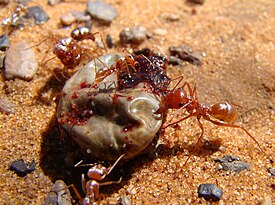 Ants grabbing Hyalomma dromedarii ixodid tick | |||||||||||||||||||||||||||||||||||||||||||||||
| Scientific classification | |||||||||||||||||||||||||||||||||||||||||||||||
|---|---|---|---|---|---|---|---|---|---|---|---|---|---|---|---|---|---|---|---|---|---|---|---|---|---|---|---|---|---|---|---|---|---|---|---|---|---|---|---|---|---|---|---|---|---|---|---|
| |||||||||||||||||||||||||||||||||||||||||||||||
| International scientific name | |||||||||||||||||||||||||||||||||||||||||||||||
Cataglyphis bombycina Roger , 1859 | |||||||||||||||||||||||||||||||||||||||||||||||
| Synonyms | |||||||||||||||||||||||||||||||||||||||||||||||
| |||||||||||||||||||||||||||||||||||||||||||||||


Content
Distribution
The species Cataglyphis bombycina is widespread in the Sahara desert in the countries of North Africa: in Algeria , Egypt , Libya [1] , Morocco [2] , Tunisia [1] .
Description
Medium-sized formicine ants, the stalk between the breast and the abdomen consists of one nodular segment of the petiolus , the sting is absent. The antennae of workers and females consist of 12 segments (13 segments in males), there is no mace. The mandibular palps consist of 6 segments, the lower labial palps are 4-segmented [1] . Families consist of several hundred workers, one ovipositing uterus and several large soldiers , rarely appearing on the surface. These large workers are distinguished by their wide heads and long saber-like mandibles , similar to those of the nomad ants . Presumably, they are intended to protect against reptiles and preserve food in the form of fat reserves in their large abdomen [3] .
Largely because of the extremely high temperature of the habitat, and also because of the threat from predators , ants are active outside their nest for no more than ten minutes a day [4] . Ground activity occurs in a narrow temperature range, which begins above the temperature at which lizards hunting this species of insects cease their activity and hide in burrows [5] [6] .
They live by collecting and eating corpses of insects or small animals [5] [7] . Ants have several unique adaptations that help to cope with high temperature. Longer limbs than other ants keep the body farther from the hot surface of the earth [6] , using four out of six legs when moving. Such a gait is achieved by lifting the front pair of legs [8] .
Silvery hairs of a triangular section, covering the upper part, have high reflectivity in the range of visible radiation and in the near infrared range [5] [9] . The hairs covering the lower part act as a passive radiator and actively emit in the mid-infrared range [5] [9] .
This type of living creature is one of the most resistant to high temperature [5] [10] . Ants remain active at ambient temperatures up to 70 degrees Celsius due to the combination of the ability of their hairs to work as passive cooling radiators and the high reflectivity of the outer cover [5] [11] .
In Morocco, on the body of ants, like a tick, live myrmecophilous skin- eating beetles Thorictus castaneus Germar, 1834 ( Coleoptera : Dermestidae : Thorictinae) [12]
View from above
Head
Side view
Systematics
The species was first described in 1859 by the German entomologist Julius Roger under the original name Formica bombycina [13] . In 1862, the Austrian worldmecologist Gustav Mayr included him in the genus Runner Ants ( Cataglyphis ) [14] .
In the composition of the species:
- Cataglyphis bombycina sinaitica Wheeler, WM & Mann, 1916
- Cataglyphis bombycina bruneipes Santschi, 1911
Notes
- ↑ 1 2 3 Agosti, D. Review and reclassification of Cataglyphis (Hymenoptera, Formicidae) (Eng.) // Journal of Natural History. - 1990. - Vol. 24. - P. 1457-1505. - DOI : 10.1080 / 00222939000770851 .
- ↑ Cagniant, H. Liste actualisée des fourmis du Maroc // Myrmecologische Nachrichten. - 2006. - Vol. 8. - P. 193-200.
- ↑ Mathieu Molet, Vincent Maicher, Christian Peeters. Bigger Helpers in the Ant Cataglyphis bombycina : Increased Worker Polymorphism or Novel Soldier Caste? (English) // PLoS ONE. - 2014 .-- Vol. 9 (1). - P. e84929. - DOI : 10.1371 / journal.pone.0084929 .
- ↑ Wehner, R .; Marsh, AC; Wehner, S. Desert ants on a thermal tightrope (Eng.) // Nature . - 1992. - Vol. 357, no. 6379 . - P. 586-587. - DOI : 10.1038 / 357586a0 .
- ↑ 1 2 3 4 5 6 Sahara ant hairs turned out to be cooling radiators . N + 1 (June 19, 2015). Date of treatment June 19, 2015.
- ↑ 1 2 PJ Gullan, PS Cranston. The Insects: An Outline of Entomology. - 5th edition. - Wiley-Blackwell , 2014 .-- 624 p. - ISBN 978-1118846155 .
- ↑ Carol Kaesuk Yoon. Life at the Extremes: Ants Defy Desert Heat . The New York Times (June 30, 1992). Date of treatment June 19, 2015.
- ↑ Zollikofer, C. Stepping Patterns in Ants - Influence of Body Morphology (Eng.) // The Journal of Experimental Biology . - 1994. - Vol. 192, no. 94 . - P. 100. - PMID 9317436 .
- ↑ 1 2 Norman Nan Shi, Cheng-Chia Tsai, Fernando Camino, Gary D. Bernard, Nanfang Yu, Rüdiger Wehner. Keeping cool: Enhanced optical reflection and heat dissipation in silver ants (Eng.) // Science . - 2015. - DOI : 10.1126 / science.aab3564 .
- ↑ Pope L. Moseley. Heat shock proteins and heat adaptation of the whole organism (Eng.) // . - 1997. - Vol. 83, no. 5 . - P. 1413-1417.
- ↑ Steven L. Chown, Sue W. Nicolson. Insect Physiological Ecology: Mechanisms and Patterns . - Oxford University Press , 2004 .-- P. 162. - 243 p. - ISBN 9780198515487 .
- ↑ Jiří Háva, Alain Lenoir, Abdallah Dahbi & Fernando Amor. (2012). Cataglyphis viatica (Fabricius, 1787) (Hymenoptera: Formicidae), host ant for Thorictus buigasi Escalera, 1923 (Coleoptera: Dermestidae: Thorictinae) from Morocco . Arquivos Entomolóxicos ( Revista galega de Entomoloxía ), 7: 95–98. ISSN: 1989-6581
- ↑ Roger, J. Beiträge zur Kenntniss der Ameisenfauna der Mittelmeerländer. I. (German) // Berl. Entomol. Z .. - 1859. - Vol. 3. - P. 225-259.
- ↑ Mayr G. Myrmecologische Studien. (German) // Verh. KK. Zool.Bot. Ges. Wien. - 1862. - Vol. 12. - P. 649-776.
Literature
- Agosti, D. Review and reclassification of Cataglyphis (Hymenoptera, Formicidae ) // Journal of Natural History. - 1990. - Vol. 24. - P. 1457-1505. - DOI : 10.1080 / 00222939000770851 .
Video
- David Attenborough. BBC Silver Desert Ant, Cataglyphis, Sahara Desert. youtube.com
- Cataglyphis bombycina (saharan silver ant). youtube.com