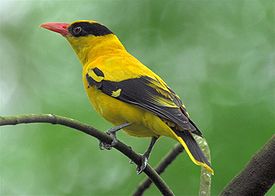
The Orioles are a compact group of songbirds with similar morphological and environmental characteristics - for this reason, their definition is usually not particularly difficult. It is believed that the family was developed from a large group of raven-like birds in Australasia more than 30 million years ago, somewhere in the middle of the Tertiary period . [1] [2] The earliest fossil record - the well-preserved beak of an ancient bird - was discovered in 1997 in the well-known Riversleigh fossil reserve in the Australian state of Queensland . The analysis showed that the bird that inhabited the continent in the Early Miocene and which was called Longimornis robustirostrata belongs to the family of orioles. [3]
It is traditionally believed that the closest relatives of the orioles are representatives of the dragovy , corvidae and leaf families. [4] Some authors also believed that starling was closely related to these birds. [5] Molecular studies based on the DNA hybridization method, conducted in the 1970s and 1980s by American ornithologists C. Sibley and J. Alquist, showed that the larvae family is the closest to the Oriole group of birds. The authors, known for their fundamental revision of the bird system, included all the orioles (including some other groups of birds) in the corvidae family, which caused criticism by proponents of traditional research methods. [five]
The family of Orioles includes 2 genera - the Orioles themselves ( Oriolus ) and Fig Orioles ( Sphecotheres ). The latter is considered monotypic and includes the only species Sphecotheres viridis from Australasia . The genus Orioles consists of 25-30 species, four of which are included in the list of threatened species of the international Red Book . Distinctive features of the fig Oriole are the ring of fledgling skin around the eyes and the colonial nesting method, unusual for other species. [four]
Description
Medium-sized, woody, densely built birds. Body length varies between 20–28 cm. [1] The plumage of most species is dominated by a combination of golden yellow and black, sometimes with the addition of dark red. In some species, such as the fig or striped ( Oriolus sagittattus ) ivologist, instead of bright yellow tones, olive-yellowish ones are represented. Finally, in black ( Oriolus hosii ), bloody ( Oriolus trailili ), raspberry-chested ( Oriolus cruentus ) and silver ( Oriolus mellianus ) ivologists, the yellow color in the plumage is completely absent, and instead red, brownish or silver tones predominate. Females, as a rule, are less brightly colored, although differences in individual individuals may not be expressed at all. Young birds outwardly differ from adults. It has been observed that some species from Southeast Asia and New Guinea are very similar to the Philemon , living next to them, belonging to another family. It is believed that this is a kind of mimicry for a larger, and therefore more protected, bird. [6]
In representatives of the genus Oriole, the beak is elongated and slightly convex, with a hooked bent beak at the end. The beak, as a rule, is brick-red or pinkish in color, its length and thickness vary widely - from the long and elegant in the thin-billed Oriole ( Oriolus tenuirostris ) to the relatively short and massive in the large -billed Oriole ( Oriolus crassirostris ). The fig Oriole and some Asian species, in the plumage of which there are red tones, the beak is black or steel. Distinctive features of only fig Orioles are a short beak and a ring of bare reddish skin around the eyes. The nostrils are narrow, slit-like, partially covered by a membrane. The wings are long, with ten paramount wings, the first of which is greatly shortened and is half the length of the previous one. The tail is short or medium length, wedge-shaped, consists of 12 tail feathers. The metatarsus is short, covered with shields, the fingers are well adapted to the arboreal lifestyle.
The voice of an ivologist is a loud and melodic squeak, reminiscent of the sounds of a flute , while singing of different kinds has a similar sound. [7] The vocalization of the fig Oriole is less musical and is a simple repetitive whistle, as well as short squeaks.
Distribution
The Orioles live in various forests of the eastern hemisphere, mostly light. In the temperate climate of the northern hemisphere, only 2 species are widespread, both of which are migratory and both nest in Russia - the common Oriole in the European part of the country and Southern Siberia, and the Chinese black-headed Oriole in the Far East. Tropical species are represented mainly in three main regions: in sub- Saharan Africa , South and Southeast Asia , as well as Australia and New Guinea .
Reproduction
Oriole monogamous , and with the exception of fig Orioles, breed in pairs. The latter forms small free colonies in the breeding season. Some species from Australasia tend to nest next to other birds that are more aggressive towards predators. In general, depending on the species and habitat, two to ten pairs of ivologist nest per 1 km². [1] During the mating season, the male screams, jumps around the female and chases after her, while the chase often ends with mating. Representatives of the Oriole genus have a cup-shaped nest , woven from twigs and lined from the inside with pieces of moss, feathers, wool, or even soft human debris. It is usually located in a horizontal fork of thin branches in the thick of foliage and high above the ground. The nest of fig Orioles is simpler - from soft vegetation and without lining. The whole building is well mounted on the outside to withstand strong gusts of wind. The nest is mainly set up by the female, while the male, if it takes part in its construction, is only the extraction of building material. The main role of the male in this period is the protection of the territory.
In the clutch, most often 2-3 motley eggs, although in general their number can vary from one to six. [4] The general color tone is usually creamy with numerous dark spots and specks, but it can be white or pinkish-white without any staining. The incubation period takes 16-18 days, with rare exceptions, one female incubates. Chicks appear fledgling and helpless, both parents feed them, belching food from beak to beak. The basis of the feed of the chicks in the first days of life is caterpillars.
Nutrition
The Orioles find their livelihood mainly among foliage in the crowns of trees and shrubs, very rarely on the ground. Their diet is quite wide and can include both animal and vegetable feed. They willingly catch insects (in particular, hairy caterpillars ) and other invertebrate animals, feed on seeds, berries, fruits, buds and flowers of trees and herbs. On occasion, they hunt small lizards and ruin the nests of other birds. Large insects before use are broken on a tree branch. Depending on the availability in a given territory and at a certain point in time, the ratio between plant and animal food at the ologologist may vary, although as a rule the latter prevails. Fig Oriole feeds mainly on the juicy fruits of plants, especially ficus . [four]