Balkan wars - two wars that occurred in 1912 - 1913 shortly before the First World War , as a result of which the countries of the Balkan Peninsula pushed the Turks from European territory.
| Balkan Wars | |||
|---|---|---|---|
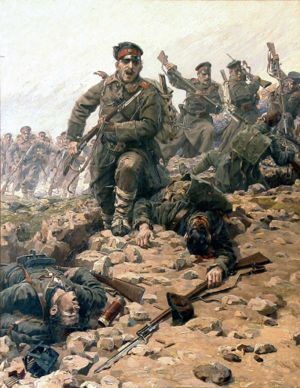 | |||
| date | 1912 - 1913 | ||
| A place | Balkan Peninsula | ||
| Cause | The desire of the Balkan Union to deprive Turkey of the territory in Europe | ||
| Total | The actual independence of Albania from the Ottoman Empire, the victory of the Balkan states, Turkey is deprived of many territories in Europe leaving only Istanbul behind. | ||
| Opponents | |||
| |||


The first war had a liberating, anti-Turkish character. The Balkan Union ( Serbia , Montenegro , Greece and Bulgaria ) planned to completely deprive the Ottoman Empire of possessions in Europe, which he managed to do (Turkey only Constantinople and the small territories near it remained).
However, soon the contradictions between the winners led to the beginning of the war between Bulgaria on the one hand and Serbia, Greece, Romania , Montenegro and Turkey on the other. Bulgaria was defeated and lost most of its acquisitions in the first war, the Ottoman Empire brought back Adrianople and its environs.
Content
Prerequisites of the First Balkan War
Background
Even during the Great Migration of Peoples in the Balkan Peninsula, people began to appear that had not previously lived there. At the time of the division of the Roman Empire at the end of the 4th century, the region was part of the Eastern Roman Empire and new nations were engaged in a constant struggle with the emperors. Having first appeared in Europe in 354, Turkic peoples ( Huns , Bulgars , Avars ) already by 395 forced the Roman Empire to weaken and split into two states - the Western Roman Empire and Byzantium . The perennial hegemony of the Roman Empire over the Balkans was overthrown.
The situation changed at the beginning of the 15th century, when Ottoman Turks from Asia Minor began to penetrate the Balkans. The liquidation of the Byzantine Empire and the fall of Constantinople in 1453 allowed the Ottoman Empire , whose power was constantly growing, to fully occupy the Balkan Peninsula. The peoples who lived there became part of the Muslim Turkish empire. The situation was aggravated by the fact that they all differed by origin, religion and nationality [1] [2] .
Anti-Turkish uprisings often took place on the Balkan Peninsula, most of which culminated in the defeat of the rebels. Despite this, in the XIX century ethnocratic states began to form. The process took place with the support of the Russian Empire interested in weakening Turkey. As a result, by the beginning of the 20th century, Greece, Bulgaria, Serbia, Montenegro had left the Ottoman Empire, and Romania had withdrawn its vassal dependence. Despite this, not all the lands inhabited by one or another people belonged to the respective state. Thus, a large number of Bulgarians and Serbs lived in Macedonia , the Greeks lived on the islands of the Aegean Sea , a certain number of Montenegrins lived in adjacent Turkish territories with Montenegro [3] . The Albanians did not have their own state at all, although the individual vilayets of the Ottoman Empire were completely inhabited by them [2] .
Great Power Politics
The Ottoman Empire, starting from the XVII century, gradually weakened, losing its territory. Many states were interested in the disintegration of the empire, in particular Russia, the German Empire , Austria-Hungary , Great Britain and France . Each of these states wanted to get as much of a weakening empire as possible to meet their strategic needs. The Eastern Question about the straits stood sharply. At the same time, there was a political confrontation between the blocs of the great powers, which was also observed in the Balkans [1] [2] . After the Italian-Turkish war, the countries of the Balkan Peninsula, the opponents of the Ottoman Empire, realized the need for consolidation. Common factors, commonness of peoples (Bulgarians with Serbs and Montenegrins) and the Christian faith served as unifying factors. The Russian Empire took advantage of this, with the support of which the formation of a military defensive alliance began on the Balkan Peninsula. March 13, 1912 Serbia and Bulgaria signed an agreement on the formation of a military alliance. On May 12 of the same year, additional agreements were signed that allowed countries to cooperate in other areas. On May 29, Greece, fearing to remain without territorial gains at the expense of the Ottoman Empire, joined the system of Bulgarian-Serbian relations. In summer, Montenegro concluded a treaty of alliance with Bulgaria, after which the formation of the Balkan Union was completed.
Russia first of all hoped that the union would start a confrontation with its rival - Austria-Hungary. However, the member countries of the union were not interested in this and began a confrontation with Turkey [1] [2] .
Ideas for maximum expansion of boundaries
The Balkan Union directed its interests to the European possessions of the Ottoman Empire, in which the Greeks, Bulgarians, and Serbs lived. All member countries of the union planned to maximize their borders at the expense of the Turkish possessions, but sometimes their territorial interests overlapped.
The Bulgarians wanted to create a comprehensive (Great) Bulgaria - a state that would include in its composition all the lands inhabited by the Bulgarians and the territories that once belonged to the Second Bulgarian Kingdom . The Serbs wanted to include in their state all of Albania and Macedonia, which in turn was claimed by Greece and Bulgaria. Montenegro sought to get the north of Albania and the major port cities of the Adriatic Sea , as well as Novopazar Sandzak . The Greeks wanted Macedonia and Thrace , which Bulgaria claimed. Thus, the Allies had serious disagreements and claims to each other [1] .
First Balkan War
Second Balkan War
In June 1913, the Second Balkan War began. Bulgaria, Serbia, Greece, Montenegro were not allies for long and could not agree on a section of the “Turkish inheritance” acceptable to all. This time, a coalition against Bulgaria was created, uniting Serbia, Montenegro, Greece and their “historical enemy” - Turkey. This time Romania was among the allies. Each of the coalition members demanded that Bulgaria, which had seized vast areas, territorial concessions in its favor. Bulgarian king Ferdinand I and his government, relying on the diplomatic support of Berlin and Vienna, did not want to hear anything.
The Bulgarian troops were the first to attack the Greek and Serbian positions on June 30, 1913. All adjacent states were quickly drawn into military conflict. Bulgaria resisted briefly and on July 29 capitulated. Soon the Bucharest peace treaty was concluded , under which Bulgaria lost significant territories in the north, west and south.
Results of both wars
The Ottoman Empire lost most of its European possessions. Albania gained independence. Bulgaria, Serbia, Greece and Romania increased their territory. These wars claimed over 240,000 lives.
World War Backgrounds
Bulgarian king Ferdinand I was dissatisfied with the outcome of wars. Austria-Hungary feared gains on its borders Serbia, which after the defeat of Bulgaria and Turkey in the Balkan wars could become the strongest power in the Balkans. In addition, in Vojvodina , which belonged to the Austrian crown, a large number of Serbs lived. Fearing the separation of Vojvodina, and then the complete disintegration of the empire , the government of Austria-Hungary was looking for a reason to declare war on the Serbs [4] .
Meanwhile, Serbia itself has become radicalized. Victories in two wars at once and a sharp strengthening of the state caused a national upsurge. At the end of 1913, Serbian forces attempted to occupy part of Albania. The Albanian crisis began , which ended with the withdrawal of Serbian troops from the newly formed state [2] . At the same time, under the auspices of the Serbian counterintelligence during the wars, the Black Hand group was formed.
Part of the group, known as Mlada Bosna , operated in Bosnia and set a goal to split it off from Austria-Hungary. In 1914, Sarajevo murder was committed with the support of Black Hand. Austria-Hungary has long sought to eliminate the only state in the Balkans, which at the same time prevented Germany from penetrating into the Middle East - Serbia. Therefore, she presented an ultimatum to the Serbian side, after which the First World War began .
Revanchist Bulgaria in the new war sided with Austria-Hungary and Germany. Her government wanted to restore the state within the borders of May 1913, for this it was necessary to defeat Serbia again. The outbreak of world war led to more changes in the Balkans than the previous two Balkans. Thus, the Second Balkan War has far-reaching indirect consequences [4] .
See also
- Trotsky about the Balkan Wars
Notes
- 2 1 2 3 4 Zhogov P.V. Diplomacy of Germany and Austria-Hungary and the First Balkan War. - M .: Science , 1969.
- ↑ 1 2 3 4 5 Zadokhin A. , Nizovsky A. Porokhovaya cellar of Europe . - M .: Veche, 2000. - ISBN 5–7838–0719–2.
- ↑ Ryabinin A. Small wars of the first half of the XX century. The Balkans . - M .: ACT , 2003. - 5000 copies. - ISBN 5–17–019625–3.
- ↑ 1 2 Balkan War. 1912-1913 - M .: Ed. T-va publishing and book trade N. I. Pastukhova, 1914.
Literature
- Histoire du peuple serbe : [] . - Lausanne: L'Age d'Homme, 2005.
- Crampton, RJ The hollow detente: Anglo-German relations in the Balkans, 1911-1914 . - G. Prior, 1980. - ISBN 978-0-391-02159-4 .
- Helmreich, Ernst Christian. The Diplomacy of the Balkan Wars, 1912-1913 . - Harvard University Press, 1938.
- Jelavich, Barbara. History of the Balkans: Twentieth Century . - Cambridge University Press, 1983. - Vol. 2
- Rossos, Andrew. Russia and the Balkans: inter-Balkan rivalries and Russian foreign policy, 1908-1914 . - University of Toronto Press, 1981.
- Schurman, Jacob Gould. The Balkan Wars 1912–1913. - 1st. - Princeton University, 1914.
Links
- Trotsky, L. D. Before the historical boundary. Balkans and Balkan Wars
- . The Balkan Wars: 1912-1913 / 3rd edition. (1916)
- Balkan Wars from a Turkish perspective
- Richard C. Hall. Balkan Wars 1912-1913 // International Encyclopedia of the First World War