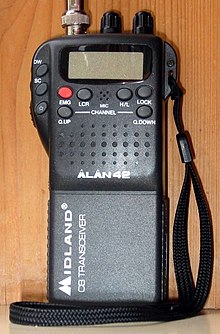
CBS - the abbreviation for “civilian band” ( CB, Citizen`s Band ), adopted to denote unlicensed, accessible to all citizens short-wave radio communications in the 27 MHz band (in some countries, “CB” means any kind of unlicensed radio communications on any free ranges). Depending on the country, the use of this range is either minimally regulated by the rules for local connections, or is not regulated at all. Radio communications of this range are wearable, portable or stationary radio stations , which differ, as a rule, from amateur and professional radio stations at a lower price, fewer functions (lack of telegraph mode , single - band modulation , repeater shift, tone and code noise suppressors , trunk modules, etc. etc.), more modest technical characteristics, less impact resistance and moisture resistance. As an exception, civilian radio stations with advanced functions for radio amateurs and radio communication fans are mass-produced.
CBS Application
The possibilities of using CBC communications are very wide. This is a fairly reliable and affordable means of communication, allowing you to connect, for example, a store with a warehouse, a warehouse with vehicles, etc. You can use CBC radio communication in small boats - on boats and yachts. At the same time, the communication range on the water increases significantly due to the absence of serious obstacles.
CBC found the most widespread use of radio communications as mobile communications. Radio stations in cars allow you to maintain constant contact with each other, receive operational road information, help with choosing a route, help with accidents and technical problems along the way. The use of portable CB radio stations is somewhat problematic, since in the CB range the wavelength is 11 meters, and a full quarter-wave antenna has a length of ~ 2.7 meters. For CB portable antennas, they have to be geometrically shortened 10–20 times, which significantly reduces the communication range. In addition, portable CBS radio stations were distinguished by a rather large weight (about 500 g), low transmitter efficiency when operating on a compact antenna, and low amplitude noise canceling efficiency - as a result, both the communication range and the cost-effectiveness of such radio stations were small. Therefore, almost all such radio stations were discontinued (in 2010 in Russia only Alan-42 could be found from new portable CB stations in radio stores, but already in 2011 there was plenty to choose from: Dragon stations returned and new Intek arrived) . At the same time, due to the peculiarities of radio wave propagation in the 27 MHz band, portable CB radio stations have significant advantages over the widespread “unlicensed” radio stations of higher frequency ranges ( LPD 433 MHz, 446 MHz PMR ) when used in dense forests and rough terrain . This is just due to a wavelength of 11 meters. The fact is that a radio wave can go around an obstacle smaller than half the wavelength. Therefore, for the LPD range (wavelength ~ 70 cm), an object with sizes from 35 centimeters or more will be a serious obstacle, while for C-B problems will begin only with an obstacle of 5 meters or more. Thus, CBC is more suitable for cross-country and forest communications, while LPD and PMR are more suitable for the city.
Using a CBS radio station, you can sometimes contact the fire department , police , ambulance , emergency services through special dispatch services that will assist you by calling the necessary service by phone. Channel 9C is reserved for these purposes, on which emergency services must be on duty at all times. But in Russia it is practiced only in Moscow and St. Petersburg. In the rest of the country, it is recommended to use the 15C channel for communication with drivers on routes that are sure to respond if they are called more aggressively (this is due to the fact that the car is still lower than the dispatcher's antenna, and communication with the car is much shorter in distance). Also, on various channels (including 9C, 15C, 19C), one can stumble upon radio amateurs, whose equipment (and as a result, communication range) is comparable to the dispatch service, and sometimes exceeds the latter in many respects. Radio amateurs can also help in an emergency.
Truck drivers can be found at 27.135 MHz AM or C15EA (at Midland-Alan radio station: D15E).
The approximate range of radio communications between typical car / stationary and imported portable CB radio stations:
- between base stations using reflection from the ionosphere is practically unlimited, which can be easily confirmed . Unfortunately, this type of communication is unstable and depends on the state of the ionosphere . Usually it is possible to contact correspondents at a distance of no more than 1500-2000 km. Rarely does it turn out closer, since the radio wave does not always have time to bounce off and fall back to the ground without having passed a sufficient distance, even if radiating "into the zenith."
- between base stations - 15–80 km;
- between the base station and the car - 15-40 km;
- between the base station and the portable - 3-10 km;
- between cars - 5-15 km;
- between a car and a portable station - 2-7 km;
- between portable stations - 1-5 km.
Range data are averaged, and are valid for most cases, although in reality facts of exceeding these figures by 2-3 times are known, as an exception.
History
In 1945, a civil radio communications congress was held in the United States , for which the frequency band 460-470 MHz was allocated. This connection was to ensure the needs of citizens in solving any of their personal problems where it is impossible or difficult to use the phone. Two years later, Document 6661 came out, which fixed the rules of civil radio communications (CB-Radio) and allocated two classes of licenses for transmitters - Class A (60 W) and Class B (5 W). The public reaction to the introduction of license classes and the allocated frequency band was not always positive everywhere - expensive equipment, VHF communications in urban areas between mobile objects are unreliable, etc.
Then attention was drawn to the 11-meter (27 MHz) section in the short-wave range, on which various medical and industrial installations were already operating. Short waves are able to go around obstacles up to several meters in size (for example, houses or small bumps in the relief), they are relatively weakly attenuated in the forest. Enthusiasts took up the experiments, according to the results of which the band of 27 MHz was later chosen for CB-Radio.
In 1957, Document 11994 was adopted by which Class D licenses were introduced. This class is currently used in the USA. The initial reaction of the ham radio to the decision of the US Federal Communications Service was negative due to the increased level of interference in the amateur band of 28 MHz. In those years, simple equipment was used with broadband super-regenerative receivers and unstable transmitters. But soon, companies began to produce technically sophisticated, but affordable equipment. 1959 was a key year in the development of CB-Radio. Then 6,000 users were registered, in 1961 - more than 200,000, and in January 1977 there were already 500,000 users! Currently, in the United States and around the world, a huge number of CB clubs are registered, uniting people of interest, in most cases - this is the conduct of DX-connections and exchange of QSL-cards .
In the USSR, the 27 MHz band was allowed by a decision of the State Commission on Radio Frequencies of December 30, 1988 (see Radio 1991, No. 1). However, initially a number of severe restrictions were imposed on the CB equipment in the USSR. Its power should not exceed 0.5 W, the channels were in “zeros” for AM, and for the FM 10 special channels were allocated with a step of ... 12.5 kHz (for example, the Ural-Farmer radio station met these requirements). Apparently, this was done with the aim of hampering the illegal radio exchange between citizens of the USSR and foreigners. Later, the requirements for the equipment were relaxed and close to the characteristics of foreign CB radio stations.
Frequencies Used
All over the world, the main channels for CBS are channels starting at 26.965 MHz and going with a frequency step that is a multiple of 10KHz (26.975 MHz, 26.985 MHz, etc.). These channels are labeled from 1st to 40th, and in Russia amateur radio slang is called “Europe (E)” or “Five”.
Due to the growing number of users in some countries, additional grids appeared with the same step at 10 KHz, but with shifted frequencies relative to the main ones, with the same channel numbering. For example, 1 channel will correspond to a frequency of 26.960 MHz. these frequencies are most often called "poland (P)"
In Russia, the Polish numbering of frequencies was originally adopted, but they call it "Russia (R)" or "zeros". Currently, the bulk of Russian C-B users use the "fives", that is, the "European" numbering, the "Russian" numbering is used by radio amateurs.
For user convenience, the grids have been marked with letters. Marking is considered classic when the main range is indicated by the letter "C". The most common is the description of the channel of the following form: (C9FM or C9EFM or C9EF or 9EF) - in it:
- the first letter (“ C ”) denotes a grid containing a set of 40 channels. If the first letter is not indicated, then it is considered that it is (" C "). For example ( C9EF , 9EF)
- further (" 9 ") - channel number. Sometimes channels below 10 may be indicated by 2 digits. For example ( C9EF , C09EF)
- followed by an optional designation (“ E ”) for the “ European” or mandatory (“ R ”) for the “ Russian” frequency grid. For example ( C9EF , C9F , C9RF)
- at the end - the modulation used (“ FM ”) or ( “F ”), (“ AM ”) or (“ A ”). e.g. ( C9EFM , C9EF , C9EAM , C9EA )
Example of correct designation: C9EF, C9EA, C9RF, C9RA
At some radio stations, the frequency grids may not coincide with the standards generally accepted in Russia, for example, 1 channel of the C network may correspond to 1 channel of the D network (for example, Megajet radio stations).
Sometimes foreign manufacturers get confused with the "Russian" frequency grid and when choosing the "Russia" grid, the radio station is included in the "European" standard (for example, the Alan-42 radio station). In this case, you must select the "Polish" frequency grid.
Main channels and frequencies
C9EF ( 27.065 MHz ) - the calling channel of the rescue service.
At the moment, it is practically not used, however, negotiations on it that are not related to the provision of assistance are prohibited.
Drivers use their call channel to get help.
Channel 9 of the “Russian” frequency grid C9RF ( 27.060 MHz ) has no restrictions and can be used for negotiations.
C15EA ( 27.135 MHz, Grid C, channel 15, Europe, AM modulation ) - a ringing car channel.
Truckers communicate on it, and everyone who has a radio station in a car throughout Russia.
C15EF ( 27.135 MHz, mesh "C", channel 15, "Europe", FM modulation ) - a calling car channel.
Now more and more drivers are switching to FM modulation. This is due to the fact that FM modulation provides better sound quality and greater range in urban environments.
Currently, in parallel with the CBS, the 2nd channel of the PMR band is used (frequency 446.01875 MHz). To obtain long range in the PMR range, you must use an external antenna.
27.140 MHz - the frequency for operation of low-power devices with a range of several tens of meters.
An empty space (“hole”) between 15 and 16 channels is used.
Currently, it is practically not used, since the automobile channel interferes with work at this frequency.
The frequency was used in Walkie-Talkie children's radio stations, in toys with remote control, in systems for remote opening and closing gates, and in other devices for transmitting information over short distances.
C19EF , C19EA ( 27.185 MHz ) - information channel.
Designed to transmit automotive information - weather, traffic jams, announcements.
Currently, it is practically not used, all information is transmitted on the automobile channel.
The use of this channel is not recommended, as it interferes with the operation of ham radio at a frequency of 27.190 MHz.
Channel 19 of the “Russian” frequency grid C19RF ( 27.180 MHz ) has no restrictions and can be used for negotiations.
27.190 MHz - calling amateur radio frequency for long-distance communications SSB modulation.
An empty space (“hole”) between 19 and 20 channels is used.
C20RF ( 27.200 MHz ) - amateur radio calling channel for long-distance communications with FM modulation.
Amplifiers are often used on this channel, and the output power can reach several tens or even hundreds of watts.
C27RA ( 27.270 MHz ) - QRP amateur radio calling channel for long-distance communications AM modulation.
It is not customary to use amplifiers on this channel, so the output power is usually equal to the power of the radio station and does not exceed several watts.
Modulation Types
There are three types of modulation in CBC: frequency modulation ( English FM, frequency modulation ), amplitude modulation ( English AM, amplitude modulation ) and single- band modulation ( English SSB, single side band ). The maximum communication range when using FM and AM is almost the same. Most Russian users of the CBS range use FM, which provides the most high-quality sound (if the signal of the correspondent is strong enough). By virtue of an established tradition, truckers use AM. Using FM allows you to suppress most types of interference, which are usually amplitude in nature. SSB is preferable in terms of achieving maximum range (range with comparable transmitter output power is significantly higher than with AM and FM). The main obstacle to the widespread use of SSB radio stations is the need to obtain the best intelligibility and naturalness of the correspondent's voice when receiving a manual fine-tuning frequency signal and less noise immunity with respect to FM modulation. Not all stations support SSB.
Rescue Services
The rescue service or similar in function can be located at any frequency, but the standard is the C9EF channel (27065 kHz). Some radio stations even have a quick switch to this channel. It is forbidden to conduct any negotiations on this channel if they are not related to the provision of assistance.
Since December 21, 2012, the free emergency rescue service "Civil Emergency Communications" (27,065 MHz / 9C FM EUR) has been operating in the Russian Federation. An emergency or emergency signal can be transmitted in Moscow, Moscow Region, Tula, Tula Region, Samara, Samara Region, Anapa (the entire Taman Peninsula of the Krasnodar Territory), Kaliningrad, and the Kaliningrad Region. Useful area for alarm collection 15,000 km2 (when transmitting from 10 Watt devices)
and Neva in St. Petersburg (27.635 MHz / 19D FM EUR) (Stopped broadcasting on September 1, 2014).
Echo Repeaters
In addition to dispatch services, there are so-called. echo repeaters or "parrots". An echo repeater is a stationary CB radio station to which a repeater set-top box is connected, repeating through a repeater antenna the signal it received earlier in the same channel. Due to the high installation height of the antenna, the repeater receives a signal even from low-power wearable or car radios in urban areas, and you can hear the repeater in the same building within a radius of tens of kilometers. Thus, the echo repeater allows mobile users to communicate, between which tens of kilometers in a straight line. The advantage of the echo repeater compared to the base dispatch station is obvious - you do not need to hire permanent workers on duty at the "base".
Government Regulation
In Russia, CB radio stations are purchased freely, according to Decree of the Government of the Russian Federation No. 837 of October 13, 2011 [1] . CB radio stations are not subject to mandatory state registration within an output power of 4 watts. The use of CB radio stations is regulated by the decision of the State Commission on Radio Frequencies adopted at the meeting of September 3, 2013 (protocol No. 13-20) [2] amending the decision of the State Committee for Radio Frequency of May 29, 2006 No. 06-14-03-001 “On allocation of bands of radio frequencies in the range of 1.6065-30.005 MHz for radio-electronic means of the fixed and mobile civilian services ”(as amended by the decision of the State Committee for Emergency Situations of April 28, 2008 No. 08-24-04-001) (decision of the State Committee for Emergencies No. 13-20-08)
SCRF decision No. 13-20 Appendix No. 2 [3] sets the transmitter power for AM and FM 4 W , SSB - 12 W. Запрещаются направленные антенны и коэффициент усиления антенно-фидерного устройства ограничен 1,73 дБи (что примерно соответствует металлическому штырю не более 2‑х м ). При буквальном прочтении документа можно отметить что он регулирует «сухопутную подвижную связь» и никак не проясняет ситуацию со стационарной связью СиБи диапазона, отменяя ряд регламентирующих её документов.
порядок применения радиочастот 26960-27410 кГц (СиБи-диапазон), за исключением каналов с центральными частотами 26995 кГц, 27045 кГц, 27095 кГц, 27145 кГц и 27195 кГц, для личного пользования физическими лицами РЭС сухопутной подвижной службы с основными техническими характеристиками, указанными в приложении № 2 к настоящему решению ГКРЧ без оформления разрешений на использование радиочастот или радиочастотных каналов, при этом запрещается создание выделенных, технологических и других сетей связи, трансляция программ и рекламы, а применяемые РЭС не должны создавать вредных помех и не могут требовать защиты от помех со стороны других радиоэлектронных средств.
Решения ГКРЧ от 28 апреля 2008 года № 08-24-04-001 и от 20 декабря 2011 г. № 11-13-06-2 считаются утратившими силу. По смыслу документ ограничивает свободное использование частотного диапазона 45 каналами сетки C в «нулях».
В Украине также пользоваться Си-Би-связью можно свободно без оформления разрешения [4] при соблюдении следующих условий: [5] — рабочий диапазон частот 26960-27410 кГц. (40 каналов сетки С в «пятёрках», несущая 1-го канала 26965 кГц, несущая 40-го канала 27405 кГц, ширина канала 10 кГц); — мощность передатчика не более 4 Вт.
Насчёт Украины сведения несколько устарели: с декабря 2014 действительно стало возможно пользоваться свободно, до этого нельзя было, и только в «пятёрках», никак не в нулях.
В Белоруссии использовать Си-Би-связь можно свободно без оформления разрешения в полосе радиочастот 26,965 — 27,860 МГц, с выходной мощностью передатчика 5 Вт и менее [6]
See also
- Радиостанция
- Radio
- Рация
- Сравнение диапазонов CB, LPD и PMR
Notes
- ↑ постановление Правительства РФ от 13.10.2011 № 837 «О внесении изменений в постановление Правительства Российской Федерации от 12 октября 2004 г. № 539»
- ↑ Решение ГКРЧ на заседании состоявшемся 3 сентября 2013 г. (протокол № 13-20)
- ↑ Приложение № 2 к решению ГКРЧ от 3 сентября 2013 г. № 13-20-08
- ↑ решение НКРЗ от 23.10.2008 г. № 1174 (недоступная ссылка) . Дата обращения 17 мая 2010. Архивировано 6 апреля 2010 года.
- ↑ см. приложение 6 (недоступная ссылка) . Дата обращения 17 мая 2010. Архивировано 20 февраля 2009 года.
- ↑ ПОСТАНОВЛЕНИЕ МИНИСТЕРСТВА СВЯЗИ И ИНФОРМАТИЗАЦИИ РЕСПУБЛИКИ БЕЛАРУСЬ от 14 июня 2013 г. N 7 ОБ УСТАНОВЛЕНИИ ПЕРЕЧНЯ РАДИОЭЛЕКТРОННЫХ СРЕДСТВ И (ИЛИ) ВЫСОКОЧАСТОТНЫХ УСТРОЙСТВ, НЕ ПОДЛЕЖАЩИХ РЕГИСТРАЦИИ
Links
- Правила продажи, регистрации и эксплуатации портативных приёмо-передающих радиостанций, предназначенных для использования СССР
- Радиолюбители России на си-би диапазоне (дальние связи, прохождения, клубы)
- Постановление Правительства РФ от 12 октября 2004 г. № 539 «О порядке регистрации радиоэлектронных средств и высокочастотных устройств» (в ред. Постановлений Правительства РФ от 25.07.2007 № 476, от 13.10.2008 № 761)
- Таблица каналов и сеток
- Клуб дальней радиосвязи на СиБи
- Автоканал
- Карта: автоканалы городов
- Си-Би рации российского производства