The Dekelean or Ionian War ( 413 - 404 BC) is the second stage of the Peloponnesian War , a military conflict in Ancient Greece , in which the Delosian Union led by Athens on the one hand, and the Peloponnesian Union led by Sparta on the other.
| Dekel (Ionian) war | |||
|---|---|---|---|
| Main Conflict: Peloponnesian War | |||
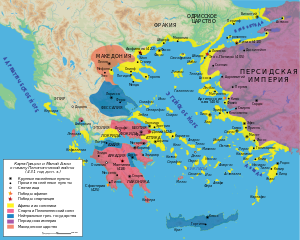 Map of Greece to the beginning of the war | |||
| date | 413 - 404 BC e. | ||
| A place | Mainland Greece , Aegean Islands, Asia Minor | ||
| Total | Victory of Sparta | ||
| Changes | Destruction of the Athenian Power | ||
| Opponents | |||
| |||
| Commanders | |||
| |||
The last period of the Peloponnesian War - the Dekel, or Ionian War - became very difficult for Athens. A crisis situation developed in the policy , which was caused by several factors. Military defeats, now following one after another, negatively affected the internal situation in the state [1] . In 413 BC e. news came of the defeat of the Athenian army and navy in Sicily . The Spartans occupied Dekhelei in Attica and turned it into their permanent bridgehead on enemy territory. Feeling the weakness of Athens, its members ( Chios , Miletus , Euboea and others) began to leave the Athenian maritime union one after another. A strong Spartan fleet, created with Persian money, appeared and began to support the fallen Athenian allies in the Aegean Sea . In Athens itself, disorganization and confusion reigned [2] .
In these very difficult conditions, the Athenians showed outstanding restraint, composure and state wisdom. The Athenians took a number of measures that allowed the continuation of the war. The oligarchic Council of four hundred , to which power passed in 411 BC. e. after the coup d'etat organized by the oligarchic heteries , he did not last long and at the end of the year was replaced by a moderate oligarchy, and later democracy was completely restored.
From 411 BC e. A series of victories of Alcibiades begins, as a result of which the advantage in the Peloponnesian war temporarily switched to the side of Athens. Returning to his homeland in 407 BC. e., Alcibiades was appointed a strategist- autocrat (commander in chief of the army and navy), however, after a small defeat that the Athenian fleet suffered in his absence, he was forced to go into exile. In 406 BC e. the Athenian fleet won a significant victory at the Arginus Islands , but already next year the Spartans completely defeated it . This defeat of the Athenians became decisive: the Spartan fleet dominating the sea besieged Athens, and the Athenians were forced to surrender in 404 BC. e.
Content
Sources
The Peloponnesian War is the first military conflict, about which a significant amount of evidence of contemporaries has been preserved. The most famous of them is the “ History ” of Thucydides , covering the period from the outbreak of war to 411 BC. e. Thus, only the very beginning of the Dekel war is described in his work. The work of Thucydides, which had a great influence on the development of historical science, largely determined the modern vision of the Peloponnesian war and the world in which it occurred [3] . At the beginning of the war, Thucydides was an Athenian commander and statesman, a political ally of Pericles . However, in 424 BC. e. he was expelled for the loss of the strategically important city of Amphipolis , and his story was written, at least in part, for the twenty years that he spent outside his hometown [4] .
Many historians wrote works that continued the story of events from the place where the “History” of Thucydides breaks off. Only the “Greek history” of Xenophon has reached us, covering the period from 411 to 362 BC. e. This work, despite its value as the only modern source for this period, is subject to reasonable criticism by today's researchers. Xenophon's work is not a “history” in the traditions of Thucydides, but rather memoirs , designed for readers already familiar with the events [5] . In addition, Xenophon is very partial and often simply omits information that he finds unpleasant; in particular, practically does not mention the names of Pelopides and Epaminondas , who played a huge role in the history of Hellas; historians use his work with caution [6] .
Other antique works about the war were written later and came to us in fragments. In the "Historical Library" of Diodorus of Sicily , written in the 1st century BC. e. The war is completely embraced. The work of Diodorus is estimated differently by historians, but its main value is that it is the only one that gives a different view of events from Xenophon. Some of Plutarch 's Biographies are closely related to war; although Plutarch was primarily a biographer and moralist, modern historians take useful information from his works. It is important to note that these authors used both direct sources and extensive, albeit not reached, literature. In addition, modern historians use speeches, works of art and philosophical works of this period as sources, many of which affect the events of war from one or several points of view, as well as numerous data from epigraphy and numismatics [7] [8] .
Background
At the end of the 420s, it became clear that the Archidam War - the first stage of the Peloponnesian War - came to a standstill. Neither side was able to win a decisive victory over the other for 10 years. With the death of Cleon and Brasid , the two main supporters of the war, at the battle of Amphipolis (422 BC), the parties of the world prevailed in both policies. As a result, both Sparta and Athens agreed to make peace. Under the terms of the contract, the pre-war situation was restored; the parties had to exchange prisoners and return the captured cities. However, despite the conditions of peace, the parties did not return the occupied territories to each other, although they issued prisoners. The peace of Nikiev , concluded for fifty years, lasted only six. This time was filled with constant skirmishes, the arena of which was the Peloponnese [9] .
In 420 BC e. the Athenian politician Alcibiades was a decisive opponent of the Nikiev of the world with Sparta and a supporter of the resumption of hostilities. In the same year he was elected a strategist and was reelected for this position for five consecutive years [10] . While in this position, in the first year of his strategy he was able to drastically change the foreign policy of Athens [9] . Previously, he preferred the feud with her to a popular course on peaceful relations with Sparta. To renew the military conflict, he began to look for allies in the Peloponnese. He managed to make an alliance with Argos , the eternal enemy of Sparta. Then two more former Spartan allies, Mantinea and Elis, joined this alliance [9] .
The creation of this coalition was the first major diplomatic success of Alcibiades [11] . The union allowed Athens to create a foothold in the Peloponnese and subjugate other cities to its influence [11] . At the same time, Nikiev, the world was still in force, and the situation became ambiguous. To clarify it, the Spartans sent ambassadors to Athens. However, Alcibiades discredited the ambassadors before the assembly, making them suspicious and insincere, and frustrated their mission. Nicosius , whose name was the peace treaty concluded with Sparta, with great difficulty dissuaded the Spartans from his immediate rupture [12] .
In 419 BC e. At the initiative of Alcibiades, the Athenians accused the Spartans of violating the conditions of the world and declared them aggressors [13] , although in reality it was the other way around [14] . In 418 BC e. coalition troops (Argos, Mantinea, Arkady , Athens) were utterly defeated at the battle of Mantineus ; in the cities of the Peloponnese, supporters of an alliance with Sparta triumphed and an oligarchy established. The democratic alliance broke up, and most of its members rejoined the Peloponnesian Union [14] .
In 416 BC e. the Athenians tried to subjugate the neutral island of Melos , inhabited by the Dorians , and after their refusal to join the alliance began a military campaign against Melos. After a long siege, the squire surrendered. The Athenian National Assembly decided to kill all the adult male inhabitants of the island and enslave women and children, and settle the Athenian colonists on the island [15] .
In the winter of 416/415 BC e. ambassadors from the Sicilian city of Egesta arrived in Athens. They requested military help from the Athenians [16] . They reacted positively to the request and sent ambassadors to Sicily. In February or March [17] the Athenian embassy returned to Athens [18] . Soon the National Assembly took place. At it, it was decided to send to Sicily three strategists, autocrats: Alcibiades, Nikias and Lamaha [19] . Alcibiades was the most determined supporter of the Sicilian expedition [20] . Nichy, on the contrary, considered the expedition “a difficult matter” and persuaded the Athenians to abandon this idea [21] . Five days later, at the next meeting, Nikiy criticized the upcoming military expedition. As a result, the Athenians decided to further increase their expeditionary forces [22] .
In 415 BC e. a large Athenian fleet under the command of Alcibiades, Nikias and Lamach sailed to Sicily. After the departure of Alcibiades and the death of Lamakh, Nikii involuntarily turned out to be the sole commander of the operation, of which he was an adversary and in whose success he did not believe. The main event of the expedition was the siege of Syracuse , which Nikiy unsuccessfully led for about two years, and for a long time Syracuse was on the verge of defeat, but the arrival of the Spartan detachment under the command of Gilippus turned the tide of hostilities. In 413 BC e. the Athenian troops were defeated, and their commanders, Nikias and Demosthenes, were executed. Alcibiades, sentenced to death by the Athenians for an alleged crime, received political asylum in Sparta [23] .
The beginning of the war
After the resumption of the war between Athens and Sparta in 413 BC. e. Alcibiades proposed a change of tactics: instead of the annual summer invasions from the Peloponnesus, practiced by the Spartans earlier, he proposed the capture of the fortress Dekhelei and turning it into his permanent bridgehead in Attica. The Spartans accepted this advice and carried it out exactly, as a result of which Athens was in a very difficult situation, since the enemy was in the hands of the most important strategic point of ancient Attica , dominating the passage to Boeotia through the Parnis mountain range to the Chalkidic road, on which a large part of the bread supplied from the island of Euboea . Because of this, Athens was forced to completely transfer the city to sea supply. In addition, the Spartans 'capture of Dekelei cut off the Athenians' access to the Lavrian silver mines , which also had a severe impact on the situation of Athens, in addition to the Spartans about twenty thousand slaves who worked there defected [24] . According to Plutarch, “no other blow could deplete the hometown of Alcibiades as irreparably” [25] . To prevent defeat, Athens began the construction of a new fleet and began to collect all the forces of its power.
In 412 BC e. Sensing the weakening of Athens, the strongest ally of Athens Chios revolted, he was supported by the Ionian cities of Clazomen , Eritre , Theos , Miletus . Sparta sent a strong fleet to help them, which included ships of the Sicilian allies. By 411 BC e. Ionia , with the exception of Samos , completely fell away from Athens [26] . The Spartans agreed with the Persian king Darius II and his Asia Minor satraps on financial assistance. The purpose of this assistance was to create a Spartan fleet that could withstand a strong Athenian fleet [27] . Sparta pledged to transfer Persian Greek cities of Asia Minor, recaptured during the Greco-Persian wars [28] .
Athens faced defeat. However, they did not intend to give up and were ready to take emergency measures. Foros was canceled - the military spending tax that has been in effect for more than 60 years, and instead a 10 percent duty was introduced on the passage of goods through straits [29] , and assistance was given to democratic parties in allied cities (for example, on Samos ). The assembled forces were immediately sent to Ionia , which significantly improved the situation of the Athenians in this region. In addition, the Spartan forces, significantly dependent on Persian money, began to experience supply disruptions, since the Persians were unprofitable complete defeat of Athens. The intrigues of those who wanted to go over to the side of the Athenians Alcibiades, who had considerable weight with the Persian satrap Sard Tissafern, also played their role [28] .
Significant changes have occurred in Athens itself. Military failures led to an increase in the influence of supporters of the oligarchy , and in 411 BC. e. they carried out a coup d'etat [30] . The number of full citizens was limited to 5,000 people, and the Council of Four hundred received real power. The important element of Athenian democracy, such as pay for official duties, was abolished. The new government proposed Sparta peace [31] .
However, the Spartans rejected the offer. Nor did the oligarchic government recognize the Athenian fleet based on Samos. In fact, there was a dual power in the Athenian power, which the Athenian allies were not slow to take: the rich island of Euboea and the cities in the straits revolted (this was extremely important, since most of the bread was brought into Athens from the Black Sea) [2] .
Propontis Campaign
In the same year, the Spartan fleet under the command of Mindar and the Persian forces led by Farnabaz joined and settled in Kizik , and 20 ships under the command of Thrasybul and 20 more ships under the command of Feramen joined the Athenian fleet. Over the course of several years, three naval commanders — Alcibiades, Frasibul, and Feramen — conducted very successful operations against the Spartans. About any disagreements or conflicts between them in ancient sources are not reported. Apparently, Feramen and Thrasybulus recognized Alcibiades as the supreme leader of the Athenian fleet [32] . Alcibiades made a speech to the soldiers, calling for a battle "at sea, on land and even on the walls of the city." Then he ordered secretly to speak to Kizik in the pouring rain. As a result, the Athenian fleet cut off the fleet of Mindar from the harbor of Kizik. Fearing that the Spartans would retreat, seeing the numerical superiority of the Athenian ships, Alcibiades launched an attack with forty ships. In the midst of the battle , all the other Athenian ships attacked the Spartans. The Spartans began to land on land and took to flight. Alcibiades immediately landed and organized the persecution of the retreating. Mindar died in this massacre, and Farnabaz escaped. The Spartans suffered a crushing defeat, their fleet was destroyed and captured, the commander in chief was killed. The Athenians occupied Kizik, having killed a small Spartan garrison. In the city of Chrysopolis, Alcibiades established customs to levy a ten percent duty on ships going from the Black Sea to the Aegean [33] . Thanks to this, Athens received a new source of income [34] .
In 410 BC e. Alcibiades army was based in Lampsak . Alcibiades united with Thrasillus , and together they moved to Abydos . Against them came Farnabaz with the Persian cavalry. The Athenians won the equestrian battle and chased the Persians until night [35] .
In 409 BC e. Alcibiades opposed Chalkedon and Byzantium , the former Athenian allies who sided with Sparta. Having learned about the approach of the Athenians, the Chalkedonians collected their belongings and took them to Bithynia , friendly to them, depositing them with the Thracians . Then Alcibiades arrived in Bithynia and began to demand the surrender of the property of the Chalkedonians, threatening war in case of refusal. The Thracians gave him the property of the Chalkedonians and concluded a peace treaty with him [35] . After this, Alcibiades embarked on a siege of Chalkedon . The attempt to sortie the besieged, led by the Spartan accordion (governor) Hippocrates ended in failure, and Hippocrates himself fell in battle. Then Alcibiades sailed to the Hellespont to collect taxes and took the city of Selimbria [36] . Meanwhile, the strategists besieging Chalkedon entered into an agreement with Farnabaz, under which the latter pledged to pay indemnity, Chalkedon returned to the Athenian state, and the Athenians pledged not to destroy Daskileya - the satrapy of Farnabaz. When Alcibiades returned, Farnabaz persuaded him to take an oath to comply with the agreement concluded in Chalkedon [37] .
After the fall of Chalkedon, the Athenians in 408 BC. e. besieged Byzantium . They again began to surround the city with a wall, hoping to take Byzantium to starvation. In the city there was a Spartan garrison led by the harlest Clearch , as well as the Allied perieki , Meghars and Boeotians . Confident that no one would hand over the city to the Athenians, Clearch sailed to Farnabaz for financial help. When he sailed away, several Byzantines decided to surrender the city to the Athenians. At night, the conspirators opened the gates of the city. The Athenians immediately occupied the city and forced the forces of the Peloponnesian Union to surrender [37] . Byzantium fell. The Black Sea straits were completely cleared of Spartan and Persian forces; the Athenians regained control of this strategically important region [34] .
Now Alcibiades aspired to his homeland in the halo of the winner. In Athens, meanwhile, he was elected strategist. In the spring of 407 BC e. Alcibiades with all the brilliance arrived in Piraeus at the head of the victorious fleet. Soon he was elected an autocratic strategist - commander in chief of the land and naval forces with unlimited powers. This was the highest point of his career [38] .
End of War
Promptuarii Iconum Insigniorum ( 1553 )
Soon, Alcibiades conducted a set of troops and went with the fleet against the rebellious Andros . He defeated the Androans and the Spartans who supported them, but he did not take the city. Now the people demanded of him even greater victories. However, Alcibiades was constrained in financial resources. He often had to go away to find financial means to pay salaries to sailors. In 406 BC e. setting off for a salary, Alcibiades left Antiochus as fleet commander, ordering him not to engage in battle with the Spartans. He violated the order and was defeated by the Spartan navarch Lysander in the battle of Notia . Upon learning of this, Alcibiades returned to Samos and tried to give Lysander a new battle, but he remained in the harbor [39] .
Thrasibulus, the son of Phrason, sailed to Athens and began to accuse Alcibiades of the National Assembly of having left the command to unworthy people, and himself had sailed to have fun in the company of Abydos and Ionian heterosexuals. As a result, the Athenians removed him from command and appointed ten strategists in return. Alcibiades, fearing the wrath of the people, decided to go into exile [40] .
The last victory of the Athenians: the battle of the Arginus
The situation of the Athenian fleet in view of the lack of funding and active actions of the Spartans was difficult. The Athenian strategist Konon on Samos was able to equip only 80 ships out of a hundred. He was opposed by the Spartan navarch Kallikratid , who replaced Lysander at this post [41] . Kallikratides added ships from the allied cities to his ships, and as a result he had at his disposal one hundred forty triremes , with which he opposed Mefimna in Lesbos , which still remained faithful to the Athenians.
After the capture of Mefimna, Kallikratid, as a result of successful military operations, blocked the surviving Athenian fleet from the sea and land. The Athenians sent a large fleet to Lesbos under the command of eight strategists. Upon learning of the approach of the enemy, Kallikratid left fifty ships at Mytilene under the command of Etheonik to guard Konon, and he, with one hundred and twenty triremes, headed towards the Athenians [42] . The Athenian fleet lined up in front in two rows, whose left flank was facing the open sea. The second line was designed to prevent breakthroughs by the Spartan ships. Kallikratid, on the other hand, lined up his ships in one line, since his triremes were faster. In the battle, the Athenians won a major victory [43] .
Strategists have instructed some triarchs to save the dying Athenians, but they were prevented by a strong wind and storm. At home, Athenian strategists were removed from their posts and were accused of not providing assistance to fallen fellow citizens. Two of them did not return to Athens at all, and the remaining six strategists were sentenced to death [44] .
Aegospots
The Athenian fleet, based on Samos, was apparently inactive for a year after the Battle of Arginus, which may have been due to the lack of funds to pay salaries to sailors [45] . In 405 BC e. Spartan naval commander Lysander with 170 ships moved to the Hellespont Strait to intercept merchant ships sailing to Athens from the Black Sea. The Athenians with 180 ships followed him to the Hellespont. They needed to defeat the Spartan fleet, since Lysander cut the vital trade route for the Athenians from the Black Sea to the Aegean [45] .
After several days of standing near the mouth of the Egospotama River, Lysander took advantage of the loss of vigilance of the Athenians and suddenly attacked. The Athenian fleet was almost completely destroyed [46] . Strategist Konon did not dare to appear in Athens and fled to Cyprus . The forces of Athens were exhausted - there was no fleet, no warriors, no money, no hope of salvation.
Now the Spartan fleet dominated the sea, and Lysander besieged Athens from the sea and from land [47] . Ambassadors from the Spartans arrived in the besieged city with proposals for peace, but this initiative was thwarted by the demagogue Cleophont [48] . Over time, famine began in Athens [49] . The influence of the “moderate” Feramen increased. He was sent as an ambassador to Lysander [50] .
In ancient historiography, there are two interpretations of the events of this Feramen mission. According to one of them, Feramen deliberately delayed negotiations so that the Athenians, exhausted by hunger, were ready for any concessions [51] . According to another version, Lysander kept Feramen for several months in his camp, and then stated that he was not authorized to resolve such issues, and sent him to the efor [52] . The Ephors dictated the harsh conditions of the world (in the history known as Feramenov ), according to which the Athenian sea power dissolved, the fleet was destroyed, the Long walls were torn down, Athens entered the Peloponnesian Union and recognized Spartan hegemony [52] . Moreover, these conditions were still comparatively merciful: for example, Thebes and Corinth generally proposed to destroy the city [53] .
Consequences
For a short period in Athens, the openly oligarchic authority of the Thirty Tyrants , openly supported by Sparta, was established. The most famous of these was Critias . “Thirty tyrants” launched a real terror in the city, both against their political opponents and simply against wealthy people whose means they wanted to take over [54] . However, after some time (in 403 BC ), the oligarchy was overthrown, and democracy was restored in Athens.
Notes
- ↑ Surikov, 2011 , p. 210.
- ↑ 1 2 Surikov, 2011 , p. 211.
- ↑ J.V. A. Fine. Ancient Greeks: A Critical History, p. 442
- ↑ J.V. A. Fine. Ancient Greeks: A Critical History, p. 446
- ↑ Lurie S. Ya. Crisis of the 4th century (401-362). Sources // History of Greece .
- ↑ Sergeev, 2002 , p. 40.
- ↑ J.V. A. Fine. Ancient Greeks: A Critical History, p. 527
- ↑ History of Ancient Greece, ed. V.I. Kuzishchina, p. 15
- ↑ 1 2 3 Surikov, 2011 , p. 183.
- ↑ Surikov, 2011 , p. 184.
- ↑ 1 2 Surikov, 2011 , p. 185.
- ↑ Thucydides. V. 46
- ↑ Thucydides. V. 56. 3
- ↑ 1 2 Surikov, 2011 , p. 186.
- ↑ Thucydides. V. 116. 4
- ↑ Thucydides. VI. 6
- ↑ Surikov, 2011 , p. 135.
- ↑ Thucydides. VI. 8. 1
- ↑ Thucydides. VI. 8.2
- ↑ Plutarch. Alcibiades. 17
- ↑ Plutarch. Nice. 12
- ↑ Thucydides. VI. 24. 2
- ↑ Plutarch. Alcibiades. 23
- ↑ Thucydides, History VII 27
- ↑ Plutarch. Alcibiades. 26
- ↑ Plutarch. Alcibiades. 24
- ↑ Surikov, 2011 , p. 196.
- ↑ 1 2 Surikov, 2011 , p. 197.
- ↑ Xenophon, Greek History, Prince I, ch. 1, § 22
- ↑ Thucydides. Viii. 69.1
- ↑ Surikov, 2011 , p. 245.
- ↑ Surikov, 2011 , p. 251.
- ↑ Xenophon. Greek history. I. 1.22
- ↑ 1 2 Surikov, 2011 , p. 200.
- ↑ 1 2 Plutarch. Alcibiades. 29th
- ↑ Plutarch. Alcibiades. thirty
- ↑ 1 2 Plutarch. Alcibiades. 31
- ↑ Surikov, 2011 , p. 201.
- ↑ Plutarch. Alcibiades. 35
- ↑ Plutarch. Alcibiades. 36
- ↑ Pechatnova, 2001 , p. 366.
- ↑ Xenophon. Greek history. I. 6. 26-27
- ↑ Kagan, 2003 , p. 454-456.
- ↑ Surikov, 2011 , p. 258.
- ↑ 1 2 Wylie, 1986 , p. 126.
- ↑ Wylie, 1986 , p. 133.
- ↑ Xenophon . Greek history. II. 2. 9
- ↑ Fox . Xiii. eight
- ↑ Xenophon . Greek history. II. 2.10
- ↑ Xenophon . Greek history. II. 2.16
- ↑ Xenophon . Greek history. II. 2.17
- ↑ 1 2 Surikov, 2011 , p. 259.
- ↑ Xenophon. Greek history. II. 2.29
- ↑ Xenophon (Greek history, book I, ch. 3, § 21) even gives an example of a law according to which each of the Thirty could arrest and execute one metek , confiscating his property
Literature
Sources
- Aristophanes . (the article uses a translation of Adr. Piotrovsky)
- Diodorus of Sicily . Historical library
- Xenophon . Greek history (the article uses the translation of S. Ya. Lurie)
- Pseudo-Xenophon. Athenian polity
- Plutarch . Comparative biographies
- Thucydides . History (the article uses the translation of G. A. Stratanovsky)
Research
- Belokh Yu. The fall of democracy // Greek History. - 3rd. - M .: GPIB, 2009 .-- T. 2.
- Bonnard, A. Greek Civilization, vol. 2. - Publishing house "Phoenix", Rostov-on-Don. - 1994—448 pp. ISBN 5-85880-082-3
- Wipper R. Yu. Lectures on the history of Greece. Essays on the history of the Roman Empire (beginning). Selected Composition in Volume II. Volume I. Rostov-on-Don: Publishing house "Phoenix", 1995.
- Kuzishchin V.I., Gvozdeva T. B., Strogetsky V. M., Strelkov A. V. History of Ancient Greece. - M .: Academy, 2011 .-- ISBN 978-5-7695-7746-8 .
- Lurie S. Ya. History of Greece . - SPb. : Publishing house of S.-Petersburg University, 1993. - 680 p.
- Nikityuk E.V. The process of winning strategists in the Arginus Islands 406 BC e. and the crisis of Athenian democracy // Mnemon. - 2006. - No. 5 . - S. 223-230 .
- Pechatnova L.G. History of Sparta (the period of archaics and classics). - SPb. : Humanitarian Academy, 2001. - 510 p.
- Samoilo A.R. Politics of the navarch Kallikratida (406 BC) // Historical, philosophical, political and legal sciences, cultural studies and art history. Questions of theory and practice. - 2011. - No. 5 (11) . - S. 176-179 .
- Sergeev V.S. History of Ancient Greece. - SPb. : Polygon, 2002 .-- 704 p. - ISBN 5-89173-171-1 .
- Surikov I.E. Chapter IV. The turn of the century: Feramen, Critius, Thrasybul // Ancient Greece: politics in the context of the era. Godina feuds. - M .: Russian Foundation for the Promotion of Education and Science, 2011. - 328 p. - ISBN 978-5-91244-030-4 .
- Ancient world history. Ancient Greece / A. N. Baidak, I.E. Voynich, N.M. Volchek, et al. - Mn .: Harvest, 1998-800 with ISBN 985-433-227-6 ,
- Peloponnesian war // Military Encyclopedia : [in 18 vol.] / Ed. V.F. Novitsky [et al.]. - SPb. ; [ M. ]: Type. t-va I. D. Sytin , 1911-1915.
- von Pölman, R. Essay on Greek History and Source Studies. Per. from German A.S. Knyazkov under the editorship of prof. S. A. Zhebeleva. Scientific edition of the new edition, notes and additions by M. M. Kholod and S. M. Zhestokanov - Publishing house "Aletheya", St. Petersburg, 1999 (reprint of the 4th edition of the book published in 1909)
- Fine, John VA The Ancient Greeks: A Critical History. - Harvard University Press, 1983. - ISBN 0-385-72059-9 .
- Kagan D. The Fall of the Athenian Empire. - New York: Ithaca, 1987.
- Kagan D. The Peloponnesian War. - NY: Penguin Books, 2003 .-- ISBN 0-670-03211-5 .
- Hegel. Der Peloponnesische Krieg
- Wylie G. What really happened at Aegospotami? // L'Antiquité Classique. - 1986.- T. 55 . - S. 125-141 .