Crater Licetus ( lat. Licetus ) - a large ancient impact crater in the southern mainland of the visible side of the moon . The name was given in honor of the Italian physician , astronomer and philosopher Fortunio Liceti (1577-1657) and approved by the International Astronomical Union in 1935. The formation of the crater dates back to the preectarian period [1] .
| Lyceum | |
|---|---|
| lat Licetus | |
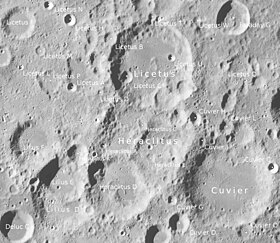 Shot of the Lunar Reconnaissance Orbiter probe. | |
| Specifications | |
| Diameter | 75.4 km |
| Deepest | 3530 m |
| Title | |
| Eponym | Fortunio Liceti (1577-1657) - Italian physician, astronomer and philosopher. |
| Location | |
| Heavenly body | Moon |


Content
Crater Description
The closest neighbors of the crater are the Proctor Crater in the west; craters Saussure , Heggins and Nasireddin in the northwest; craters Stefler and Faraday in the north; Mavrolik and Barozzi craters in the northeast; Clero Crater in the east; Cuvier Crater in the southeast; Heraclitus crater in the south (Lyceum overlaps its northern part) and Magini crater in the west-south-west [2] . Selenographic coordinates of the center of the crater , diameter 75.4 km [3] , depth 3.53 km [4] .
Crater Licet has a circular shape and is significantly destroyed over a long time of its existence. The shaft is flattened, in the southern part it is blocked by a group of small craters, and it is significantly destroyed in the northern part. Traces of a terrace-like structure are visible in the eastern part of the inner slope. The shaft height above the surrounding area reaches 1310 m [1] , the volume of the crater is about 4900 km³ [1] . The bottom of the bowl is even in the north and crossed in the southern part. In the western and eastern parts of the bowl are noticeable single craters. There is a central ridge somewhat offset east of the center of the bowl.
Satellite Craters
| Lyceum | Coordinates | Diameter, km |
|---|---|---|
| A | 8.1 | |
| B | 11.8 | |
| C | 10.3 | |
| D | 5.2 | |
| E | 18.8 | |
| F | 28.9 | |
| G | 10,4 | |
| H | 10.3 | |
| J | 10,4 | |
| K | 5,6 | |
| L | 4.2 | |
| M | 8.7 | |
| N | 7.9 | |
| P | 20,2 | |
| Q | 8.3 | |
| R | 6.4 | |
| S | 10,4 | |
| T | 7.3 | |
| U | 6.6 | |
| W | 7.2 |
- The formation of the satellite crater Licet F belongs to the nectar period [1] .
See also
- List of Craters on the Moon
- Lunar crater
- Morphological catalog of Moon Craters
- Planetary nomenclature
- Selenography
- Mineralogy of the Moon
- Geology of the moon
- Late heavy bombardment
Notes
- ↑ 1 2 3 4 Lunar Impact Crater Database . Losiak A., Kohout T., O'Sulllivan K., Thaisen K., Weider S. (Lunar and Planetary Institute, Lunar Exploration Intern Program, 2009); updated by Öhman T. in 2011. Archived page .
- ↑ Crater Licet on the map LAC-112
- ↑ Handbook of the International Astronomical Union
- ↑ John E. Westfall's Atlas of the Lunar Terminator, Cambridge Univ. Press (2000)