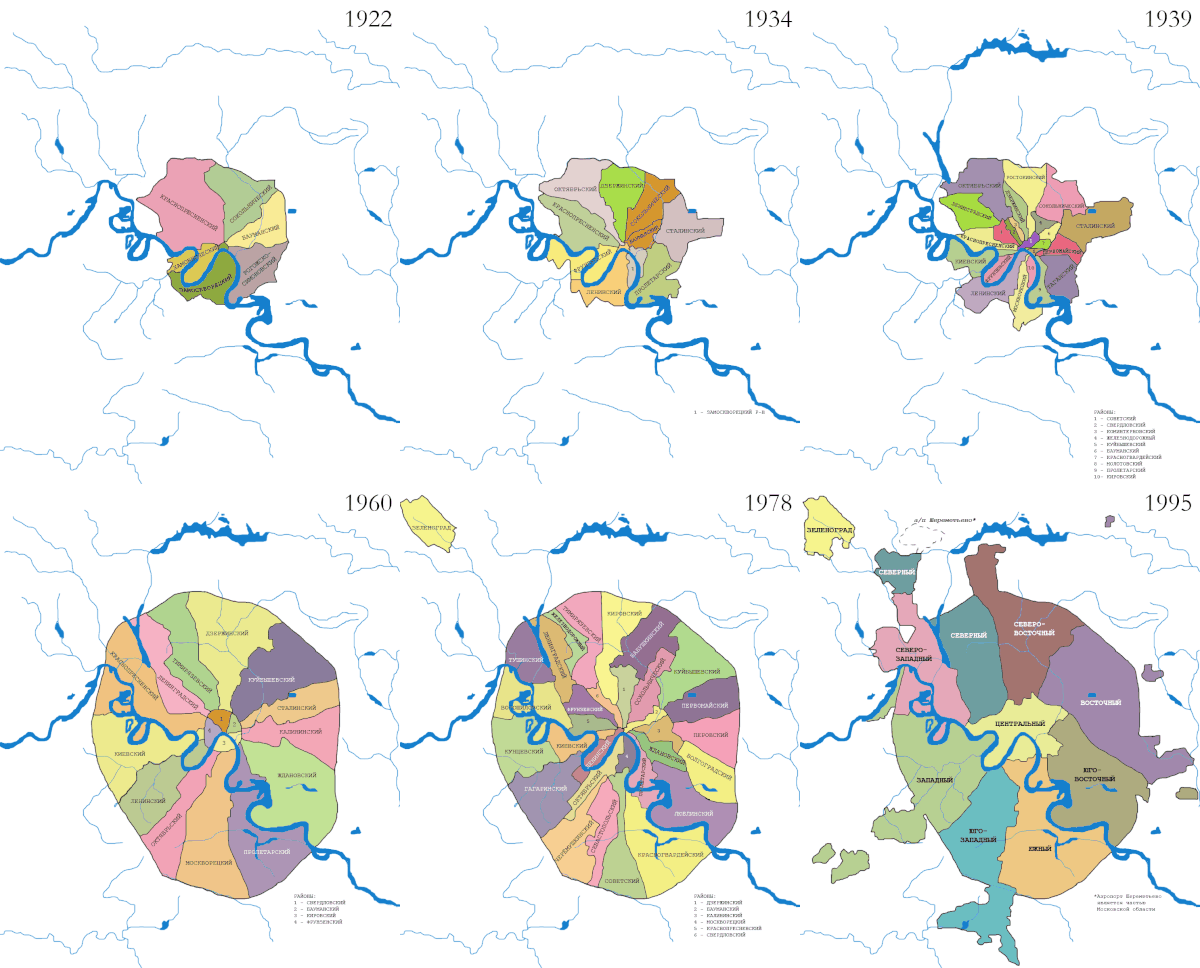
Dzerzhinsky district is a former district in the city of Moscow .
Content
- 1 History
- 2 Description
- 3 See also
- 4 notes
- 5 Literature
History
The area was created in 1930 . and named after the Russian revolutionary F.E. Dzerzhinsky . The land was built up at the end of the 19th century and at the beginning of the 20th century [1] .
The historical places of the region are connected with V.I. Lenin and the revolutionaries . So, at Prospect Mira, house number 10 was the union of tea workers, as evidenced by the memorial plaque . The military-industrial complex of the Gorodskoi district, the Republic of Kazakhstan RSDLP (b) , the district council and the headquarters of the Red Guard were located on 1st Meshchanskaya Street and on Sukharevskaya Square in October 1917 . On November 7, 1918, at the Cheka’s club on Bolshaya Lubyanka Street, building number 13, Lenin spoke at the rally , a plaque testifies to this. During the Great Patriotic War in the Dzerzhinsky district , the 6th division of the people's militia was formed. On Mira Avenue, house No. 14a, the People’s Museum of the History of the Dzerzhinsky District was organized [1] . In 1969 it was divided into several regions, in particular, the Babushkinsky district was separated [2] [3] .
In 1977, the boundaries of the district were expanded. In 1978, the housing stock amounted to 1897.4 thousand square meters, 41 production facilities were operating in the district, of which the plants: Vodopribor , Caliber , high-quality alloys; printing houses: “ Moscow Printing House of Goznak ”, No. 2; 43 research institutes, including the ambulance and regional clinical institutes ; design organizations, 3 universities: architectural , financial, Theater School named after M. S. Shchepkin ; 30 schools, 66 preschool organizations, 4 cinemas , including Cosmos ; 8 recreation centers , 42 libraries, 6 hospitals, 37 polyclinics, 100 grocery stores and 86 grocery stores and two department stores , 300 catering outlets. There were also cultural and educational organizations: Theater of the Soviet Army , CDSA , Central Museum of the Armed Forces of the USSR , House Museum of V. M. Vasnetsov , House Museum of S. P. Korolev , Television Center in Ostankino , Durov Corner and others. Hotels: “Berlin”, “Golden Ear”, “ Space ” [1] .
After 1991, the district was divided [1] .
Description
The building of the District Executive Committee and the CPSU RK was located at the mailing address : Prospekt Mira , house number 48. The district was named after the revolutionary F. E. Dzerzhinsky .
Since 1977, the district’s territory has been located from Dzerzhinsky Square to the Exhibition of Economic Achievements of the USSR and is adjacent to two sides of the Garden Ring [1] .
The entire area of 1,280 hectares . Of these, the forest area is 383 hectares, in which there are:
- CDSA park ;
- Botanical Garden
- reservoirs with an area of 8.5 hectares, including their ponds in the CDSA park and the Ostankino pond [1] .
The population of the district was about 165,000 people [1] . The main road is Prospect Mira [1] .
See also
- 6th Moscow Rifle Division of the People’s Militia (Dzerzhinsky District)
Notes
- ↑ 1 2 3 4 5 6 7 8 Dzerzhinsky district . Date of treatment June 12, 2015.
- ↑ Decree of the Presidium of the Supreme Council of the RSFSR of 11.25.1968 "On the new administrative division of Moscow" // Vedomosti of the Supreme Council of the RSFSR. - 1968. - November 28 ( No. 45 (530) ). - S. 983 . TsAMAM. F. 150. Op. 1. D. 3550. L. 2-31. TsAMAM. F. 150. Op. 5. D. 235. L. 27-52.
- ↑ Trofimov V.G. Moscow. Guide to the Moscow regions. - M: Moscow Worker, 1972.- S. 400.