Heiligenberg - a hill in the city of Heidelberg of the federal state of Baden-Württemberg in Germany , on the banks of the Neckar River, consists of sandstone and reaches 439.9 m in height. The hill has two peaks, one of which is sometimes referred to as a separate Michaelsberg hill.
| Heiligenberg | |
|---|---|
| him. Heiligenberg | |
 | |
| Highest point | |
| Highest point | 439.9 m |
| Location | |
| A country |
|
| Earth | Baden-Wurttemberg |

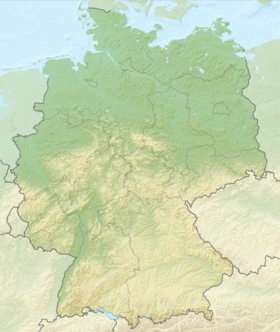

It is located in the urban areas of Handshusheim and Neuenheim and together with the Königstuhl hill on the other side of the river is the main landscape dominant of the city. Refers to the historic Bergstrasse region - the junction of the Odenwald hills and the upper Rhine valley .
Content
- 1 History
- 2 Attractions
- 3 notes
- 4 Literature
- 5 Links
History
Heiligenberg at all times was distinguished by a favorable defensive position due to a good overview of the river valley and adjacent plains.
Archaeological surveys have been carried out several times since 1881, including in the 1920s and 1930s during the construction of the Place of Ting and other structures. During excavations, Neolithic linear tape ceramics were found , indicating that the hill has been inhabited from 5500-5100 BC. e.
The Celts settled here at the beginning of the first half of the 1st millennium BC. e. and built a double ring of ramparts around the peaks (the source that supplied the inhabitants of this village with water, known as the Gorky Stream ( German Bittersbrunnen ), was restored in 1979 ). In the early Latin period , iron ore mining began. [one]
The hill was the local political, religious and cultural center of the Celtic and then Germanic tribes from the 5th century BC. e. until about 200 BC e. when the capital of the region moved to the Roman settlement of Lopodunum ( lat. Lopodunum ), now Ladenburg . But even under the rule of the Romans, religious sacrifices continued on the hill, including human: cult mines into which people tied to tree trunks descended go to a depth of 78 meters. At the same time, there was a sacred place for the Romans: on one of the peaks, the base of the north-oriented temple of Mercury was discovered (it was first studied by Philip Melanchthon in 1508 ). Among other things, sacrificial stones with Latin dedications to "Mercury of Cimvri " ( Latin Mercurius Cimbrianus ) [2] were found , which is supposedly a dedication to the god of the Germans Wotan , which the Romans interpreted as Mercury. This temple was plundered during the Great Migration , however, the ritual services here lasted until about 600 , because pagan burials were discovered up to this period.
The hill is sometimes identified with Mount Mons Piri , which the Roman historian Ammianus Marcellinus refers to as the place where the construction of the fortress began in 369 on the orders of the Roman emperor Valentinian (but was destroyed by the attack of Germanic tribes). [3] From the 4th and 5th centuries , only a few finds have been preserved, but since the end of the 6th century the hill has been populated again. [1] From the end of the 7th century , Christian burial sites began to occur, and in the 8th century , during the Carolingian dynasty, new stone structures (probably used by the royal governors) began to be erected on the foundations of the Roman rule.
The first written mention of a hill called Aberinsberg ( German: Aberinsberg ) dates back to 882 , when King Louis III the Younger presented it to the Lorsch Monastery on the occasion of the burial in Lorsch of his father, King Louis II of Germany . In the IX century, the Lorsch Monastery built on one of the peaks a church dedicated to Michael the Archangel . The ruins of the late restructuring of this church in the Romanesque style survived: the eastern part dates from the end of the 10th century , and the western one is approximately 1030 . In 1023, the abbot Reginbald founded the monastery of St. Michael .
In 1090, the Benedictine monk Arnold laid on the other peak a church dedicated to St. Stephen , in 1094 transformed into the monastery of St. Stephen . A noble woman named Hazecha ( German Hazecha ) was buried in him in 1100 ; her grave is the oldest known medieval burial place in Heidelberg .
In the middle of the XIII century, both monasteries became subordinate to the Archbishop of Mainz . After their transfer in 1265 to the jurisdiction of the premonstrant monks from the All Saints Monastery in the Black Forest, the hill began to be called the “All Saints Mountain” ( German Allerheiligen-Berg ), which was gradually transformed into the modern “Heiligenberg” . [1] In 1555, during the Reformation, the Pfalzgraphs took possession of them. Political conflicts led to the destruction of monasteries one by one.
Since 2012, the hill has been under state protection. [four]
Attractions
- The remains of the double ring of ramparts of the Celtic fortification ( 4th century BC ).
- " Pit of the Gentiles " ( German: Heidenloch ) - a mine of unknown age and destination with a depth of 55 meters. Presumably an ancient Roman well or cistern .
- The ruins of the monastery of St. Michael ( 1023 ). There are also traces of the ancient Roman temple of Mercury .
- The ruins of the monastery of St. Stephen (end of the XI century ). Like the previous one, it was founded by the monks of the Lorsch monastery.
- On the southern slope of the hill is located the "path of philosophers" , important for the history of Heidelberg University, and the so-called. Heidelberg Romanticism .
- Panoramic Heiligenberg Tower ( XIX century ), built from stones taken from the ruins of the monastery of St. Stephen.
- Bismarck Tower ( 1903 ), built as a monument to the first chancellor of the German Empire, Bismarck . This is one of the many similar towers designed by Wilhelm Chrys . It was supposed that on its top in a special bowl fire should burn.
- “The Place of Ting ” ( German: Thingstätte ) ( 1935 ) is a stone amphitheater built during the Third Reich to hold Nazi meetings. In the post-war period it is used for various events, celebrations and concerts (including informal ones).
Pit of the pagans
The ruins of the monastery of St. Michael
The ruins of the monastery of St. Stephen and the Heiligenberg Tower
Bismarck Tower
Ting Place
Notes
- ↑ 1 2 3 Peter Marzolff, Uwe Gross, “Zwischen Merkur und Michael: Der Heiligenberg bei Heidelberg in Völkerwanderungszeit und Frühmittelalter”, published in Höhensiedlungen zwischen Antike und Mittelalter von den Ardennen bis zünlertener German Adrian, German Adlerten , Germany ed. de Gruyter, 2008, ISBN 978-3-11-020235-9 , pp. 121–63 (German) ( pdf ).
- ↑ CIL 13, 06399 , CIL 13, 6402 , AE 1921, 52 ; dedication to Mercury: CIL 13, 6400 .
- ↑ Ammianus Marcellinus. Acts. Xxvii. X. 1-16.
- ↑ Bodendenkmal Heiligenberg (German)
Literature
- Wolfgang von Moers-Messmer. "Der Heiligenberg bei Heidelberg. Ein Führer durch seine Geschichte und seine Ruinen ”, Schutzgemeinschaft Heiligenberg e. V. , 1987 (German)
- Renate Ludwig, Peter Marzolff. Der Heiligenberg bei Heidelberg, Führer zu archäologischen Denkmälern in Baden-Württemberg 20 , Stuttgart, ed. Theiss, 1999. ISBN 3-8062-1416-6 (German)
- Peter Marzolff. "Der Heiligenberg," published in Heidelberg. Geschichte und Gestalt , Heidelberg, 1996. ISBN 3-921524-46-6 . p. 38-45 (German)
- Martin Schemm. Das Heidenloch 3rd Edition, Ubstadt-Weiher / Heidelberg / Basel, ed. Regionalkultur, 2004. ISBN 3-89735-165-X (German)
Links
- Thomas Juelch, "Der Heiligenberg" (Unavailable link) . Archived on June 29, 2011. , 2002 (German)