Trichomyrmex destructor (lat.) - a species of small ants of the genus Trichomyrmex . An invasive species , a pest that has settled with the help of human commerce in many countries and continents and more than a hundred years (since 1893) known as Monomorium destructor (Jerdon, 1851) [1] .
| Trichomyrmex destructor |
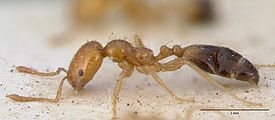
Invasive Ant Worker Trichomyrmex destructor |
| Scientific classification |
|---|
| No rank : | Bilateral symmetrical |
| Subtype : | Tracheo-breathing |
| Infraclass : | Winged insects |
| Treasure : | Fully Transformed Insects |
| View: | Trichomyrmex destructor |
|
| International scientific name |
|---|
Trichomyrmex destructor ( Jerdon , 1851) |
| Synonyms |
|---|
- Atta destructor Jerdon, 1851
- Monomorium destructor (Jerdon, 1851)
- Monomorium gracillimum (Jerdon, 1851)
- Myrmica atomaria Gerstäcker, 1859
- Myrmica basalis Smith, F., 1858
- Myrmica gracillima Smith, F., 1861
- Myrmica ominosa Gerstäcker, 1859
- Myrmica vexator Smith, F., 1861
|
|
Tropics , subtropics , partially temperate zone (North and South America , Asia , Africa , Australia , Europe ), natural open biotopes, gardens, plantations and urbocenoses (houses and surroundings). Detection points: USA (New York), Afghanistan , Iran , Turkmenistan , Uzbekistan , Japan . Known finds in Europe: UK , Spain . The alleged homeland is South Asia ( India or other close countries) [1] [2] .
The length of the tan working ants (the abdomen is darker) is 1.8-3.5 mm (females up to 4 mm). Head length 0.49-0.76 mm (width 0.38-0.68); antennae scapus length 0.39-0.52 mm. Antennae 12-segmented, the club consists of 3 segments. The mandibular palps are 2-segmented, the lower labial palps are composed of 2 segments. Zhvalov with 4 teeth (3 large + 1 small). The workers' eyes are small or medium-sized elliptical in shape, located in the front-side of the head, slightly in front of its midline (the eyes of the males are large, occupying almost half of the side surface of the head). Workers have no ocellium. The occipital margins of the head are rounded. On the underside of the head there is an underdeveloped psammophore . Worker's scapus index (ratio of scapus length to head width, SI) from 70 to 104; head index (ratio of head length to width, CI) from 76 to 92. Head, breast and abdomen are smooth and shiny, with spaced bristles on top. The propodeum is round, without spines or teeth on the posterior breast. The stalk between the breast and the abdomen consists of two segments: the petiolus and postpetiolus (the latter is clearly separated from the abdomen), the sting is developed, pupae are naked (without cocoon) [1] [3] .
Nest in a variety of conditions: in the ground, tree branches, walls of houses. Omnivores, collect dead and living insects, seeds, nectar. Workers forag, slowly moving along narrow paths. Form large polygynous colonies with many females. Propagated by division of colonies and swarming of winged females and males [1] [4] .
Settling in offices and residential buildings, they damage electric networks (damage the insulation of electrical wires), there are known findings in air conditioners and computers , and kitchen stores spoil food supplies. Able to disable the ignition system of a car left in a parking lot or in a garage for a long time. At night they can attack pets and sleeping people, causing painful stings ; able to kill laboratory rats sitting in cells [1] [4] .
To combat ants, they use insecticides and poisonous baits based on hydramethylnone (5,5-dimethylperhydropyrimidin-2-one 4-trifluoromethyl-α- (4-trifluoromethylstyryl) cinnamilidenehydrazone; C 25 H 24 F 6 N 4 ) and sulfulfuroluramide (N -1-sulfonamide; C 10 H 6 F 17 NO 2 S) [5] [6] [7] .
The species Trichomyrmex destructor was first described in 1851 by British zoologist Thomas Jerdon ( Thomas Jerdon ; 1811-1872) based on materials from India under the original name Atta destructor Jerdon, 1851 . In 1893, the taxon was included in the genus Monomorium (in the subgenus Parholcomyrmex ) [1] [8] [9] , and in 2014 it was transferred to the genus Trichomyrmex [10] . Trichomyrmex destructor is similar to the species Trichomyrmex robustior and Trichomyrmex mayri , which are darker in color, and M. latinode , which has 5 pronged teeth, instead of 4 in T. destructor [11] .
In ant families there are workers, females ( uterus ) and males [1] [4] .
Workers
Females
Males

