False Tritons [1] ( lat. Pseudotriton ) is a genus of caudate amphibians from the family of lungless salamanders .
| False Newts |
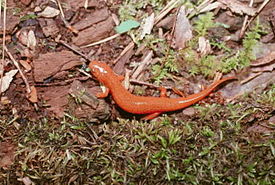
False Newt |
| Scientific classification |
|---|
| No rank : | Bilateral symmetrical |
| Family: | Lungless salamanders |
|
| International scientific name |
|---|
Pseudotriton Tschudi , 1838 |
| Synonyms |
|---|
- Mycetoglossus Bonaparte, 1839
- Batrachopsis Fitzinger, 1843
- Pelodytes Gistel, 1848
|
|
Content
The total length of representatives of this genus ranges from 7 to 20 cm. The head is small but wide. Eyes bulging slightly with horizontal pupils. The body is strong, slender. The limbs are thin. Coloring is red or orange with various shades. Often there are numerous black spots or dots on the back.
They love rivers, lakes, streams. Found quite high in the mountains. Active at dusk. They lead a semi-aquatic lifestyle. They feed on various invertebrates.
These are oviparous amphibians.
Endemic to the east and south of the United States . They are found from New York south to Florida and west to southern Ohio , Kentucky , Tennessee , and eastern Louisiana [2] .
The number of species in different sources varies from three to two. The Amphibian Species of the World lists indicates three species [2] :
- Pseudotriton diastictus Bishop, 1941
- False Triton [1] ( Pseudotriton montanus ) Baird, 1850
- Red Triton [1] ( Pseudotriton ruber ) (Sonnini de Manoncourt and Latreille, 1801)
However, AmphibiaWeb provides a list of only two species, as he considers Pseudotriton diastictus a subspecies of Pseudotriton montanus [3] . The same opinion is shared by the International Union for Conservation of Nature [4] .
- ↑ 1 2 3 Ananyeva N. B. , Borkin L. Ya. , Darevsky I.S. , Orlov N.L. Amphibians and reptiles. Latin, Russian, English, German, French. / edited by Acad. V. E. Sokolova . - M .: Rus. Yaz., 1988 .-- P. 30 .-- 10,500 copies. - ISBN 5-200-00232-X .
- ↑ 1 2 Frost, Darrel R. Pseudotriton Tschudi, 1838 (neopr.) . Amphibian Species of the World: an Online Reference. Version 6.0 . American Museum of Natural History (2015). Date of treatment May 18, 2015.
- ↑ Plethodontidae (neopr.) . AmphibiaWeb: Information on amphibian biology and conservation. [web application] . Berkeley, California: AmphibiaWeb (2015). Date of treatment May 18, 2015.
- ↑ Pseudotriton montanus (Eastern Mud Salamander, Mountain Triton, Mud Salamander)
- Beachy, CK and RC Bruce. 1992. Lunglessness in Plethodontid Salamanders is Consistent with the Hypothesis of a Mountain Stream Origin: A Response to Ruben and Boucot. American Naturalists 139 (4): 839-847.
