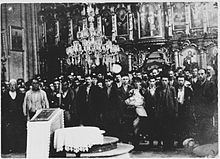


The Roman Catholic Church is accused by many in collaboration with the Croatian radical nationalist movement Ustashe , who ruled the puppet Independent State of Croatia during the Second World War and unleashed the Holocaust and the genocide of the Serbs . Despite the fact that the Vatican de jure did not declare its support for the Ustashes, and a number of Catholic Church leaders were engaged in saving Jews and Serbs from mass killings and extraditions, the Holy See was accused and continues to be accused not only of inaction and unwillingness to save the civilian population from genocide, but also in the secret support of the Ustasha. According to estimates, during the war years, between 197 [5] and 800 thousand people [6] died at the hands of Ustashi according to various estimates.
Background
Croatia from 1527 to 1918 was part of the Habsburg Empire . On its territory there lived a multitude of peoples who professed various religions and spoke different languages. The largest Croatian peoples were the Croats proper, who adhered to the Catholic faith, and the Serbs , mostly Orthodox. [7] The dominant political beliefs in these two ethnic groups also differed - the Croats considered the countries of Western Europe and Austria itself as their advocates, while the Serbs considered the Russian Empire as their patron in foreign policy. The attempt to unite the two peoples in order to create a single Slavic state, free from German and Hungarian influence, began with the birth of the ideology of Illyrism , from which the ideology of Panslavism grew.
By the First World War, Austria approached with serious intra-national contradictions that escalated during the war. After the collapse of Austria-Hungary, most Croats dreamed of creating their own independent state, while the rest of the Croats and all the Serbs dreamed of joining Serbia or creating a single Slavic state in the Balkans. The formation of the Kingdom of Serbs, Croats and Slovenes did not justify the dreams of many Croats, even despite the guaranteed equality of all three peoples mentioned in the name of the new country. The Croatian Party of Rights first fought for the extension of Croatian autonomy and the rights of the Croatian population, and then began to advocate for a full withdrawal from the kingdom. Croatian emigration formed the so-called Croatian Committee , which managed the actions in this direction. However, in 1929, King Alexander I Karageorgievich actually introduced a dictatorship that forbade any movement for autonomy, and renamed the country into Yugoslavia [8] .
In response to the actions of the authorities, a group of Croatian nationalists formed the Ustasha movement, which was led by Ante Pavelic . Italy came to the aid of the new movement, which also had its differences with Yugoslavia. The Ustashi movement is attributed to the murder of Alexander I in 1934 , although the performer was Vlado Chernozemsky , an agent of the MMPO nationalist organization VMRO . After the death of Alexander, Prince Regent Pavel Karageorgievich came to power, who was softer than his predecessor and began to provide all possible assistance to the Croatian population in realizing their rights. The Croatian peasant party , headed by Vlade Machek, was able to achieve an agreement , under which the Croatian banovy was formed, which had wide autonomy [7] .
The agreement not only did not satisfy the Ustasha, but also increased their desire to achieve independence for Croatia: they regarded the agreement as the first step on the way to secession from Yugoslavia. The frustrated entry of Yugoslavia into the “axis” block and the subsequent breakdown of relations with Hitler’s Germany became a signal for the Ustasha: Hitler, who regarded Yugoslavia’s refusal to join the “axis” block as a betrayal, actually gave the Ustish people hope for the realization of their plans. On April 6, 1941, Germany entered the war against Yugoslavia and Greece [9] . In Croatia, the Yugoslav military authorities faced the greatest difficulties with mobilization, since the turnout of the conscripts was very low [10] . Moreover, a number of military commanders and soldiers began to openly side with the occupiers: for example, on April 3, 1941, Croatian Colonel Vladimir Kren flew over to Graz and gave the Germans detailed information about the Yugoslav armed forces, including data on the deployment of secret air bases; before the war, two regiments in Bjelovar , which were formed from local Croatian reservists, raised a riot [10] , blocked Bielovár and demanded the surrender of the garrison, threatening to kill all Serbs and officers family members in the city and its environs. After the capitulation of Yugoslavia , the victorious countries divided it : on the ruins of the kingdom was created the puppet Independent State of Croatia , which included Bosnia and Herzegovina , as well as part of Dalmatia , which they decided not to transfer to Italy [7] . Ante Pavelic became the de facto leader of the state, although the appointed king Tomislav II was to rule them legally. Machek, despite the long-awaited independence of Croatia, decided not to support the pro-Hitler regime. Pavelic became a loyal ally of Hitler [9] . However, the enthusiasm that arose after the declaration of independence came to naught, because the country was under the control of the Germans and Italians. Ustashi, striving to create an ethnically pure state, outlawed Serbs, Jews, Gypsies and in general all nations that did not support the Ustasha regime (some of the representatives of the Croatian people came under attack) [11] .
Roman Catholic Church Activities in the NGH
Creation and recognition
According to the historian Michael Fayer , Croatia’s relations with the Vatican were no less important than relations with Germany. Pavelic was an ardent serfophobe and a zealous Catholic fanatic, considering Catholicism to be an integral part of Croatian culture [12] . However, a number of other historians believe that the Holy See considered Pavelic too ambitious and impatient: the researcher of the Catholic movement Peter Goebleware wrote that Pavelic was looking forward to the blessing from the Vatican for his political activities, which, however, was not expected in the near future. The secretary of the Vatican State Secretariat, Giovanni Montini, the future Pope Paul VI , warned Pavelic that the Holy See could not recognize the state that sets the boundaries by military decision, and also opposed the hasty appointment of the King of Croatia. The candidacy of Duke Spoleto, proposed by the King of Italy, Victor Emmanuel III, was criticized by Montini: the pope, he said, could not communicate with the duke until he was officially crowned; while Montini allowed the Pope to talk with Pavelych [13] .
Relations with the Vatican, according to Fajer, were as important for the Ustashes as were relations with Germany: the support of the Vatican could be the key to increasing support for Croatia in the foreign policy arena [12] . Stepinats, who saw Croatia’s liberation from the “prison”, which he called the Yugoslav state with a large proportion of the Serbian population, was granted an audience with Pius XII [12] , during which he repeatedly mentioned Pavelic. From the transcript of the conversation compiled by Montini, it follows that the Vatican was ready to recognize Croatia only after the end of the war and the conclusion of a peace treaty, and this was not a guarantee, since part of the Catholics could be outraged by such an act, and the opinion of this part should be respected [13] .
Fejer wrote that Pavelic was adopted by the Pope in May 1941, already becoming the ruler of Croatia. At the same time, Pavelic and his Ustashsky lieutenants received a blessing, as it turned out, for “indescribable genocide in their new country” [14] [15] . The Vatican did not formally recognize the new state, but in order not to deceive the Ustashes, he sent his apostolic delegate to Croatia - the Benedictine monk Giuseppe Marcon . Pavelic was quite satisfied with such an act, and Cardinal Stepinats felt that the Vatican had in fact recognized Croatia as independent [12] , but the pope refused to establish diplomatic relations with the Ustashes and met with Pavelic again in 1943 [15] . Later, the world community condemned the negotiations of Pius XII with the Ustashes, and one of the employees of the British Foreign Office even called the pontiff "the greatest moral coward of our time" [16] .
The Vatican, according to the Ustashe, was supposed to help overcome communism and baptize more than 200 thousand Serbs who allegedly renounced the true Catholic faith and turned to Serbian Orthodoxy [12] - according to Aloiziy Stepinats, to the greatest "schizmatics." Stepinats, who welcomed the independence of the country in his letter in April 1941, called from the very beginning to build a Catholic state, for which he endorsed the idea of the forcible baptism of Serbs into Catholicism. Although he often said in his speeches that it was impossible to resolve national issues through bloodshed, he meant only the protection of Jews from particularly radical Ustash activists. The moral side of the treatment of the Croats with the Serbs was not particularly worried by him: he was more concerned that the mentality of already baptized Serbs might not adapt to the new situation and even lead to another schism in the church [17] .
Ideology
The Croats proposed to solve the issue regarding the Serbian Orthodox population in a radical way: one-third to forcibly baptize to Catholicism, another one-third to be expelled from the country, the remaining third to be physically destroyed [18] . The first to declare this was Mile Budak , who advocated an alliance with Muslims in the fight against the Orthodox. His statement “Independent State of Croatia - the state of two religions, Roman Catholic and Islamic”, which first appeared in the newspaper Hrvatski Narod, No. 143 of July 7, 1941, is well known [19] . All magazines and newspapers of Zagreb published a warning on the same day so that all Orthodox Serbs would leave the city within 12 hours, otherwise all those who remained would be killed on the spot [19] .
Minister Milovan аниanić stated that there could be no compromise between Catholics and Orthodox, and from the first days he said that the territory of the National Christian Movement should be completely cleared of the slightest trace of the Serbs. The memory of the fact that the Orthodox people once lived here had to be erased from the minds of people and wiped off the face of the earth. On June 3, 1941, the Novi List newspaper published his speech [19] :
Get tired!
You know, I speak frankly: this country, this country of ours should be Croatian and draw no more. And that's why those who came here, you need to expel.
Over the centuries, and especially the last twenty years, it has become obvious that there can be no compromise. This land should belong to the Croats and to no one else, and there are no methods that we, the Ustashi, cannot use; therefore, we will start building a real Croatia and clean it of Serbs that have threatened us for centuries and could have destroyed us at the first time.
We do not conceal that this is the policy of our state, and when we do that, we will only follow what the Ustash beginnings say.
Participation in Ustash terror
Many Croatian nationalist clerics endorsed intentions to destroy or forcefully batch Serbians, Gypsies, and Jews [20] . Aloysia Stepinats, who initially did not take violent baptism seriously, soon began in his speeches to call for the struggle against the traces of Orthodoxy in Croatia and to approve the murders committed by the Ustashs [21] . The first wave of murders swept in the summer and autumn of 1941, although the concentration camps appeared as early as April 1941. Since June, the country has a law on the establishment of a special network of secret agents who could detect ethnic and religious minorities and report information to the authorities about them [20] .
Ustash crimes against Jews and Serbs differed greatly from the German ways of solving the Jewish and Slavic issues. The Nazis assumed a final solution to the Jewish question by “ rushing to the East ” and getting rid of Jews with the help of Einsatzgruppen ; Ustashi were going to unite the Croats and Muslims, who were to become titular nations in the new state, with the goal of destroying all the Gentiles and foreigners and appropriating all their property. This resulted in a real terror, the like of which was not yet in the Balkans. The Serbs were so frightened that they could only flee to Nedichevo Serbia occupied by the Germans or accept Catholicism. The Ustash government left most of the Catholic clergy in the country to implement the second scenario [17] .
According to Richard Evans, a Holocaust researcher, there were a lot of Franciscans among the guards and leaders in the Jasenovac concentration camp [20] . Faer wrote that many religious leaders directly or indirectly participated in punitive operations and reprisals against believers and foreigners, which is confirmed by the writings of Catholics Corrado Zoli (Italy) and Evelyn Vo (Great Britain) [22] . Franciscan Miroslav Filipovich became the most famous in the list of the notorious Franciscans who collaborated with the Ustashes. He was the commandant of Jasenovac and for his unbearable cruelty he received the nicknames “The Devil from Jasenovac” and “Brother Satan”. According to various sources, from 49.6 to 600 thousand people died in Jasenovac [3] [4] [23] . Evans writes that Filipovic led the execution teams and executioners for three months [24] . The Franciscans in 1942 drove him out of the order for crimes against the civilian population, but he continued to wear monastic clothing and was hanged in it after the war following a Yugoslav court sentence [25] [26] [27] .
Another notorious Catholic priest, famous for his hatred of the Jews, was Ivan Sharic . He held the post of Archbishop of Vrhbosny (Sarajevo) and confiscated all private property belonging to the Jews, using it for his own purposes. He was never convicted of such crimes [28] . Šarić wrote in his articles the following:
There is a limit to love. The movement for the liberation of the world from the Jews is a movement for the renewal of human dignity. The all-knowing and all-powerful Lord is behind this movement [28] .
Among other famous Catholic priests who supported Pavelic's policy were his personal bodyguard, Ivan Guberin, who led the Croatian Catholic movement (a kind of Catholic action in Croatia); the head of the Sarajevo security service, Bojidas Bralo, who initiated the pogroms of the Jews [3] ; The Ustash commissar in Bosnia and Herzegovina, Jura Francetich , who kept order in Bosnia and fought with dissidents [29] . The statements of other clergymen differed brutally: for example, Mate Mugos urged the clergy to put aside a prayer book and take a revolver [3] , and Dionosii Yurichev in the Novi list newspaper wrote that killing a child over seven years old is not a sin [3] . Faer, summing up, wrote that the Ustashsk genocide of the Serbs is no less terrible a crime than the Holocaust , and the position of Catholicism in World War II is ambiguous: if in Poland the Catholics were victims of terror, in Croatia they became its instigators and perpetrators [30] .
In 2000, the International Commission of Experts for the Truth about Jasenovac was formed . На одном из её заседаний в Нью-Йорке велась речь о причастности католического духовенства к преступлениям: было сообщено, что около 1400 католических священников из Хорватии непосредственно были причастны к убийствам, о чём говорил один из членов комиссии — профессор Лондонского университета антрополог . Его заявления были опубликованы в газете «Политика» 3 июля 2002 [31] . Всех жертв усташского террора, погибших от рук католических духовников, епископ Николай (Велимирович) вписал в церковный календарь в день 31 августа как «семьсот тысяч пострадавших за православную веру от рук римских крестоносцев и усташей во время Второй Мировой войны». Он осуждал деяния усташей, говоря, что их жестокостью восхищались бы не только в Риме, но и в аду [31] .
Противники усташского террора
Несмотря на большое количество католических деятелей, призывавших к насилию, были и те, кто не признавал насилие усташей и осуждал его. Архиепископ Загреба Алоизие Степинац , одобривший первоначально независимость и поддержавший политику усташей, вынужден был начать принимать меры по спасению сербов и евреев от полного истребления в стране (так он стал обращать их в католичество) [9] . Павелич даже жаловался Иоахиму фон Риббентропу на то, что Степинац не поддерживал режим усташей, в отличие от обычных священников, поскольку опасался возмущения со стороны Ватикана [13] . Даже самые ревностные католики порой выступали против политики насилия и истребления [28] . Гебблтуэйт писал, что Ватикан пытался усилить позиции Степинаца, который отвергал насильственное крещение и жестокость [13] и выявлял даже в своём окружении сторонников геноцида [32] . Так, с июля по октябрь 1943 года Степинацем был арестован 31 священник, который участвовал в массовых убийствах по всей Хорватии [33] .
Мартин Гилберт писал, что Степинац лично участвовал в спасении группы евреев [34] , однако есть свидетельства, что его инициативу поддерживали и другие. Так, важную роль в спасении евреев от усташей сыграли Алоизие Мишич , епископ Мостарский [28] (в одном из своих писем он возмущался бездействием Степинаца по поводу еврейских и сербских погромов в городе) и Грегорий Рожман , епископ Люблянский, который обращал евреев в католицизм и укрывал их у себя, а при помощи иезуита Пьетро Такки Вентури даже предоставлял им покровительство от итальянских гражданских деятелей [35] .
Посол Германии в Хорватии Зигфрид Каше заподозрил неладное с самого начала существования НГХ и пожаловался Берлину, что итальянцы не стремятся решать еврейский вопрос, поскольку на них слишком давит Ватикан . Ряд апостольских делегатов действительно занимался спасением евреев: делегат Пия XII в Загребе Джузеппе Марконе лично спас около тысячи хорватских евреев, состоявших в смешанных браках [9] ; делегат в Турции Анджело Ронкалли (будущий папа римский Иоанн XXIII ) помог многим евреям выбраться в Палестину и позднее неоднократно говорил, что следовал распоряжениям Пия XII [32] .
« Яд ва-Шем » признал 109 хорватов праведниками мира. Среди них много католических священников и монахов, в числе которых сестра Цецилия (в миру Йозица Юрин), сестра Каритас (в миру Мария Пирович), сестра Амадея Павлович и отец Драгутин Йесич (последний был убит) [36] [37] [38] .
Насильственное крещение
Пока правительство Павелича преследовало сербов, евреев, мусульман и даже фольксдойче-протестантов, католическое духовенство решило исполнить план по окатоличиванию сербов [39] . 14 июля 1941 года Министерство внутренних дел Хорватии дало распоряжение Хорватскому епископату начать пропаганду перехода в католичество, но при этом представители сербской интеллигенции, православные священники, а также богатые купцы и ремесленники лишались права принять католичество: их планировалось истребить, в том числе и тех, кто обратится в католицизм [40] . Хорваты конфисковали земли Сербской православной церкви и сами храмы, переделав их в католические [40] . Степинац, узнав об этом, высказал своё недовольство [9] и в июле 1941 года, по словам Фэйера, пожаловался Павеличу, осудив депортацию евреев и сербов. Позднее он всё-таки поддержал массовое окатоличивание, объяснив это тем, что сербы таким образом могут избежать расправы [3] .
Агенты спецслужб Третьего рейха, изучавшие деятельность католического духовенства, позднее сделали выводы, что церковь в общем и целом смотрела на преступления усташей и их сообщников сквозь пальцы и почти не высказывала свои возражения против насильственного окатоличивания сербов [17] .
Роль католического руководства
Архиепископ Степинац
В 1934 году назначенный на должность архиепископа Загреба Степинац стал самым молодым католическим епископом в мире [3] . Он был освобождён от жёсткого контроля Ватикана, получив полномочия не дать усташскому режиму прийти к власти или подготовить вторжение. Однако и его контроль над местным духовенством не был полным [3] . Историк Холокоста Мартин Гилберт писал, что Степинац уже с самого начала дней войны начал действовать вопреки официальной государственной политике, спася группу евреев в старом доме [9] . Поддержавший усташей Степинац выступал за создание хорватского национального католического государства, поскольку Югославия, не оправдавшая обещаний в равноправии между всеми её народами, превратилась с его точки зрения в тюрьму. Ватикан не разделял энтузиазма Степинаца, не признав новое государство и отправив туда вместо нунция только своего апостольского делегата Джузеппе Марконе. Но даже этого Степинацу хватило, чтобы удостовериться в поддержке Ватикана, ибо тот фактически признавал независимость Хорватии, а Марконе получал все права нунция [12] .
С мая 1941 года в поведении Степинаца стали проявляться антиусташские нотки [28] : пока летом и осенью по стране прокатывалась волна насилия, тот вынужден был отступать от ряда своих убеждений, но порвать с усташами и уйти в сопротивление он не мог [41] . Фэйер писал, что Степинац фактически даровал усташам презумпцию невиновности, а сам решил молчать о своей позиции [41] . В ноябре 1941 года Степинац созвал синод хорватских епископов, который призвал Павелича быть максимально гуманным к евреям в условиях присутствия немецких войск в стране [41] . Ватикан поддержал начинания синода и попросил Марконе молиться о спасении граждан еврейского происхождения [41] , а Пий XII позднее лично благодарил синод за отвагу и решительность, проявленную при помощи нуждающимся [42] .
По словам израильского историка Менахема Шелаха, синод призывал защищать только крещёных евреев, а в отношении православных сербов и оставшихся в иудаизме евреев ничего подобного никто предпринимать не собирался [41] , а Степинац решился выступить открыто против массовых убийств других национальностей только в середине 1943 года. Представитель папского секретариата Доменико Тардини списал прокатившуюся волну насилия на «болезни роста нового режима» в Риме [43] . С другой стороны, американский историк Рональд Рыхляк отмечает, что Степинац, получив указания из Рима, официально осудил жестокие действия правительства ещё раньше, выступив 24 октября 1942 года с официальной речью и заявив:
Все люди и все расы — дети Господа, все без исключения. Те, кто являются цыганами, чернокожими, европейцами или арийцами, имеют одинаковые права… По этой причине Католическая Церковь всегда осуждала и осуждает любую несправедливость и любое насилие, совершённое во имя классовой, расовой или национальной теории. Недопустимо преследовать цыган или евреев из-за убеждений, что они низшая раса [2] .
Associated Press , по словам того же Рыхляка, указывала на Степинаца как критика нацистского марионеточного режима, от рук которого погибли «десятки тысяч сербов, евреев, цыган и хорватов», и раздражителя для Павелича, которому отказали во встрече с понтификом в Риме [2] .
Архиепископа Загреба нацисты и усташи презрительно называли «другом еврейства» ( нем. judenfreundlich ), а сам он даже боролся в своей епархии с призывавшими к геноциду [32] . Майкл Фэйер отмечает, что Степинац впервые выступил против массовых убийств в середине 1942 года, заступившись за цыган и евреев. Через год в Загреб прибыл Генрих Гиммлер , который проверял, как решается «еврейский вопрос», и Алоизие стал угрожать Павеличу: «Католическая Церковь не боится мирской силы, каковой бы та ни была, если необходимо защищать основные права человека». А когда Андрия Артукович приказал депортировать евреев и сербов, апостольский делегат Марконе и архиепископ Степинац стали протестовать против подобного решения. Согласно Фэйеру, Ватикан лично приказал архиепископу любой ценой спасти как можно больше евреев на фоне грядущих депортаций [32] , но даже этого оказалось недостаточно, чтобы серьёзно повлиять на Павелича [44] .
Роль Ватикана
По свидетельствам Майкла Фэйера, Степинац и Ватикан прекрасно знали об убийствах, совершаемых усташами [4] . Журналист Джон Корнуэлл признаёт, что Пий XII знал о зверствах, но не предпринимал никаких усилий с целью прекращения убийств и вместо этого занимался борьбой с окончательным решением еврейского вопроса в Северной Европе [45] . Более того, Пий XII испытывал определённую симпатию к хорватским националистам. В ноябре 1939 года в Риме состоялось паломничество по случаю 50-летия причисления к лику святых хорватского монаха-францисканца Николая Тавелича , на котором Пий XII выразил поддержку действиям усташей как влияющим на ход всей мировой истории. Степинацу он неоднократно повторял слова папы Льва X о том, что Хорватия — оплот христианства, намекая на то, что сербы были не истинными христианами, а вероотступниками, и ожидал от того содействия в установлении «гармоничных» отношения между сербами и хорватами в новом государстве [39] .
Будущий папа римский Павел VI (тогда ещё заместитель государственного секретаря Святого Престола Джованни Монтини) обязался следить за событиями в Хорватии и Польше [42] . Во время ежедневных отчётов в 1941 году он однажды сообщил Пию XII, что слышал о зверствах усташей [42] . В марте 1942 года он обратился к представителю усташей в Ватикане с просьбой объяснить, могли ли подобные бесчинства иметь место, в ответ на что усташ назвал это «ложью и пропагандой». Монтини пообещал внимательно изучать дальнейшую информацию. Доменико Тардини позднее говорил представителю усташей, что Ватикан будет закрывать глаза на преступления против гражданского населения по той причине, что «Хорватия — молодое государство, а молодёжь часто допускает ошибки в своём возрасте, поэтому здесь нет ничего удивительного» [42] .
In April 1942, Stepinats arrived in Rome and received a nine-page compromising document on various ugly actions of Pavelic. The atrocities committed in Croatia in the document were called “anomalies” [4] , about which Pavelic did not know or did not sanction them (the document was kept for some time in a special Archive of the Holy See along with acts of World War II, but was later removed from there) . The Vatican suggested Stepinats not to risk and try to stop Pavelic in an amicable way, until the pope deprived the Croatian leader of his blessing and put the country's independence in jeopardy [4] . According to the testimony of Eugene Tisseran , the future dean of the cardinals collegium , the Vatican knew the names of all the clergy involved in the massacres and evictions of Serbs and Jews, and they had to be punished accordingly to wash off the disgrace of the church [46] . But Pius XII refused to condemn the regime and take measures against the priests who had joined the slaughter, as this could split the Catholic Church in Croatia and even destroy the state itself [47] .
Michael Fayer shows that the Vatican had only superficial knowledge about the genocide of his Polish flock, but they knew absolutely everything about the situation in Croatia thanks to the efforts of Aloysius Stepinac [30] . Secretary of State Luigi Malone instructed Nuncio Marcone as follows: “If your Eminence finds a suitable opportunity, you should give a non-public recommendation so that it does not resemble an official appeal, that restraint should be exercised towards the Jews in Croatian territory. Your Eminence should ensure that [...] the impression of loyal cooperation with civil authorities is constantly maintained " [48] . In this way, the Vatican limited itself to only diplomatic pressure on the Ustasha government and did not try to openly condemn them [35] . However, according to Ronald Ryhlyak, the Vatican did not always and not everywhere: from 1941 to 1944 he sent four official letters and expressed a huge number of protests against the First Slovak Republic . In a letter dated April 7, 1943, Pius XII wrote:
The Holy See has always had a firm hope that the Slovak government, considering also the feelings of its own people, almost exclusively Catholics, will never engage in the forced expulsion of persons belonging to the Jewish race. Therefore, the Holy See learned with great pain about the continuation of such actions on the territory of the republic. This pain is reinforced by various reports that the Slovak government intends to completely expel the Jewish population of Slovakia, sparing neither women nor children. The Holy See would not have been worthy of its divine purpose if it had not condemned these actions, which grossly violate the natural right of people only for the reason that they belong to a particular race.
The next day, the Holy See received a message from its representative in Bulgaria with a request to take measures to protect Jewish citizens who were facing deportation. The secretary of the Jewish Agency for Palestinian Affairs soon met Archbishop Angelo Roncalli (future Pope John XXIII ) to thank the Holy See for the happy outcome of the case against the sons of Israel in Slovakia. In October 1942, the Vatican reported on the painful situation of Croatian Jews in Croatia to its Zagreb representatives and urged them to persuade the NGH government to change their attitude towards the Jewish population. In the notes of the Secretary of State of the Holy See , it is written that by January 1943 the Vatican still managed to temporarily suspend the deportation of Jews from Croatia, but at the same time Germany began to put pressure on him. On March 6, 1943, the Holy See sent another order to its representatives in Zagreb - to continue and continue to provide assistance to the Jews [2] .
Audience Pavelic
John Cornwell writes that on May 18, 1941, Pavelic arrived in Rome to conclude an agreement with Mussolini on granting Italy the right to manage several Croatian cities and districts on the Dalmatian coast [49] . On the same days, Pavelich obtained the right to an audience with Pius XII, which in fact became the recognition of the independence of Croatia by the Holy See, [49] and , moreover, Abbot Giuseppe Marcon was appointed apostolic delegate in Zagreb. Cornwell is not sure whether the Vatican knew the details of the crimes against national minorities committed by the Ustashes by this time, but he was convinced that Rome knew one thing well: Pavelic - the totalitarian dictator, the puppet of Hitler and Mussolini, the author of the cruel fascist and anti-Semitic laws and advocate of Orthodox conversion to Catholicism [49] .
Giuseppe Marcone
In 1941, Pius XII appointed Giuseppe Marcona as apostolic delegate to Croatia [50] , effectively making him a nuncio (without official appointment) [12] . Marcone reported to Rome about the terrible conditions of the treatment of Jews in Croatia, led negotiations with Croatian officials, and he engaged in the export of Jewish children to Turkey [51] . The Vatican through Stepinac and Marcone put pressure on Pavelic to stop the violence [44] . When the deportation of Jews from Croatia began, both demanded an explanation from Andria Artukovich [44] . Martin Gilbert, summing up the activities of Marcone, wrote that thanks to his timely intervention, thousands of Croatian Jews were saved [9] .
Implications
Relations with Yugoslavia
The independent state of Croatia ceased to exist on May 8, 1945, on the day of the surrender of Germany. A new country emerged on the ruins of royal Yugoslavia - the Socialist Federal Republic of Yugoslavia [52] . Only part of the territory was liberated by the Red Army: in Croatia and Slovenia, the Yugoslavs defeated their opponents without the help of Soviet troops [13] . But even in spite of the fact that the partisans were at enmity with the Ustashes, Evelyn Vaught wrote to the British Foreign Ministry and Pius XII at the end of the war that Tito could simply destroy the Catholic faith in the country: 5 million Roman Catholic parishioners were in danger [13] . According to Fayer’s testimony, Tito decided, even before the end of the war, to deal not only with the Ustashes, but also with the Catholic clergy who supported them [53] .
The guerrillas vigorously protested anger on the Catholic clergy, who collaborated with the Ustashes. It is believed that by the hands of the partisans, by February 1945, 14 priests were killed, by March this number had grown to 160, and by the end of the year, 270 representatives of the clergy had been killed [54] . In, who visited socialist Croatia after the war, he wrote that the partisans' task was facilitated by the fact that the Catholic Church was compromised by its tolerant attitude toward the Ustasha pro-Nazi regime or even its active support [54] . In particular, the Franciscans had a hard time: during the war years, 15 monasteries were destroyed [54] . Perhaps for this reason, the Vatican for a long time could not find a common language with the USSR and its allies under the Warsaw Pact [55] . But Pius XII managed to overcome some of the differences with Yugoslavia: the sending of the American bishop Joseph Patrick Hurley was the first step to the establishment of diplomatic relations [54] . Tito demanded to withdraw Stepinats, convicted of his crimes, to Rome, but the pope suggested Stepinats to choose his own fate personally, and he decided to stay at home [56] .
Rat trails
A number of Nazi leaders escaped from court, having fled to Western Europe and joined the anti-communist movement in exchange for the silence of Nazi activities. The United States called similar routes by which the Nazis fled from the court, "rat paths." In Rome, the help of the Croats was provided by the Austrian Alois Gudal and the Pontifical Croatian College of St. Jerome, which was led by Krunoslav Draganovic [13] . According to Fajer, Ustashe leaders and priests who supported them, led by Bishop Ivan Saric, fled Croatia with looted gold and hid in Rome [57] . But the location of Pavelic could not even establish intelligence [58] . Counterintelligence Corps agent William Gowan, the son of US representative at the Vatican, Franklin Gowan, personally looked for Pavelic, but the Holy See did not like this kind of US activity, and eventually Gowen was forced to leave the Vatican territory [59] .
According to Fayer, Pius XII hid Pavelic for some time, giving him asylum in 1946, and even facilitated his flight to South America. During this time, Pius XII and Ante Pavelic agreed on the beginning of a single struggle against socialist Yugoslavia and the desire to create a purely Catholic state in the Balkans [60] . Pavelic already arrived in Argentina in 1948 [60] : agents of the US, Soviet Union, Yugoslavia and Italy intelligence agencies hunted his head, but the Vatican banned any intelligence activities on its territory [14] . As Fayer believed, the Vatican feared that Tito would put an end to the influence of the Roman Catholic Church in Yugoslavia [58] . Goebbltuate writes that Pavelic got to Rome in 1948 from the monastery in Salzburg with the help of Draganovic, who was not stopped by any laws, and lived under the name of “Father Gomez” at Pia's Latin American College, until at the invitation of Juan Peron he moved to Argentina [13] . Despite the fact that Ante Pavelic did not appear before the court, Serbian emigration continued to hunt him: Blagoe Jovovich , a Serbian chetnik, on April 10, 1957, attempted to assassinate him by shooting twice. Pavelic survived, but received two serious injuries that undermined his health. Spain became his last refuge, where Pavelic died on December 28, 1959 shortly before the operation: the health of the former dictator was undermined by diabetes and those two wounds [60] .
Dozens of Croats, including war criminals, were hiding in the Pontifical College in Rome [58] . Since the spring of 1947, the Vatican has increased pressure on the US and the UK to prevent the extradition of Ustash criminals to Yugoslavia [61] . Special Agent Gowen warned that Pavelic, who hated Orthodoxy and Communism, had secured such connections that his arrest could be a shock to the entire Catholic world and cause mass protests [62] . But basically, the Vatican was not embarrassed by the fact that Pavelic was using “rat paths”, but by the possible publicity of the facts that were unpleasant for the church at his trial, which in the end did not take place [63] . Pius XII himself did not believe in a fair trial of Pavelic and his accomplices in Yugoslavia [64] . At that time, there were a lot of religious figures among the war criminals: in addition to Aloizie Stepinats, the president of the puppet Slovakia Josef Tiso (he was hanged), Hungarian Primate Jozhef Mindszenty (who, however, opposed the Nazis) and members of the Jewish Aid Council of Poland went to court. Jogging " [13] [65] . Rome began to regard the Tito regime as a threat to its parishioners in Croatia, who could be convicted on false accusations of collaborationism [13] .
Trials
The Rozhman Case
Gregorius Rojman became the first Catholic bishop convicted of collaborationism. In August 1946, he was convicted in absentia by the military tribunal of Yugoslavia: Rozhman himself fled to the United States, where he lived the rest of his life, and did not appear before the court, and in 2007 the Supreme Court of Slovenia acquitted Rozhman in all articles [66] . The British offered to arrest and extradite him to the Yugoslavs as collaborating with the Ustashes [56] , which did not happen. However, after Rozhman, Stepinats also fell into the hands of justice [56] .
The Stepinac case
Aloysia Stepinats appeared before the Yugoslav court on September 26, 1946 . Goebbltuate called the court a play with a predetermined sentence that had nothing to do with justice [13] . Time magazine in October 1946 described the court hearing as follows:
In the Zagreb gym, beautifully lit for photographers and 500 spectators, the indicative trial of Archbishop Aloisiy Stepinats and twelve Catholic priests ended. The 48-year-old head of the fifth-largest Catholic diocese in the world accused by Marshal Tito of committing crimes against humanity ... temporarily lost his composure. He angrily pointed his finger at the court and shouted: "The church in Yugoslavia is not only deprived of freedom - the church will soon be destroyed."
Original Text (Eng.)In the Zagreb sports auditorium, there has been a series of twelve Catholic priests. The temporarily lost his equanimity. It is not true that it will be the case. [67] .
Stepinats were charged with the support of the Ustash government, calls for violently polishing the Orthodox Serbs and fighting the partisan movement [56] . He refused the services of a lawyer, admitted his guilt and was sentenced to 16 years in prison [13] . Fajer believes that Stepinats could have been commuted if he had been able to prove that he didn’t support violent bailiffs, but he could not justify himself on the rest of the points [68] . In defense of Stepinac, Gebblethwaite wrote that the independence of Croatia was guaranteed by the Atlantic Charter , according to which all nations have the right to exist [13] . Ronald Ryhlyak He called the court a farce that was aimed at denigrating the Catholic Church and proving its unconditional support for Nazism, and expressed regret that the anti-Catholic propaganda of Yugoslavia was accepted by many in the world on faith. On October 13, 1946, the head of the US Jewish community, Louis Brayer, defended Stepinac, saying:
This great leader of the Church was accused of being a Nazi collaborator. We Jews deny it. He is one of the few who rebelled in Europe against Nazi tyranny at the most dangerous moment. He openly and without fear opposed racial laws. After His Holiness Pius XII, he was the greatest defender of oppressed Jews in Europe.
Original Text (Eng.)It has been accused of being a Nazi collaborator. We, the Jews, deny it. It was at the moment when it was most dangerous. He spoke openly and fearlessly against the racial laws. He was the greatest defender of Jews in Europe [2] .
Archbishop Stepinats spent 5 years in Lepoglava Prison until his conditions of detention were replaced with house arrest. Pope Pius XII introduced Stepinac to the College of Cardinals in 1952 [69] [70] [56] . Phayer, calling the trial of Stepinats revealing, nevertheless, does not deny his support of the Ustasha regime [68] and believes that if Stepinats dared to say something in response to the accusations, his defense would collapse overnight and allow the truth to be revealed on the support of the Vatican criminal Pavelich [71] . Moreover, Stepinats allowed to keep documents from the time of the Ustash regime in his episcopal residence, including those that contained information about the Ustash’s rise to power and evidence of their war crimes [68] .
In 1953, Stepinats returned home to the village of Krasic, where he spent the last 7 years of his life under house arrest and died. In 1998, John Paul II beatified him, which caused mass protests among Orthodox Serbs.
Filipovich case
In 1946, the Franciscan Miroslav Filipovic , who was the commandant of the concentration camps Jasenovac and Stara Gradiška, appeared before the court. Filipovic was accused of mass murder of Serbs and Jews: at least 40 thousand people (mostly women, children and old people) were killed by him or by his order from 1942 to 1943 [32] , and at least 20 thousand were killed by Jews nationalities [3] . All murders were committed with extreme cruelty. Filipovic admitted his guilt, and the court sentenced him to hanging.
Gold is Ustaše
In the Pontifical College, the Ustashi hid huge reserves of gold, which later fell into the ownership of the Institute of Religious Affairs (Vatican Bank) [72] [15] . But compared to the Nazi gold, the stocks of Ustash gold (worth hundreds of thousands of US dollars) were very small. Faer believes that the Vatican was well aware and understandable whereabouts of gold [72] .
The survivors of Ustash terror and their descendants living in California tried to get gold back through the court by filing a lawsuit against the Vatican with the help of the US judicial system [72] . Банк Ватикана обвинялся в отмывании денег и сокрытии усташского золотого запаса, а также создании депозитов в Европе, Северной и Южной Америке и финансировании хорватской усташской миграции [73] . В качестве основного доказательства истцы представили выдержку из так называемой «депеши Бигелоу» (отправленной Эмерсоном Бигелоу Гарольду Глэссеру, директору исследовательского отдела министерства финансов США 16 октября 1948 года [73] . Ещё одним свидетельством стало сообщением агента УСС Уильяма Гоуэна о том, что полковник Иван Бабич вывез из Швейцарии в Понтификальный колледж 10 грузовиков с золотом [74] . Несмотря на все старания, истцы проиграли дело.
See also
- Magnum Crimen
- Клерикальный фашизм
- Сербская православная церковь во Второй мировой войне
Notes
- ↑ Ronald J. Rychlak. Article . First Things. Дата обращения 15 мая 2013. Архивировано 9 июня 2011 года.
- ↑ 1 2 3 4 5 Goldhagen v. Pius XII (2007). Архивировано 9 июня 2011 года.
- ↑ 1 2 3 4 5 6 7 8 9 Phayer, 2000 , p. 34
- ↑ 1 2 3 4 5 Phayer, 2000 , p. 38
- ↑ Žerjavić, Vladimir. Yugoslavia - Manipulations with the number of Second World War victims. — Croatian Information Centre., 1993. — ISBN 0-919817-32-7 . (eng.)
- ↑ Мане М. Пешут. Крајина у рату 1941-1945. — Београд, 1995. — С. 51.
- ↑ 1 2 3 Статья о Хорватии в Encyclopaedia Britannica (англ.)
- ↑ Беляков, 2009 , с. 106
- ↑ 1 2 3 4 5 6 7 Martin Gilbert, The Holocaust: The Jewish Tragedy ; Collins: London (1986), p. 147
- ↑ 1 2 Югославия в XX веке, 2011 , с. 355.
- ↑ Croatia : History: World War II . Britannica.com. The appeal date is April 6, 2016.
- ↑ 1 2 3 4 5 6 7 Phayer, 2000 , p. 32.
- ↑ 1 2 3 4 5 6 7 8 9 10 11 12 13 Peter Hebblethwaite ; Paul VI, the First Modern Pope ; Harper Collins Religious; 1993; pp. 153—157, 210—211
- ↑ 1 2 Phayer, 2008 , p. 221.
- ↑ 1 2 3 Phayer, 2008 , p. 219.
- ↑ Mark Aarons and John Loftus, Unholy Trinity pgs. 71-72
- ↑ 1 2 3 Др Срђа Трифковић, 25 ноября 2001 Усташки покољи и америчка јавност . Лист «Слобода»
- ↑ Институт всеобщей истории РАН . «Новая и новейшая история» — М. : Издательство «Наука» — 2006. — Вып. 4-5. — С. 211.
- ↑ 1 2 3 Velibor V. Džomić: Ustaški zločini nad srbskim sveštenicima. Položaj i stradanje srbskog naroda i Srbske pravoslavne crkve u Nezavisnoj državi Hrvatskoj
- ↑ 1 2 3 Evans, 2009 , p. 158—159.
- ↑ Evans, 2009 , p. 159—160.
- ↑ Phayer, 2000 , p. 34—35.
- ↑ Yad Vashem website ; accessed 27 February 2014.
- ↑ State Commission investigation of crimes of the occupiers and their collaborators in Croatia (1946), entitled Crimes in the Jasenovac Camp , p. 62 (Zagreb)
- ↑ Evans, 2009 , p. 160
- ↑ Katolička crkva i Nezavisna Država Hrvatska 1941—1945 by Jure Krišto, Zagreb (1998), p. 223
- ↑ Phayer, 2008 , p. 237.
- ↑ 1 2 3 4 5 Phayer, 2000 , p. 35
- ↑ War and Revolution in Yugoslavia, 1941—1945: Occupation and Collaboration by Jozo Tomasevich, p. 490, Stanford University Press (2001); ISBN 0-8047-3615-4 , ISBN 978-0-8047-3615-2
- ↑ 1 2 Phayer, 2000 , p. thirty.
- ↑ 1 2 Десанка Крстић, март , 2003 . Фамозна посета Ватикану . Православље
- ↑ 1 2 3 4 5 Phayer, 2000 , p. 86
- ↑ Phayer, 2000 , p. 47
- ↑ Martin Gilbert; The Righteous — The Unsung Heroes of the Holocaust , Doubleday (2002), pp. 203, 466; ISBN 0385 60100X .
- ↑ 1 2 Phayer, 2000 , p. 39
- ↑ Croatian Righteous among the Nations , yadvashem.org; accessed 17 June 2014.
- ↑ Mordecai Paldiel, Churches and the Holocaust—Unholy Teaching, Good Samaritans and Reconciliation ; Ktav Publishing House; 2006.
- ↑ Croatian Righteous Among the Nations info Архивировано 19 октября 2013 года. , dalje.com; accessed 26 February 2014.
- ↑ 1 2 Cornwell, 1999 , p. 250
- ↑ 1 2 Cornwell, 1999 , p. 250—251.
- ↑ 1 2 3 4 5 Phayer, 2000 , p. 36
- ↑ 1 2 3 4 Phayer, 2000 , p. 37.
- ↑ Encyclopedia of the Holocaust , vol 1, p. 328.
- ↑ 1 2 3 Phayer, 2000 , p. 85.
- ↑ Cornwell, 1999 , p. 249.
- ↑ Phayer, 2008 , p. 225.
- ↑ Phayer, 2008 , p. 9—16.
- ↑ Phayer, 2000 , p. 36—37.
- ↑ 1 2 3 Cornwell, 1999 , p. 252.
- ↑ The papers of Apostolic Visitor, Giuseppe Ramiro Marcone reveal the Holy See's commitment to helping Jews persecuted by Nazis (англ.)
- ↑ Papers of Apostolic Visitor Giuseppe Ramiro Marcone , www.news.va; accessed 27 February 2014.
- ↑ Encyclopaedia Britannica Online — Josip Broz Tito ; retrieved 7 September 2013
- ↑ Phayer, 2008 , p. 135.
- ↑ 1 2 3 4 Phayer, 2008 , p. 148.
- ↑ Phayer, 2008 , p. 136.
- ↑ 1 2 3 4 5 Phayer, 2008 , p. 150
- ↑ Phayer, 2000 , p. 40
- ↑ 1 2 3 Phayer, 2008 , p. 222.
- ↑ Phayer, 2008 , p. 222—223.
- ↑ 1 2 3 Phayer, 2008 , p. 220
- ↑ Phayer, 2008 , p. 227.
- ↑ Phayer, 2008 , p. 228.
- ↑ Phayer, 2008 , p. 228—229.
- ↑ Phayer, 2008 , p. 226.
- ↑ Norman Davies; Rising '44: the Battle for Warsaw; Vikiing; 2003; pp. 566-68
- ↑ Sodba proti Rožmanu razveljavljena: Prvi interaktivni multimedijski portal, MMC RTV Slovenija . Rtvslo.si. Дата обращения 15 мая 2013.
- ↑ YUGOSLAVIA: "Aid for the Archbishop" ; Time Magazine ; 14 October 1946.
- ↑ 1 2 3 Phayer, 2008 , p. 151.
- ↑ Phayer, 2008 , p. 10—15.
- ↑ Phayer, 2008 , p. 147.
- ↑ Phayer, 2008 , p. 152.
- ↑ 1 2 3 Phayer, 2008 , p. 208.
- ↑ 1 2 Phayer, 2008 , p. 209.
- ↑ Phayer, 2008 , p. 210.
Literature
- Беляков, Сергей. Усташи: между фашизмом и этническим национализмом. — Екатеринбург: Гуманитарный университет, 2009. — 320 с. — ISBN 5774101153 .
- Югославия в XX веке: очерки политической истории / К. В. Никифоров (отв. ред.), А. И. Филимонова, А. Л. Шемякин и др. — М. : Индрик, 2011. — 888 с. — ISBN 9785916741216 .
- Cornwell, John. Hitler's Pope: The Secret History of Pius XII. — Viking, 1999. — ISBN 0670876208 .
- Evans, Richard J. The Third Reich at War. — New York: Penguin Press, 2009.
- Falconi, Carlo; Wall, Bernard. The Silence of Pius XII. — Boston: Little, Brown, and Company, 1970.
- Phayer, Michael. The Catholic Church and the Holocaust, 1930–1965. — Indianapolis: Indiana University Press, 2000. — ISBN 0253337259 .
- Phayer, Michael. Pius XII, The Holocaust, and the Cold War. — Indianapolis: Indiana University Press, 2008. — ISBN 9780253349309 .