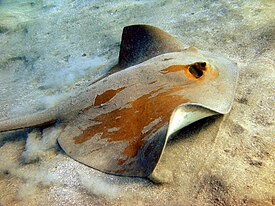
The wide - tailed stingray [1] ( lat. Pastinachus sephen ) is a species of the genus Pastinachus from the family of the caudate - tailed squad of the caudate - shaped superorder of rays . These fish are widespread in the Indian Ocean and in the western Pacific . They are found at a depth of 60 m, swim in brackish waters . The maximum recorded disk width is 183 cm. Their pectoral fins fuse with the head, forming a diamond-shaped disk, the width of which exceeds the length. Snout slightly elongated and pointed. On a rather long caudal stalk there is a wide ventral skin keel, which flutters like a flag during movement. Coloring of the dorsal surface of the disc of an even gray-brown color. On the back, from the area between the eyes to the base of the tail, there is a wide strip of sharp scales, the edges of the disc are bare.
| Wide-tailed stingray |
|---|
 |
|
| No rank : | Bilateral symmetrical |
| View: | Wide-tailed stingray |
|
|
Pastinachus sephen ( Forsskål , 1775) |
|
- Dasybatus gruveli Chabanaud, 1923
- Raja sancur Hamilton, 1822
- Raja sephen Forsskål, 1775
- Taeniura atra Macleay, 1883
- Trigon forskalii Rüppell, 1829
|
|
Not enough data IUCN Data Deficient : 70682503 |
|
Like other tail-tailed broad-tailed stingrays, they reproduce by egg-production . Embryos develop in the womb, feeding on the yolk and histotroph . The diet of these stingrays consists of bony fish , crustaceans , polychaetes and other marine invertebrates. These skates are the target fishing target. They make shagreen leather from their skins. Due to the poisonous spike on the tail are considered potentially dangerous to humans [2] [3] .
For the first time, a new species was scientifically described in 1775 [4] . The species epithet comes from the Arabic name for shagreen leather [5] . An individual from the Red Sea , whose endemic was originally considered a new species, was designated a holotype . In fact, stingrays living in the rest of the Indo-Pacific region may belong to a complex of species . Recent molecular studies have confirmed the existence of two different forms that inhabit the waters of Southeast Asia , which differ in the thickness of the tail and the size at which puberty is achieved [3] .
When moving, the ventral skin fold flutters like a flag
The wide-tailed stingray is widespread in the tropical waters of the Indian and Pacific Ocean from South Africa and the Red Sea, to Japan and Australia , including Melanesia and Micronesia . These slopes are found in coastal lagoons and around coral reefs from the surf zone to a depth of 60 m [6] . Sometimes they swim in estuaries and even rise upstream. There is evidence of the capture of this species in the Ganges River at a distance of 2200 km from the sea [7] [8] . Like most stingrays, they lead a bottom lifestyle [3] [9] .
The thick pectoral fins of these stingrays fuse with the head, forming a diamond-shaped flat disk, the width of which is 1.1-1.3 times the length, the edges of the fins (“wings”) are rounded. The anterior margin is almost straight, the snout is blunt and rounded. Behind small, wide-set eyes, there are splashes . On the ventral surface of the disk there are 5 pairs of gill slits, mouth and nostrils. Between the nostrils lies a flap of skin with a fringed lower edge. The mouth is small, and at the bottom of the oral cavity there are 5 processes. Each jaw has 20 dentitions. The teeth are in the form of hexagons and end with a tip. The whip-like tail , thinning to the tip. On the dorsal surface, next to the rather thick base of the caudal stem and far behind the ventral fins, there is a spike connected by a duct with a poisonous gland. Behind the spine on the caudal peduncle there is a ventral skin fold not reaching the tip, the height of which is 2-3 times greater than the tail [2] [6] [10] .
The skin as a whole is devoid of scales, with the exception of a wide range of scales, stretching along the spine from the tip of the snout to the base of the tail, excluding the edges of the disc. The skin of newborn stingrays is bare, scales appear shortly after birth. In young animals, 4 round plaques are located in the center of the disc, which in adults are sometimes indistinguishable. Coloring of the dorsal surface of the disc of an even gray-brown color. The skin fold and tip of the tail are black. The ventral surface of the disc is white. The ventral caudal skin fold is light gray in color. The maximum recorded disk width is 183 cm, although on average it does not exceed 65 cm [6] [2] . In Southeast Asia, 2 different morphs of this species live: with a thick and thin ventral fold. The maximum body length of slopes with a thick fold reaches 325 cm with a disc width of 149 cm [3] .
These slopes often rest on a sandy bottom.
The basis of the diet of these stingrays is composed of bony fish, such as silver-bellied , nitepera and marine , crustaceans, polychaetes, sipunculides and mollusks [11] . In turn, Pastinachus sephen can become the prey of hammerhead and gray sharks , as well as bottlenose dolphins . In case of threat, these slopes try to move away from the predator at an angle of 45 °, which allows them, while maintaining the maximum speed, not to lose sight of them [12] .
Dendromonocotyle ardea , Decacotyle tetrakordyle and Pterobdella amara parasitize on Pastinachus sephen [13] [14] [15] . Adults are often accompanied by remors and stavridovye [2] .
Like other tail-tailed broad-tailed stingray, it belongs to ovoviviparous fish. Embryos develop in the womb, feeding on the yolk and histotroph . There is probably no more than 1 newborn in the litter with a disk about 18 cm wide. Males and females reach puberty with a disk width of 98-100 and 100 cm, respectively [3] . In the Strait of Molucca , single young stingrays Pastinachus sephen are found all year round, they differ from mature ones with a more pointed snout [16] .
Observations made in Shark Bay , Australia, showed that a broad-tailed stingray swims in sandy shallows during high tide and remains there for at least 4 hours. Often they rest in muddy water in small groups. The number of groups, as a rule, does not exceed three individuals and rarely reaches nine. Stingrays are going to the "outlet", putting their tails out. Probably, in this way they protect themselves from predators, since they are able to detect their approach from any direction. They substitute for the potential threat the least vulnerable part of their body - the tail, which is also equipped with mechanical receptors. Group members flee collectively, which makes each ramp less vulnerable [12] . Sometimes wide-tailed stingrays form mixed clusters together with ringed stingrays , taking advantage of the advantage that the long tail provides the latter [17] .
The poisonous serrated spike makes the wide-tailed stingray potentially dangerous to humans. If you grab a stingray by the front edge of the disk, it is able to bend its tail like a scorpion and inflict an injection [18] . In small quantities, they are caught as by- catch in commercial fishing using trawls . The meat is used as food; shagreen leather is produced from dressed skin [6] . The fashion that arose in the 90s of the last century for products from this material, from which purses, pens, etc. were made, led to the mass fishing of stingrays in Southeast Asia. Slow reproduction makes them very sensitive to overfishing. There is insufficient data to evaluate the conservation status of the species by the International Union for Conservation of Nature [3] .
