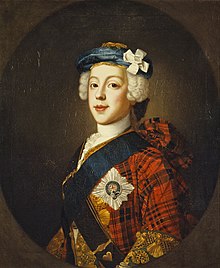
Jacobites ( eng. Jacobites ) - adherents of the English king Jacob II and his descendants expelled in 1688 by the Glorious Revolution , supporters of the restoration of the house of the Stuarts on the English throne.
Content
Political struggle
Prerequisites
After the Glorious Revolution of 1688, Jacob II fled with his newborn son, Prince of Wales, James Francis Edouard , to France. The parliament proclaimed his Protestant daughter Maria II and her son-in-law (at the same time nephew) William III of Orange , who was the king of the Netherlands, proclaimed kings as co-rulers. After their childless death (1694, 1702), the youngest daughter of Jacob, also Protestant Queen Anne, inherited the throne. Even during the life of Wilhelm III in 1701, the dispensation act in force was passed, according to which Catholics were excluded from the English succession, and after Anna the descendants of Jacob I's granddaughter Sophia of Hanover were to inherit the crown. With the death of Anne in 1714, the son of Sophia, Elector of Brunswick-Lüneburgskiy Georg I , founder of the Hanover House, took the British throne.
Emigration
Many of the followers of Jacob II followed him to France , where they founded the names MacDonald , Berich , Dillon , McMagon and others. The descendants of the Jacobites are the marshals of France, Jacques MacDonald and Patrice de MacMahon (MacMahon was also the president of France).
Motion Base
It was incomparably more dangerous for the new English dynasty to be Jacobites who remained in their homeland. To them belonged many Tories of England and Scotland and almost all the nobility of highland Scotland . They mainly opposed the merger of Scotland with England, which took place only in 1707 . In the highlands of Scotland and Ireland, the Jacobite movement acquired the character of a national struggle for independence.
For some time the Jacobites were supported by the Roman Catholic Church (until the death of the “old challenger” in 1766), France (until the Peace of Utrecht in 1713 and then the death of Louis XIV in 1715) and a number of other Catholic countries, including Spain ; this external support, however, played a limited role in the struggle of the Jacobites. Within Britain itself (except for Ireland and some parts of the highlands of Scotland), Catholics constituted an insignificant minority and could not serve as a serious basis for the movement.
Military clashes
Jacobite was an important political map during the War of the Spanish Succession . Supporters of the Protestant kings ( legalists ) put forward the slogan: “Against the Pope, the Devil and the Pretender” ( eng. Against the Pope, the Devil and the Pretender ).
Twice ( in 1715 And in 1745 ), the Jacobites attempted an open uprising, the basis of which both served as a mountainous Scotland, but without success.
Decline of Jacobitism
After the uprising of 1745, the British authorities carried out serious repressions in Scotland, adopted laws on the disarmament of all Scottish clans, and also on banning civilians of clan tartans , kilts and other traditional clothing for seven-year imprisonment for a repeat of seven years in exile. The traditional structure of the highland society of Scotland over the next several generations was substantially destroyed.
Under George III , the Jacobite party no longer had any serious threat. After the death of the “Old Challenger” by James Francis Stewart (1766), the Vatican recognized the Hanover dynasty to be the legitimate kings of Great Britain as the legitimate kings. In 1788, after the death of his son, the leader of the 1745 uprising " Handsome Charlie ", the Scottish Catholic minority also recognized the central authority and from 1790 began to pray for King George by name. In 1782, the ban on traditional clothing was lifted.
Jacobite Legacy
Jacobite ideals have been preserved in Scottish literature and folklore, repeatedly mentioned by Robert Burns ( injective “Jacobites in words”). The connection of the Jacobite movement with the latest battles of the Scottish mountain clans contributes to the romantic halo around it and in our days.
In 1819, a collection of Jacobite songs , compiled by James Hogg , was published. Many songs from the compilation gained popularity among Scottish folk singers in the 60s of the 20th century, for example, the song Cam Ye O'er Frae France , making fun of George I.
Jacobite Challengers
Jacobite contenders for the English and Scottish thrones were:
- Jacob II (to death in 1701 ).
- The “old challenger” (James, Prince of Wales, son of Jacob II, who lived in France under the name of Chevalier de Saint George), from 1701 to 1766 , claimed the English throne as Jacob III and as Scottish as Jacob VIII.
- "Young Challenger" (Charles Edouard, the eldest son of the previous one, known as "Handsome Prince Charlie" English Bonnie Princie Charlie ), from 1766 to 1788 claimed the throne as Charles III. Headed the Scottish uprising in 1745, acting as a " Prince of Wales " on behalf of his father.
- Heinrich Benedict Stewart , the younger brother of the previous one. The Cardinal of the Roman Catholic Church , Bishop of Ostia, in recent years, the dean of the College of Cardinals, spent his whole life in Italy. Among adherents enjoyed the title " Duke of York ." After the death of his brother, he became a contender for the English throne as Henry IX, and as Scottish as Henry I.
Jacobite succession after 1807
With the death of Cardinal Henry ( 1807 ), House of Stuart cut short in the men's knee, and leadership in the Jacobite party formally transferred, through the female line, in series in a Sardinian ( House of Savoy ), Modena ( Habsburg ) and Bavaria ( House of Wittelsbach ) home (and then will go to the genus Princes of Liechtenstein ). However, the Catholic representatives of these houses have never made any claims to the English or Scottish thrones, although small groups of ideological heirs of the Jacobites in Scotland still worship them as their kings and princes.
Jacobite succession after 1807 (no real complaints were made):
- Karl Emmanuel IV (1751–1819), a former king of Sardinia (renounced in 1802), from the Savoy dynasty, a descendant of Charles I’s daughter Henriette Anna Stewart . "Charles IV, King of England and Scotland" (1807-1819).
- Victor Emmanuel I (1759–1824), King of Sardinia (otrёksya in 1821), from the Savoy dynasty, the brother of the previous one. "Victor I, King of England and Scotland" (1819-1824).
- Maria Beatrice of Savoy (1792-1840), in marriage the duchess of Modena, the daughter of the previous one. "Mary III, Queen of England, and Mary II, Queen of Scotland" [1] (1824-1840).
- Francesco V d'Este (1819-1875), Duke of Modena (since 1846, overthrown in 1859), from the Hapsburg-Este dynasty, the son of the previous one. "Francis I, King of England and Scotland" (1840-1875).
- Maria Theresa of Habsburg Este (1849-1919), married the princess and then the queen of Bavaria (wife of Ludwig III ), the niece of the previous one. "Mary IV, Queen of England, and Mary III, Queen of Scotland" (1875-1919).
- Ruprecht of Bavaria (1869–1955), the son of the previous one. "Robert I, King of England, and Robert IV, King of Scotland" (1919-1955).
- Albrecht (Prince of Bavaria) (1905-1996), son of the previous one. "Albert I, King of England and Scotland" (1955-1996).
- Franz, Duke of Bavaria (born 1933), son of the previous one. "Francis II, King of England and Scotland" (since 1996).
Duke Franz is single. The "heir" of the English and Scottish crowns, according to the part of the Jacobites, is his younger brother Prince Max (born 1937), then (since Max has no sons) - his daughter Sophia (born 1967), the wife of the Crown Prince of Liechtenstein Alois , and then - their son Joseph Wenzel (born in 1995 in London; the first Jacobite challenger, born in Britain since 1688).
Alternative line
In 1812, "Mary III, Queen of England, and Mary II, Queen of Scotland" married her uncle Francesco IV d'Este - that is, entered into a marriage that did not conform to the customs of either England or Scotland. As a result, neither she nor her descendants, according to another part of the Jacobites, can be considered as candidates for either of the British thrones.
In this case, after the death of "Victor I", the Jacobite succession is as follows:
- Maria Teresa of Savoy (1803–1879) , in marriage the Duchess of Parma, daughter of “Victor I”. “Mary III, Queen of England, and Mary II, Queen of Scotland” (1824–1879).
- Robert I (Duke of Parma) (1848-1907), the last ruling Duke of Parma and Piacenza (1854-1806), grandson of the previous one. "Robert I, King of England, and Robert IV, King of Scotland" (1879-1907).
- Enrico Bourbon-Parma (1873–1939), the titular duke of Parma and Piacenza, son of the former. "Henry X, King of England, and Henry II, King of Scotland" (1907–39).
- Giuseppe Bourbon-Parma (1875-1950), the titular duke of Parma and Piacenza, the brother of the previous one. "Joseph I, King of England and Scotland" (1939-50).
- Elia Bourbon-Parma (1880–1959), titular duke of Parma and Piacenza, brother of the previous one. "Elia I, King of England and Scotland" (1950–59).
- Roberto Bourbon-Parma (1909–1974), the titular duke of Parma and Piacenza, son of the former. "Robert II, King of England, and Robert V, King of Scotland" (1959-1974).
- Elizaveta Bourbon-Parma (1904–1983), Princess of Parma and Piacenza. "Elizabeth I, Queen of England and Scotland" [2] (1974-1983).
- Maria Francesca Bourbon-Parma (1906-1994), Princess of Parma and Piacenza. "Mary IV, Queen of England, and Mary III, Queen of Scotland" (1983-1994).
- Alice of Bourbon-Parma (1917–2017), in marriage - the titular queen of the Two Sicilies. "Alice I, Queen of England and Scotland" (since 1994).
- Carlos , son of Alice (1938–2015), “Charles, Prince of Wales”),
- The line of "heirs" of Carlos:
- his son Pedro (born 1968), Duke of Calabria, Count di Caserta, head of the royal house of the Two Sicilies, one of the claimants for the crown of the Two Sicilies, "Prince Peter."
- the son of the latter, Juan (born 2003), "Prince John") [3] .
- his son Pedro (born 1968), Duke of Calabria, Count di Caserta, head of the royal house of the Two Sicilies, one of the claimants for the crown of the Two Sicilies, "Prince Peter."
However, since the marriage of Mary III and Francesco IV received the blessing of the Pope, the alternative line claims to the thrones of England and Scotland are rather weak.
See also
- War of two kings
- Second jacobit rebellion
- War of the Austrian Succession
Notes
- ↑ The Jacobites consider the Scottish queen Maria Stewart also the queen of England (under the name of Mary II) and do not recognize the reign of the daughter of James II Mary either in England or in Scotland.
- ↑ The Jacobites do not recognize the reign of Queen Elizabeth of England, since the marriage of her parents was declared invalid and she was illegitimate.
- ↑ His older brother Jaime (born 1993; “Prince Jacob” or “Prince James”) is excluded from the throne because of his premarital birth.
Literature
- "Culloden papers" (L., 1815 );
- Hogg, "Jacobite relics" (Edinb., 1819 );
- Chambers, "Jacobite memoirs" (Edinb., 1834 );
- Jesse, "Memoirs of the Pretenders and their adherents" (L., 1845 ; next ed., 1856 );
- Doran, "London in Jacobite times" (L., 1877 - 1879 ).