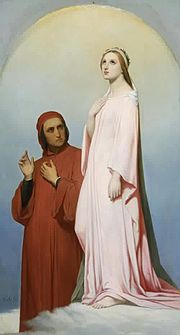
Eternal femininity , eternally feminine ( German: Ewig-Weibliche ) - the image used by IV Goethe in the final lines of the second part of “ Faust ”, meaning “transcendental power, lovingly lifting a person into the realm of eternal creative life” [1] . After Goethe, the image was also used by other philosophers, poets and writers, becoming a universal symbol of the highest principle of femininity [2] . At the beginning of the 20th century, the idea of eternal femininity was very common in the intellectual environment of the Silver Age , connecting with the image of Sofia [2] [3] .
Content
Goethe's Faust
The image of eternal femininity became popular after its use by Johann Goethe in the second part of “Faust”: “Das ewig weibliche zieht uns hinan” - “Eternally feminine attracts us up” [4] (or “Eternal femininity attracts us up” [1] ):
Alles vergängliche |
The same lines in the translation of Boris Pasternak [5] :
All fleeting - |
According to Germanist H. Jantz, of all the Faust lines that became winged, Goethe’s “impressive and memorable” words about femininity were most widely used [6] . According to Goethe, eternal femininity governs the world of men (forever courageous) with the help of the latent force of attraction that is hidden in it (the Goethe researcher I. Eckerman put it the following way: “Among lovers ... magnetic force is especially strong and acts even at a great distance ") [1] . K. G. Carus interpreted the image used by Goethe as the arrival of a “man tearing forward in life” to a female “reconciling, calming, enlightening principle”, where male egoism dissolves in the element of love [7] [2] .
Goethe became the prototypes of eternal femininity by the forgiving Mother of God and Beatrice from the " Divine Comedy " by Dante Alighieri [8] . In the words of V. K. Cantor , “Goethe's idea of eternal femininity is at the end of Faust the quintessence of world spiritual and historical experience. Faust went through all the temptations of human history, while at the end of Goethe gave him the saving Ewig-Weibliche ” [9] .
Faust contains a large number of Christian allusions. According to the literary critic I. N. Lagutina in an article in the “ Catholic Encyclopedia ”, “love is also the central word in the final scene of the second part of the tragedy, when Our Lady of Sorrows ( lat. Mater Dolorosa ) surrounded by saints elevates the immortal soul of Faust ” [10] .
As a universal symbol
Out of the context of “Faust,” eternal femininity has become a universal symbol of the highest female principle: from the lofty ideal of a woman “as the center of beauty and harmony of the world” to the personification of the wisdom of God [2] .
Describing the image of eternal femininity, researchers consider its existence even before the Goethe tragedy. So, Joseph Eiges believed that in the Middle Ages the cult of eternal femininity merged with the worship of the Mother of God [4] . The idea of the Divine wisdom of Sophia , with which the image of eternal femininity was connected by the beginning of the 20th century, can be traced from the mention of Wisdom, which existed together with God, in the Bible book of the parables of the Solomon . Christian mystics ( Jacob Boehme ) and Russian religious philosophers ( Vladimir Solovyov , Pavel Florensky , Sergey Bulgakov ) developed the ideas of Divine wisdom in philosophical and theological aspects [2] . Christian- sophiological ideas about eternal femininity have been criticized by Friedrich Nietzsche and Otto Weininger [11] .
In the presentation of Joseph Eiges , eternal femininity becomes the world principle, the direct vehicle of which is feminine . In his opinion, "art passes under the sign of Eternal Femininity", which "is, first of all, the beauty, source and purpose of all the highest experiences of beauty in art or outside it." Creativity can be direct (images of women and love) and the invisible manifestation of eternal femininity, and can also be inspired by love for a woman (for example, V. Zhukovsky ’s tender and elevated feelings for Maria Protasova ) [4] .
In Russian Culture
Zhukovsky, when the word “femininity” was not yet in Russian, used the German word “Weiblichkeit”: “she [the woman] only needs to acquire what is so beautifully called Weiblichkeit in German and for which there is still no expression in our language” [ 4] . In the 19th century, Russian writers discovered "among the Russian" district ladies "(Pushkin) the ability for true love, which leads to eternal femininity" [9] . The implementation of this idea is present in the works of various Russian writers, so D. Andreev considered F. Dostoevsky "the messenger of the Eternally Feminine" [2] .
In the religious philosophy of V. Solovyov, the concept of eternal femininity is identified with the concept of Sofia [2] . Solovyov believed that she was “an image of the unity of the world contemplated by God,” and dedicated her poems to her mystical image [4] , one of which was called “Das Ewig-Weibliche” (1898):
... Know: eternal femininity is now |
At the beginning of the 20th century, the idea of eternal femininity was very common in the intellectual environment of the Silver Age . Sophiologists considered it in two aspects: as a metaphysical principle and as a feminine divine principle. In the culture of the Silver Age, “the archetypal motive of a woman mother, savior, protector, guardian of the mystery of the continuation of the human race” was one of the main ones. The development of the meanings of femininity was facilitated by a discussion in society about the relations between men and women [12] .
Among the poets of the Silver Age, the image of eternal femininity was “the face of an eternal mystical sweetheart”, which existed only “in apprehension and hope” [2] . The “Beautiful Lady” of A. Blok is similar to the image of V. Solovyov’s eternal femininity. The block in the use of this image followed J. Polonsky , who described his Fair Lady in the poem Tsar Maiden [4] .
Notes
- ↑ 1 2 3 Machs, 2001 , p. 119.
- ↑ 1 2 3 4 5 6 7 8 Machs, 2001 , p. 120.
- ↑ Mazina, 2009 , p. four.
- ↑ 1 2 3 4 5 6 Eiges, 1925 .
- ↑ Johann Goethe. Faust. - M .: State Publishing House of Fiction, 1960.
- ↑ Jantz, 1953 , p. 791.
- ↑ Karus K. G. Letters about Goethe. - 1835.
- ↑ Makhov, 2001 , p. 119-120.
- ↑ 1 2 Cantor, 2003 .
- ↑ Lagutina, 2002 , p. 1304.
- ↑ Makhov, 2001 , p. 120-121.
- ↑ Mazina, 2009 .
Literature
- in Russian
- Kantor V.K. “Eternally feminine” and Russian culture // “ October ”. - 2003. - No. 11 .
- Lagutina I.N. Goethe // Catholic Encyclopedia . - M .: Publisher Franciscantsev, 2002. - T. 1. - S. 1304.
- Mazina E.I. Theme of Eternal Femininity in the cultural space of the Silver Age / abstract. ... candidate of culturology: 24.00.01. - M .: State. Acad. Slavs. Culture , 2009. - 29 p.
- Makhov A.E. Eternal Femininity // Literary Encyclopedia of Terms and Concepts. - 2001 .-- S. 119-121.
- Eiges I. Eternally feminine // Literary Encyclopedia : Dictionary of Literary Terms: In 2 volumes .. - M .; L .: Publishing house L.D. Frenkel, 1925.
- in other languages
- Jantz H. The Place of the "Eternal-Womanly" in Goethe's Faust Drama (English) // PMLA. - 1953. - Vol. 68 , no. 4 . - P. 791-805 .
- Neumann M. Das Ewig-Weibliche in Goethes "Faust" (German) . - Heidelberg, 1985 .-- 415 p. - ISBN 978-3825336585 .