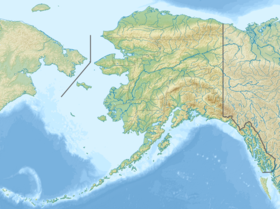
Yukon ( Eng. Yukon Island ) - an island in Kachemak Bay , which is the sleeve of Cook Bay , which in turn is part of Alaska Bay (northeast Pacific Ocean ). Administratively refers to borough Kenai , Alaska , USA .
| Yukon | |
|---|---|
| English Yukon island | |
 | |
| Characteristics | |
| Area | 2.5 km² |
| Highest point | 150 m |
| Population | 0 pax (2010) |
| Location | |
| Washer water areas | Kachemak , Cook's Bay |
| A country |
|
| State | Alaska |
| Borough | Kenai |


Content
- 1 Geography, description
- 2 Archeology, history
- 3 See also
- 4 notes
- 5 Links
Geography Description
The Yukon Island has a maximum north-south size of approx. 2.25 km, east-west - 1.9 km, its area is approximately 2.5 km², its maximum height is about 150 meters above sea level (in 1964 it sank about 60 centimeters as a result of a powerful earthquake ). The minimum distance to the mainland is about 1.3 km. Around the Yukon are scattered several smaller, also uninhabited, islands: Hesketh (about 650 m to the south-west), Cohen (about 900 m to the northeast) [1] . 12 kilometers to the north, through the strait, the city of Homer is very large by local standards (about 5,000 inhabitants). Sea taxis regularly go from there to the Yukon, as there are many who want to spend their free time on kayaks in the vicinity of the island [2] .
Yukon Island is completely forested and has no permanent population. The most common trees of the island are Sitka spruce and Tsuga .
Archeology, History
The island is of significant archaeological value: numerous traces of the prehistoric inhabitants are found on it. The first discovery of this kind was made in 1924, when the remains of a woman who lived here hundreds of years ago were discovered on the island. In the 1930s, major research on the Yukon Island was carried out by the famous ethnologist, anthropologist and archaeologist Frederic de Laguna , her work made a significant contribution to the study of the history of Alaska [3] . On December 29, 1962, the island was included in the list of national historical monuments of Alaska and received the status of " National Historic Site of the United States " [4] , and in 1966 it was included in the National Register of Historic Places of the United States . In the 1970s, it was planned to open a research center on a small part of the island, but it was on this plot of land that new archaeological finds were soon made, so the center, with an area of about 280 m², began to operate only in 1991. Groups of 50-60 people work and study in shifts, there are 24 berths [5] .
See also
- List of National Historic Monuments of Alaska
- List of places inscribed on the National Register of Historic Places in Borough of Kenai
Notes
- ↑ Yukon Island West, KB-08 (eng.) At dec.alaska.gov
- ↑ Best kayaking day trip from Homer, Alaska (English) on withoutbaggage.com
- ↑ Fog on the mountain . (1938) Homer (Alaska) : Kachemak Country Publications . OCLC 32748448
- ↑ Yukon Island Main Site (inaccessible link) . Date of treatment May 20, 2015. Archived June 6, 2011. (English) on tps.cr.nps.gov
- ↑ Yukon Island Center - History on the official website of the Yukon Island Research Center