Gerasim of Jordan Monastery ( Greek Ιερὰ Μονὴ τοῦ Αγίου Γερασίμου Ιορδανίτου or Deir Hajla , Arabic . دير حجلة, Hebrew דיר הגילה ) - a male monastery located in the southern Jordanian Jerusalem River in Jerusalem east of Jericho , in the village of Deir Hajla , six kilometers from the Dead Sea, under the complete control of Israel (zone C) [1] . Named after the Rev. Gerasimus of Jordan .
| Monastery | |
| Monastery of Gerasim of Jordan | |
|---|---|
| Ιερὰ Μονὴ τοῦ Αγίου Γερασίμου Ιορδανίτου | |
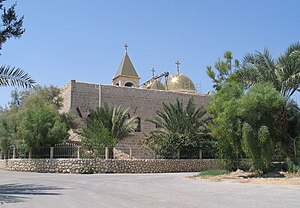 The appearance of the monastery | |
| A country | Israel (Zone From the West Bank ) |
| Provinces | Jericho |
| Denomination | Orthodoxy |
| Diocese | Jerusalem Orthodox Church |
| Type of | male |
| Founder | Gerasim of Jordan |
| Famous inhabitants | Gerasim of Jordan , Kyriak the Hermit, John Hosevit, George Hosevit |
| Relics and Shrines | relics of saints, the revered icon of Gerasim of Jordan, the icon "Mammal" |
| Abbot | Archimandrite Chrysostom (Tavulareas) |
| Status | Protected by the state |
| condition | acting |
Initially, the Monastery of St. Gerasimus of Jordan was located 1.5 km from the Jordan River. The current monastery of the Monk Gerasim is located 3.5 km from the Jordan, until the 13th century it was called the monastery of Kalamon [2] .
Content
- 1 History of the monastery
- 1.1 Monastery in the time of Gerasimus of Jordan
- 1.2 Monastery in the Byzantine era
- 1.3 Monastery during the crusaders
- 1.4 Monastery in the Ottoman period
- 1.5 Monastery in the XX century
- 2 Symbols and traditions of the monastery
- 2.1 Leo Jordan
- 2.2 Donkey
- 2.3 Double-headed eagle
- 3 The device and view of the monastery
- 3.1 Thrones of the upper temple
- 3.2 Iconostasis
- 3.3 Images on columns and walls
- 3.4 Monastery cemetery
- 3.5 Mosaic workshop
- 4 Relics of the monastery
- 5 Rectors of the monastery
- 6 Literature
- 7 References
- 8 See also
- 9 notes
Monastery History
Monastery in the time of Gerasimus of Jordan
The foundation of the monastery dates back to the time of Queen Apostle Helena . But since the apostolic times there was a small church in the cave, where, according to legend, the Holy Family stayed for the night.
The monastery was built in 455 by the Rev. Gerasim of Jordan [3] and was located at a distance of about 1.5 km from the Jordan River [2] .
Not far from the monastery was the Lavra of Kalamon of Our Lady, or Lavra Kalamon, mentioned by the Rev. John Mosch in the essay “Spiritual meadow” [4] ( Greek. Καλάμι - “ reed ”, that is, reed laurel, laurel “Good refuge”, lavrakin ), but at the end of the XIII century it was renamed in honor of Gerasim of Jordan (the current monastery of the Monk Gerasim), since the original monastery of the Monk Gerasim was abandoned [2] [5] .
Saint Rev. Gerasim was a native of Lycia ( Asia Minor ). Having received monastic tonsure, he retired to the Thebaid desert in Egypt. After that, in about 450, the monk reached Palestine and settled by the Jordan River, where he founded the monastery. In Palestinian laurels, cells were usually caves. He became the head of the monastery, in which 70 monks lived. Gerasim of Jordan approved the strict rules of asceticism (self-restraint) in the monastery, which forbade eating during Lent, with the exception of Holy Communion on Sunday. He is considered one of the leaders of hermits (desert inhabitants) of the second generation in the Judean Desert, who followed the founders of the hermit Euthymius the Great and Chariton the Confessor .
Saint Gerasimus of Jordan took part in the IV Ecumenical Council in Chalcedon in 451. This Council, held in Asia Minor, became a turning point in the Christian religious debate, and caused a huge split in the Orthodox world: the heresy of Monophysitism (Eutychianism) was condemned, affirming only the Divine nature of Jesus , and rejecting human nature.
The monastery was inhabited by a student of Gerasim - Rev. Kyriak the Hermit.
The monastery functioned as a laurel with a group of caves in which the hermit monks lived. The hermits spent their lives alone, in constant prayer, weaving ropes and baskets. They came to the center of the laurel on Saturdays and Sundays, taking part in the Divine Liturgy and social activities. The monastic rules were strict, during the week the hermit monks ate only dry bread, dates and water. At the weekend, they ate cooked food and wine. Their personal belongings comprised a rug and utensils for water. Hermit caves have survived at present, and they can still be seen on the steep cliffs 1 km east of the monastery in the surrounding mountains [6] .
Regarding the education of monks, the monastery of Gerasim was very similar to the monasteries of the Byzantine era. Beginners lived in cinemas , engaging in cutting wood, holding water, preparing food, and many other duties, until they showed complete spiritual readiness to accept the life of hermitism. In addition, the original monks were kept in separate dormitories, while they began to look not so young, because they served as too much a temptation for elderly monks in the Lavra. The monks who became "perfect in God's eyes" were allowed to live in caves separately from the cinnamon [7] .
Later, Gerasim of Jordan established another important rule of the monastery - Communion 2 times a week on Saturdays and Sundays. He borrowed this rule from Egyptian monasticism.
Monastery in the Byzantine era
Around 575, the Byzantine monks John Mosch and Sophronius of Jerusalem visited the Jordan Valley and monastery [8] .
In the Byzantine period, the monastery was repeatedly destroyed and rebuilt. In 614, the Persians destroyed it. Since the monastery stood next to another monastery of Malon (The monastery of Malawn), in 617 they united and became known as Deir Hijle [9] .
The Arabic name for the place, Deir Hagla (Deir Hijle), refers to its Old Testament roots. "Deir" is translated as a monastery , and "hijle" - this comes from Hebrew "חוגלה" - partridge-partridge . Bet-Khogloy (the "partridge house") was a village on the border of the tribes of the tribes of Judah and Benjamin (Joshua 15: 6, 18:19).
In 640, the monastery was restored by monks. The monastery was subjected to frequent destruction due to numerous earthquakes, since it is located near the Great Afro-Syrian rift valley , which runs along the Jordan River and along the bottom of the Dead Sea, which is a zone of increased seismic activity.
Crusader Monastery
During the Crusader period (1099–1291), during the reign of Emperor Manuel I Komnin (1143–1180), the Jerusalem Patriarch John IX restored the monastery [10] .
In 1106, the monastery was visited by the Russian pilgrim Abbot Daniel , who wrote about it:
And from the monastery of St. John to the Garasimov monastery there is one verst, and from the Garasimov monastery to Kalamonia, to the monastery the Holy Virgin, there is one verst. And in that place the Holy Mother of God with Jesus Christ, and with Joseph, and with Iyakov, I always flee to Egypt, then in that place the night lodging was ready; then the Holy Mother of God is the name of the place of that of Kalamonia, every day he interprets the "Good abode". Now the Holy Spirit descends to the icon of the Holy Virgin. And there is a monastery on the mouth, even Jordan enters the Sodom Sea, and there is a hail made all around the monastery; the monk-priest (monks) is in it 20. And from there to the monastery of St. John Chrysostom there are two miles, and the same monastery is all done in a hail and is rich in grandees [11] .
In 1185, the monastery was visited by the Greek pilgrim John Fok , who describes:
In the interval between the monasteries of the Forerunner and Kalamon, there is the monastery of St. Gerasimos destroyed to the foundations of the Jordan River - you can see almost nothing in it, except for the insignificant remnants of the temple, two caves and a closed pillar, in which the great elder Ivir, very pretty and amazing, was enclosed. Having visited him, we have greatly benefited from meeting him, for some kind of divine grace is inherent in the old man. But we consider it necessary to tell here for the delight of those who like to delight in the divine, a miracle performed by him a few days before our arrival. On the winding and knotted course of the Jordan, as well as on other rivers, there are places densely overgrown with reeds. A tribe of lions is used to living in these places. Two of them came to the old man’s shutter every week, and, laying their heads on the pillar, with an expression of their eyes, they asked themselves for food. Having received it without difficulty, they happily went to their usual places by the river. Food for him was either small oysters in the river, or maybe pieces of spelled or barley bread. Once when they (the lions) came and asked with a movement of their eyes for ordinary food, the old man, not abundant in what he usually satisfied the demand of animals, because it happened that for twenty days he did not stock up on anything edible, the holy husband said to the beasts: since we are not we just don’t have anything edible to comfort the weakness of your nature, but we ourselves don’t get enough of what is customary for God, who arranged things for us like that for reasons that are well known to him, then you need to go to the Jordan riverbed and bring to us what or a small tree. Having prepared crosses from it, we will give them to visitors as a blessing, and from them we will receive in return, at the will of everyone, any crumbs to feed my and yours, we will get rich. He said the animals listened, and as if with a reasonable movement and gait went to the channel of the Jordan. And lo! not long after, they brought two trees on their shoulders, and laying them at the base of the pillar, they willingly retired to the thickets of the Jordan [12] .
A German traveler, a Dominican monk , Burchard , who visited Palestine from 1274-1484, also mentions the monastery in his notes.
Ottoman Monastery
After the period of the Crusades , in the period of Ayyubids and Mamluks , the monastery was abandoned and restored only in the XIV century.
During the reign of the Ottoman Empire (1516-1917) in Palestine, in 1588 it was rebuilt. However, in 1734 the monastery was again destroyed.
The monastery acquired its modern look through reconstruction from 1882 to 1885, on the remains of the Byzantine Lavra Kalamaon, initiated by Archimandrite Antonin (Kapustin) from the Russian Spiritual Mission . The collector of Russian Palestine, Archimandrite Antonin (Kapustin), in his notes of a fan of 1857, narrated:
Ahead of us appeared a black dot, which, gradually growing, as we approached it turned into a pile of buildings. We were told that this is the former monastery of St. Gerasimus of Jordan, under whose name the lion who served him involuntarily is recalled. Now lions on the Jordan are an unheard of thing. Sometimes you can still hear about tigers. There are many hyenas and jackals. Firearms drove the king of the deserts from his possessions. It seems that it alone can drive out in our time from the same deserts its current king - the Bedouin. It is believed that if Ibrahim Pasha of Egypt had kept Palestine behind him for at least 20 years, the Bedouins would have turned into peaceful Fellahs, like at least the Jericho. Monastery Ave. Gerasim (or rather Kalamon, because Gerasimov was lying, according to the testimony of ancient pilgrims, at the very Jordan) is five miles away from Jordan and occupies a relatively high place. It could still be easily restored and serve as a haven for fans.
- Archimandrite Antonin (Kapustin). Five days in the Holy Land and in Jerusalem in 1857. January 6th in Jordan. Publishing house "Indrik", Moscow, 2007. Pages. 205.
In 1858-1859, the head of the Russian Ecclesiastical Mission in Jerusalem, Archimandrite Leonid (Cavelin) , wrote in his work:
According to the interpretation of some, Lavra Kalomon or Kalomonskaya means reed, and others a good shelter, because it was built on the spot where the Holy Family stayed while fleeing to Egypt (the road from Galilee to Gaza runs through the Jericho field). Blessed John Mosch clearly distinguishes this monastery from the monastery of St. Gerasim even by the very definition of her place, speaking of Gerasim’s laurel: “near the Jordan”, and about Kalomon’s laurel: “near the Jordan”, that is, on the very bank of the sacred river. But later writers, beginning with Foki, constantly mix these two monasteries, on the grounds that the Monk Gerasimus was also called Kalomonitoy. It is more than likely that the name was acquired by the Monk Gerasim because he laid the foundation of the Kalomon Lavra, or simply lived in it temporarily until the foundation of his own monastery, just as the Monk Euthymius lived in the Laurel of Faran until the founding of his laurel, or finally because Kalomonskaya Lavra joined the ave. Gerasim after one of the devastations of the desert of the Holy City, and since then this monastery became known indifferently from one name to another. This last assumption seems unlikely to us. Our pilgrim Abbot Daniel says that the Lavra of Kalomon was at the very mouth of the Jordan, that is, at its confluence with the Dead Sea. In my opinion, its place is indicated by a rather definitely high hill, located not far from the mouth of the Jordan, on its very shore, and, apparently, covering some ruins. In any case, the evidence is bliss. John Mosch, clearly distinguishing between these two cloisters (the monastery of Kalomon and the monastery of St. Gerasimus), cannot be ignored.
- Archimandrite Leonid (Cavelin). Old Jerusalem and its surroundings. From the notes of the monk-pilgrim. 1858-1859 Page 303-304. M. Publ. Indrik 2008
Monastery in the 20th Century
In 1927, the monastery suffered another destruction after an earthquake.
After the Arab-Israeli war (1947-1949) between the Jewish population of Palestine and neighboring Arab states, the territory on which the monastery was located, went to Jordan. Visiting the monastery was minimized, so by the middle of the 20th century the monastery was abandoned.
After the Six Day War , in 1967, the monastery again became an important pilgrimage site. At that time, the monastery was completely abandoned; piles of garbage lay everywhere. There was no water, no light, no road, not a single singing bird and living plant; of living things, only mice, snakes, cockroaches. In 1976, the monk, later archimandrite, Chrysostomos (Tavulareas) settled in the monastery and took up its restoration. According to Archimandrite Chrysostom: “For the first 12 years I lived completely alone (without water, electricity, telephone and road). I literally had nothing to eat. I asked for alms in tourist buses to somehow maintain the monastery. He made candles. The water was rainy. Then a source appeared ” [13] .
Today, the monastery is home to about 30 inhabitants , including monks from Bulgaria, Greece, Romania, Russia and Cyprus.
Symbols and Traditions of the Monastery
Leo Jordan
All the frescoes and icons of the monastery depict a lion and a donkey. These animals are associated with the life story of Gerasim of Jordan.
The last report on the existence of a subspecies of the Asiatic lion in the territory of modern Israel is mentioned in the 15th century.
It is traditionally believed that St. Gerasimus walked along the Jordanian desert and met a lion, who held out his paw. The paw was so sore that the lion looked imploringly at the monk. Gerasim realized that a thorn had fallen into the paw of a lion, which caused his suffering. The saint removed the splinter, cleaned the wound of pus and wrapped it in cloth. Since then, the lion everywhere followed Gerasim as a “disciple”. Saint Gerasim was surprised by the lion's mind, meekness and readiness to eat bread. Leo was given accommodation in a monastery. And since then, the lion has become a symbol of the monastery.
Donkey
The Monks had a donkey that carried water from the Jordan River. Leo was instructed to accompany the donkey to the river, guarding him. Once a lion fell asleep in the sun, leaving a donkey to graze. It so happened that an Arab merchant with his camel caravan passed by and saw a donkey. Thinking that it was a stray animal, he tied it to a caravan of camels and took it with him. When the lion woke up, he began to look for a donkey, but he could not find it anywhere. The beast returned to the monastery and immediately went to St. Gerasim, who, noticing his dejected expression on his face, decided that the lion had eaten the donkey and asked: “Where is the donkey?” The lion stood silently, bowing its head in shame. Старец похвалил льва, чтобы тот не убежал после своего злодеяния и с тех пор поручил ему выполнять работу осла. Монахи загружали большую бочку на спину льва, как это они делали раньше с ослом, и посылали его к реке за водой.
Однажды в монастырь пришел воин, чтобы помолиться, и, увидев льва, несущего воду, пожалел его и дал монахам три золотых монеты, чтобы те купили другого осла. Ко льву вернулась его старая обязанность охранять осла. Через некоторое время, арабский купец вновь шел по Иорданской пустыне, чтобы продать пшеницу в Иерусалиме. И с ним был тот же осел. В тот день, лев случайно оказался рядом с рекой и, когда караван приблизился, он узнал осла. С громким ревом лев бросился к купцу. В ужасе купец бросил караван и убежал. Лев схватил бразды осла в зубы, как он это делал ранее, и привело его вместе с караваном верблюдов к Святому Герасиму Иорданскому. Старец улыбнулся и сказал монахам, что льва напрасно и несправедливо обвинили. Льву дали прозвище „Иордан“.
Двуглавый орел
Поскольку монастырь был перестроен в период крестоносцев, в настоящее время остался фундамент с изображением двуглавого орла — символа Византийской империи . В Византии двуглавый орёл изображался в монастырях и на гербе последней династии Палеологов , правившей с 1261-го до 1453-й год [14] .
Устройство и вид монастыря
В монастыре находятся 2 храма — верхний и нижний.
- Верхний храм построен в честь Святого преподобного Герасима Иорданского, в котором расположен иконостас, подаренный Русской Духовной Миссией в Иерусалиме.
- Нижний храм (крипта) посвящён Святому Семейству, в котором стоит иконостас греческого православного патриархата. В нём находятся кости монахов, погибших во время нашествия персов в 614 г.
Рядом с монастырем находится хостел для посещения греческих паломников. Монахи вместе с местными жителями, проживают поблизости Иерихона, выполняя сельскохозяйственные работы.
Стиль и форма монастыря указывают на период, во время которого монастырь был построен. Внутри монастыря содержится квадратный двор, окруженный арками и колоннами с четырёх сторон.
Престолы верхнего храма
Верхний храм имеет три престола [15] :
- Центральный престол посвящён в честь Герасима Иорданского.
- Правый престол посвящён святому Евфимию Великому , монастырь которого находится неподалеку.
- Левый престол посвящён святому Зосиме Палестинскому и Марии Египетской .
Иконостас
Иконостас верхнего храма, отделяющий центральную часть храма от алтаря, был установлен в 1883 г. Русской Духовной Миссией, содержит 4 иконы:
- Богоматерь Одигитрия ;
- Герасим Иорданский ;
- Иоанн Креститель ;
- Иисус Христос Пантократор .
Изображения на колоннах и стенах
Колонны и стены монастыря украшены иконами и изображениями либо монахов-отшельников, которые находились в Иудейской пустыне, либо основателей монашеской жизни.
Отцы-пустынники , анахореты и основатели монашеского общежития:
- Антоний Великий — египетский монах III века, основатель и идеолог отшельнического монашества в Фивадской пустыне ; он основал одноименный монастырь Святого Антония к югу от Каира.
- Евфимий Великий — один из первых монахов в Иудейской пустыне IV века; он основал монастырь Капарвариха близ Хеврона, Нижний монастырь или монастырь Феодосия в 15 км от Иерусалима, а также лавру святого Евфимия (близ современного Хан-эль-Ахмара);
- Онуфрий Великий — египетский пустынник IV века, подвизавшихся в Фиваидской пустыне, живший в полном одиночестве 60 лет.
- Пахомий Великий — египетский монах III—IV веков, основал первый христианский общежительный монастырь и составил для него первый монастырский устав.
- Иларион Великий — палестинский монах IV века, был основателем первого монастыря в Иерусалиме и первый проповедник монашества в Палестине.
- Харитон Исповедник — христианский святой IV века, основавший Фаранскую , Иерихонскую и Суккийскую (Ветхую) лавры. Один из родоначальников Иерусалимского устава .
Столпники :
- Симеон Столпник — сирийский аскет и столпник V века, известный тем, что провел на столпе 37 лет в посте и молитве.
- Даниил Столпник — константинопольский аскет V века, последовавший подвигу Симеону, проведя на столбе более 30 лет.
- Алипий Столпник — адрианопольский аскет VII века, подвизавшийся на столпе 66 лет.
- Лука Новый Столпник — византийский аскет X века, живший при императоре Константине VII Багрянородном (913—959), простоявший на столпе 45 лет.
Другие святые, аввы и мученики :
- Зосима Палестинский — палестинский монах-отшельник , авва , живший в V—VI вв. при византийском императоре Юстине Старшем .
- Мария Египетская — христианская святая, жившая в пустыне, где провела 47 лет в полном уединении, посте и покаянных молитвах. Единственным человеком, который увидел Марию после её ухода в пустыню, стал иеромонах Зосима.
- Святая Параскева — христианская великомученица III века, пострадавшая во время царствования императора Диоклетиана ; в ранней юности посвятила себя аскетической жизни.
- Иоанн Хозевит — палестинский епископ, авва, святитель VI века, прославившийся своей борьбой с евтихианской ересью ; один из основателей монастыря Хозевитов в Иудейской пустыне.
- Георгий Хозевит — палестинский монах VII века, авва, настоятель Хозевитской лавры .
- Косма Маюмский — византийский епископ и гимнограф (автор гимнов) VIII века в Восточной Православной Церкви.
- Конон Исаврийский — византийский мученик VI века, живший во времена императора Юстиниана I Великого (527—565).
Есть также иконы, изображающие библейские события, такие как сотворение мира , изгнание из рая Адама и Евы, убийство Авеля Каином, жертвоприношение Исаака Авраамом, гибель Содома и Гоморры , нахождение Моисея у берега реки, дарование заповедей Моисею на горе Синай, завоевания Иерихона и вознесение пророка Илии на небо.
Монастырское кладбище
Вне стен монастыря расположено кладбище монастыря, на котором похоронены греческие, русские монахи и послушники.
Мозаичная мастерская
В технике укладки мозаики существуют два способа: прямой и обратный [16] . В монастыре используются оба способа для изготовления икон и библейских событий. Кроме традиционного орнамента и греческих икон мастерская изготавливает мозаичные панно для синагог с изображением Магенов Давида (Щитов Давида) и Скрижалями Завета [17] .
Реликвии монастыря
- Икона Божией Матери „ Млекопитательница “ (Галактотрафуса).
- Икона „Моление (плач) Иисуса Христа об абортах“. Её автор игумен Хризостом. Перед иконой совершают молебен о грехе аборта.
- Икона „Богоматерь с младенцем“.
- Мощи христианских мучеников, пострадавшие от царя Хосрова II Парвиза и персидского нашествия в VII веке.
- Древняя фреска с изображением Иисуса, Девы Марии и Иосифа Обручника.
Монастырь является чтимым местом Православной Церкви, поскольку, согласно евангельской традиции, на этом месте в пещере останавливалось на ночлег Святое Семейство (Мария, Иосиф и младенец Иисус), которые спасали свою жизнь от царя Ирода бегством в Египет . В ту ночь Мария кормила грудью младенца Иисуса, и это событие запечатлено в нижнем храме под главным собором монастыря [18] .
Настоятели монастыря
- Игумены
- Герасим Иорданский (? — †475)
- Василий (? — ?)
- Стефан (? — †481)
- Евгений (?—†526)
- Агиодул (? — ?)
- Александр (? — ?)
- Пресв. Олимпий (? — ?)
- Архимандриты
- Хризостом (Тавулареас) (c 1975)
Literature
- Православная энциклопедия. Том 11. Георгий — Гомар», «Церковно-научный центр „Православная Энциклопедия“», 2006 г.
- Житие и подвиги иже во святых отца нашего и богоносца Герасима Иорданского // Палестинский Патерик. СПб., 1895. Вып. 6.
- Блаженный Иоанн Мосх. Достопамятные сказания о подвижничестве святых и блаженных отцов, 2013. ISBN 9785457014657
- А Н Курэ. Палестина под властью христианских императоров. (326—636 гг.) — 2012 г.- 214 с. — ISBN 978-5-8849-9883-4
- PATRICH, J. Sabas, Leader of Palestinian Monastecism: A Comparative Study in Eastern Monasticism, Fourth to Seventh Centuries. Dumbarton Oaks: Washington, DC, 1995: 128, 205-11, 218, 238-9, 249, 263.
Links
- На Викискладе есть медиафайлы по теме Монастырь Герасима Иорданского
- На Викискладе есть медиафайлы по теме Мозаика монастыря Герасима Иорданского
- В гостях у преподобного Герасима Иорданского, или что значит в пустыне любовь? // Публикация на официальном портале информационного агентства УНИАН.
See also
- Лавра
- Лавра Саввы Освященного
- Монастырь Искушения
- Монастырь Онуфрия Великого (Акелдама)
- Монастырь Феодосия Великого
- Суккийская лавра
- Фаранская лавра
Notes
- ↑ Deir Hajla Locality Profile
- ↑ 1 2 3 Лосева О. В. Герасима Иорданского монастырь // Православная энциклопедия . — М. : Церковно-научный центр «Православная энциклопедия» , 2006. — Т. XI. — С. 164-165. - 752 s. - 39,000 copies. — ISBN 5-89572-017-X .
- ↑ Святой монастырь преподобного Герасима Иорданита // Официальный сайт Иерусалимской православной церкви
- ↑ Бл. Иоанн Мосх. Луг духовный
- ↑ Israel handbook: with the Palestinian Authority areas, За Dave Winter.
- ↑ Murphy-O'Connor, Jerome: The Holy Land: An Oxford Archaeological Guide from Earliest Times to 1700 (Oxford University Press, 2005).
- ↑ PRICE, RM (translated) and John Binns (annotated). Cyril of Scythopolis: The Lives of the Monks of Palestine. Cistercian Publications: Kalamazoo, MI, 1991: 41, 247.
- ↑ Herbermann, Charles, ed. (1913). «Johannes Moschus». Catholic Encyclopedia. Robert Appleton Company.
- ↑ Makhoul S. (2010). Deir Hajla. Data Retrieved on February 28, 2012.
- ↑ Pringle D. The Churches of the Crusader Kingdom of Jerusalem: A Corpus. Camb., 1993. Vol. 1. P. 197—202; 1998. Vol. 2. P. 238—239.
- ↑ Житие и хождение Даниила Русской земли игумена.
- ↑ Иоанн Фока, Сказание вкратце о городах и странах от Антиохии до Иерусалима, также Сирии, Финикии и о святых местах в Палестине.
- ↑ «Венец всего – любовь». Часть 1 / Православие.Ru
- ↑ Двуглавый орел в русской символике
- ↑ Монастырь св. Герасима в Иорданской пустыне. Мюнхен, 1997.
- ↑ Технология укладки мозаики
- ↑ Мозаичная мастерская в монастыре Св. Герасима
- ↑ Монастырь Св. Герасима в Иорданской пустыне Архивировано 27 марта 2006 года.