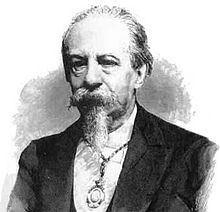
José Zorrilla y Moral ( Spanish: José Zorrilla y Moral ; February 21, 1817 , Valladolid - January 23, 1893 , Madrid ) - Spanish poet and playwright , “Spanish Victor Hugo ”.
| Jose Sorrilla y Moral | |
|---|---|
| Date of Birth | |
| Place of Birth | |
| Date of death | |
| Place of death | |
| Citizenship (citizenship) | |
| Occupation | , , |
| Genre | and |
| Language of Works | |
| Autograph | |
Content
Biography
Sorrillo's father held a high judicial position in Valladolid and sent his son to Toledo to listen to the right; but the young student wandered more around the picturesque surroundings of the city and composed poems. Without finishing the course, Sorrilla fled to Madrid , where, hiding from his family, spent a whole year full of suffering and deprivation. February 15, 1837 there was a funeral for the satirist Larra , who ended his life by suicide. At his grave, an unknown 20-year-old Sorrilla read an excellent poem with which he electrified everyone present.
His collection of legends and numerous dramatic works finally strengthened his fame. Restless and longing for adventure, Sorrilla first went to Paris , then to Mexico , where he lived at the court of Emperor Maximilian , who appointed him his reader. In 1860-66, Sorrilla was director of the National Theater in Mexico City . After the execution of the emperor, Sorrilla returned to Spain .
In 1889 he was solemnly crowned in the Alhambra with a laurel wreath, with the participation of numerous representatives from cities, universities, schools, literary societies and other associations. He was buried at state expense.
Sorrilla wrote a lot. All his works bear a bright national imprint. At the very beginning of poetry, Sorrilla announced that, having been born a Spaniard and being a Christian, he intends to sing the glories of Spain and Christianity . He remained true to this decision throughout his life. Sorrilla is a singer of the beliefs, institutions and feelings of old Spain, his great talent went to the resurrection of the motives of the old Spanish romancero .
Of the poems of Sorrillo, his Legendario del Cid, the apotheosis of the three main elements of the Spanish character: religiosity, patriotism, and a sense of equality, is especially appreciated. The remaining collections of his poems: "Cantos del Trovador" ( 1840 - 1841 ); "Poesías" ( 1840 - 1848 ); Flores Perdidas, Granada ( 1853 ); Album de un Loco ( 1867 ); Composiciones varias ( 1877 ); "Recuerdos del tempo viejo" ( 1880 - 1883 ).
Among the dramas of Sorrilla (he wrote more than twenty of them), the first place is occupied by Don Juan Tenorio , which was always staged on All Saints Day , annually celebrated on November 1; huge crowds flocked from all over Spain to watch it.
Of the other dramatic works of Sorrillo, the most popular are El zapatero y el rey, Sancho García, A buen juez mejor testigo, Traído inconfeso y mártir. Most of his plays are a stage arrangement of legends.
Compositions
- Obras completas, v. 1-2, Valladolid , 1943.
Translations into Russian
Literature
- S.V. Kostarev. // Athenaeum . - 1858 . - No. 2-3.
- Ramírez Ángel E. Zorrilla, el más grande poeta de la raza. - Madrid , [1935].
- Alonso Cortés N. Zorrilla, su vida in sus obras. - Vol. 1-3. - Valladolid , 1943.
Notes
- ↑ 1 2 SNAC - 2010.
- ↑ 1 2 Diccionario biográfico español - Royal Academy of History .
- ↑ 1 2 Encyclopædia Britannica
- ↑ 1 2 Sorrilla-i-Moral Jose // Great Soviet Encyclopedia : [in 30 vol.] / Ed. A. M. Prokhorov - 3rd ed. - M .: Soviet Encyclopedia , 1969.
Links
- Wikimedia Commons has media related to Jose Sorrilla
- Jose Sorrilla y Moral - an article from the Great Soviet Encyclopedia .