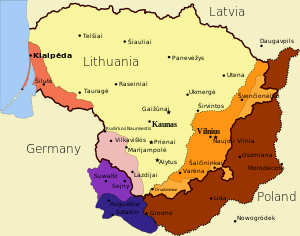
Lithuanian Polish ultimatum - an ultimatum issued by Poland to Lithuania on March 17, 1938. The Lithuanian government has consistently refused to enter into diplomatic relations with Poland, protesting against the annexation of the Vilnius Region [1] . The tension in Europe that rose before the Second World War forced Poland to seek ways to secure its northern borders. Five days earlier, based on the international recognition of the annexation of Austria by the Third Reich , the Polish government decided that it was necessary to present an ultimatum to Lithuania [1] with the requirement to give unconditional consent to establish diplomatic relations with Warsaw within 48 hours and complete mutual accreditation no later than March 31.
The establishment of diplomatic relations de facto meant the refusal of Lithuania to claim the Vilnius Territory and its historical capital Vilnius . In case of refusal, Poland reserved the right to use “all appropriate measures” to ensure the security of its border.
On March 16 and 18, 1938, Litvinov called the Polish ambassador, Vaclav Grzybowski, explaining that despite the absence of a military alliance between Lithuania and the USSR, the Soviet Union was interested in maintaining Lithuania’s independence and opposed the outbreak of war, otherwise the Soviet government would denounce the Polish-Soviet without warning In the event of an armed attack on Lithuania, the non-aggression pact will reserve the freedom of action. At the same time, a note was sent to the Government of Lithuania, which recommended the adoption of the terms of the ultimatum regarding the establishment of diplomatic relations. Thanks to this intervention, the danger of an armed conflict between Poland and Lithuania was averted. The Polish leadership limited its requirements to one point - the establishment of diplomatic relations - and abandoned the armed invasion of Lithuania [2] [3] .
Lithuania, not daring to enter into armed confrontation, adopted an ultimatum on March 19. Diplomatic relations were established, but de jure this did not mean recognition of the loss of the Vilnius Region [4] . The Polish government issued a similar ultimatum to Czechoslovakia on September 30, 1938 during the Sudeten crisis , demanding Zaolzie , the eastern part of Tieszyn Silesia . In both cases, Poland used the international crisis to resolve border disputes in its favor [5] .
Content
- 1 notes
- 2 Literature
- 2.1 Further reading
- 3 References
Notes
- ↑ 1 2 Skirius, Juozas. Lietuvos – Lenkijos santykiai 1938–1939 metais // Gimtoji istorija. Nuo 7 iki 12 klasės : [ lit. ] . - Vilnius: Elektroninės leidybos namai, 2002. - ISBN 9986-9216-9-4 . Archived March 3, 2008 on Wayback Machine
- ↑ LITHUANIAN REPUBLIC REFUSES TO VILNIUS unopened . Union of Russian Lithuania. Date of appeal April 24, 2016.
- ↑ Year of the crisis: 1938-1939. Documents and materials in two volumes. - M. , 1990. - T. 1. - S. 279-280. - ISBN 5-250-01092-X .
- ↑ Streit, Clarence K. Pressure on Poles Weakens Demands (Eng.) // The New York Times : newspaper. - 1939. - March 19. - P. 1 .
- ↑ Davies, Norman. God's Playground: A History of Poland . - Columbia University Press, 2005. - P. 319. - ISBN 978-0-231-12819-3 .
Literature
- Sakwa, George. The Polish Ultimatum to Lithuania in March 1939 (English) // Slavonic and East European Review : journal. - 1977. - Vol. 55 , no. 2 . - P. 204—226 .
- Kallio, Aulis: Liettuan historia. Tampere: Jagellonica-kulttuuriyhdistys ry, 2009. ISBN 978-951-98665-3-6 .
- Vitas, Robert. " Documents: The Polish Ultimatum to Lithuania - The Despatch of Lithuanian Minister J. Baltrušaitis in Moscow ." Lituanus 31 (4). 1985. ISSN 0024-5089
- Vitas, Robert. " The Polish – Lithuanian Crisis of 1938: Events Surrounding the Ultimatum ." Lituanus 20 (2). 1984. ISSN 0024-5089.
Further reading
- Włodzimierz Kalicki. 17 marca 1938 r. Wodzu, prowadź na Kowno (Polish) (March 19, 2010).
Links
- The text of the ultimatum (German)