Gabriel Marinakis ( Greek Γαβριήλ Μαρινάκης , 1826 , Rethymni, Ottoman Crete - November 9, 1866 , Arkadi ) - hegumen of the Arkadi monastery , politician, participant in the Cretan uprising of 1866. His heroic death linked his name with the event, which since 1866 in Greek historiography and literature has been called the Holocaust of Arkadi [1] [2] [3] .
| Gabriel Marinakis | |
|---|---|
| Γαβριήλ Μαρινάκης | |
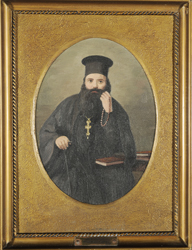 Hegumen Gabriel Marinakis. National History Museum of Greece | |
| Church | Cretan Orthodox Church |
| Birth | 1826 Margarites Rethymnon , Ottoman Crete |
| Death | November 9, 1866 Arcade |
Mother Superior
Gabriel Marinakis was born in the village of Margarites, Rethymnon around 1826 [4] . In 1856 he was elected abbot of the Arkadi monastery. He showed many initiatives in the development of the monastery, in the management of the monastery property, in the creation of the monastery cadastre . He made several personal gifts to the monastery, including 69 olive trees. [5]
Holocaust Arcady
With the beginning of the Cretan uprising of 1866, Abbot Gabriel took an energetic part in revolutionary events. October 1, 1866 , representing the revolutionary committee of Rethymnon, he took part in the General Assembly of the rebels in Fre, Chania. The assembly turned to the consuls of the "Great Powers" in Crete, asking them not to allow the massacre of women and children by Ottoman forces [6] . At the end of the same month, he took part in the military council, which took place in the monastery of Arkadi.
Colonel Panos Coroneos , who arrived from the Greek kingdom, spoke at a military council. Koroneos was a participant in the Crimean War , fighting on the side of the Russian army, as part of the Greek Greek Legion .
Coroneos assessed the situation on the spot and came to the conclusion that it was not possible to defend the monastery with the available forces and that the monastery should be abandoned.
Gabriel, along with other monks and Cretan commander George Daskalakis did not agree with the proposal of Coroneos. At the same time, they rejected Coroneos’s offer to destroy the stables and the mill, which could facilitate the task of the Turks in the expected siege. Historians agree that the proposal of Coroneos was correct, and its non-fulfillment by Gabriel was a mistake [7] . Coroneos left, leaving in the monastery 40 volunteers from the Greek kingdom, under the command of Lieutenant Ioannis Dimakopoulos .
On November 6, the monastery was surrounded by 15 thousand Turks, Albanians, Egyptians and local Muslims. Behind the fence of the monastery were 950 Orthodox Greeks, of whom about 300 were armed. The rest were children and unarmed women and old people [8] .
The Turks went on the attack in 2 days. The abbot inspired the defenders of the monastery and took part in the battle. The last defenders of the monastery lasted until November 9, after which, as the English historian D. Dakin writes, “they blew up the powder cellars, just as the defenders of Mesolongion did 40 years earlier” [9] , having received a heroic death and sending dozens of Turkish Turks [ 10] .
Most researchers suggest that Gabriel was killed on the last day of the siege. Some of them believe that he committed suicide so as not to be captured by the Turks [11] .
The Turks abused the body of Hegumen Gabriel and decapitated the corpse, showing his head in different regions of Crete. The headless body was buried in the courtyard of the monastery church [12] [13] [14] .
Links
- ↑ Αφιερώματα - Το ολοκαύτωμα της Μονής Αρκαδίου
- ↑ Henry Turot, L "insurrection cretoise et la guerre Greco-turgue, ISBN 960-7063-03-1 , Η Κρητική Επανάσταση καί ο Ελληνοτουρκικός Πόλεμος του 1897, σελ.22
- ↑ Σαν σήμερα: Το ολοκαύτωμα της Μονής Αρκαδίου (ΒΙΝΤΕΟ)
- ↑ Στυλιανός Καλλονάς, Η Κρήτη Ολοκαύτωμα (1866-1869) , 1963, σ. 119.
- ↑ Θεοχάρης Ευστρατίου Δετοράκης - Αλέξης Καλοκαιρινός (επιμ.), Πεπραγμένα του Θ 'διεθνύςύςαύΚΚΚ 2005 2005 2005 2, Νεότερη περίοδος - Λαογραφία, γλώσσα και λογοτεχνία, σύμμεικτα κείμενα, σ. 167, 170, 175.
- ↑ “Η μεγάλη Κρητική Eπανάσταση 1866-1869”, Ένθετο εφημερίδας Πστρίς , Δεκέμβριος 2008, Α΄, σ. 42, 52.
- ↑ Κάρολος Ε. Μωραΐτης, Ιωάννης Δημακόπουλος (1833-1866) - Ο ηρωικός φρούραρχος της Ιεράς Μονής Αρκαδίου , εκδόσεις Πελασγός 14 - 15.
- ↑ Μωραΐτης, 2007, σ. 20.
- ↑ Douglas Dakin, The Unification of Greece 1770-1923, ISBN 960-250-150-2 , p. 174
- ↑ Ιωάννου Π. Λιονή, Απομνημονεύματα Παρθενίου Περίδου - Η Κρητική Επανάστασις του 1866 , Εν Αθήναις 1900, σελ. 120
- ↑ Μωραΐτης, 2007, σ. 40 - 42.
- ↑ Μωραΐτης, 2007, σ. 44.
- ↑ Το "Ολοκαύτωμά της Μονής Αρκαδίου" 9 Νοεμβρίου του 1866! | veteranos | Εθνικά Θέματα
- ↑ Archived copy (inaccessible link) . Date of treatment May 14, 2015. Archived May 17, 2015.