Karl Ferdinand Zon ( German: Karl Ferdinand Sohn ; December 10, 1805 , Berlin - November 25, 1867 , Cologne ) - German historical painter and portrait painter .
| Karl Ferdinand Zon | |
|---|---|
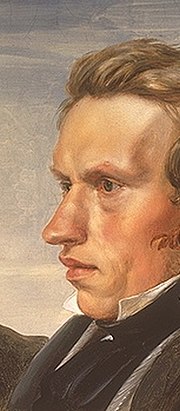 K.F. Zon on the portrait of Julius Gübner , 1839 | |
| Date of Birth | December 10, 1805 |
| Place of Birth | Berlin |
| Date of death | November 25, 1867 (61 years old) |
| Place of death | Koln |
| A country | |
| Genre | |
| Study | |
Content
Biography
He studied at the Berlin Academy , then in the private workshop of Wilhelm Shadov and, with him in 1826 moved to Dusseldorf . Having made a trip to the Netherlands and spent some time in Italy , he returned to Düsseldorf and in 1833 received the post of professor at the local academy, which he held until the end of his life. Thus, he became one of the founders of the Düsseldorf school of painting, which owes its development to the majority of contemporary representatives. One of the students of the Düsseldorf Zone was a famous artist who combined the features of romanticism and early symbolism in his work, the nephew of the philosopher Ludwig Feuerbach - Anselm Feuerbach (September 12, 1829 - January 4, 1880).
The beauty and roundness of the composition , the correctness and expressiveness of the picture and the elegance of the brush are the main advantages of his paintings, which were highly valued in their time. His paints do not differ in special warmth and gloss, but are very harmonious and give a highly plastic impression. Of the best works of his kind in history, one can name: “Rinaldo and Armida” ( 1827 ), “Gilas, carried away by nymphs into the water” ( 1829 ; at the Berlin National Museum), “Two Leonor” ( 1834 ), “Romeo and Juliet” ( 1836 ) and Lorelei ( 1853 ). A subtle characteristic of the portrayed physiognomies and an amazing grace of performance are the distinctive qualities of the portraits of this artist. In the last years of his life, Zon preferred sensual naturalism in his work, which he expressed in numerous female portraits.
Karl Ferdinand Zon had two sons, who also became artists - Paul Eduard Richard Zon (1834-1912) and Karl Rudolph Zon (Carl Rudolph Sohn, 1845-1908), also known as Karl Zon the Younger. His nephew and apprentice Wilhelm Zon (1830-1899) was also a famous artist. His daughter Maria (1841–1893) became the wife of the German painter Karl Hoff .
Works
The works of the Zone are in the collections of German museums: in Bonn, Cologne, Düsseldorf, Frankfurt, Karlsruhe, Leipzig, Mannheim, and in European museums - in Kaliningrad, Lisbon, Aix-la-Chapelle, Oslo and Poznan.
Literature
- Zones, German artists // Brockhaus and Efron Encyclopedic Dictionary : 86 volumes (82 volumes and 4 additional). - SPb. , 1890-1907.