Francois Béranger Saunière ( French: François Bérenger Saunière , April 11, 1852 - January 22, 1917) - French Roman Catholic priest from the commune of Ren-le-Chateau, Aude department (1885-1909). He gained fame thanks to various conspiracy theories in which he is the central figure associated with the Holy Grail , the treasures of the Templars , various religious documents, allegedly compromising the modern Christian church . Many elements of these theories were later used in popular culture , becoming the basis for the book by Michael Bagent , Richard Lee and Henry Lincoln, “The Holy Blood and the Holy Grail ”, as well as the Dan Brown novel, “ The Da Vinci Code, ” where Jacques Jacques Jacques was named after the priest Sauniere [2] .
| Francois Beranger Sauniere | |
|---|---|
| François Bérenger Saunière | |
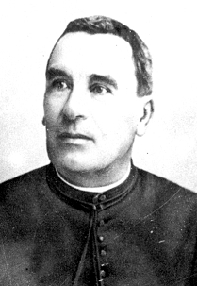 | |
| Religion | |
| Title | Priest |
| Period | 06/01/1879 - 01/28/1909 |
| Date of Birth | |
| Place of Birth | Montazel |
| Date of death | |
| A place of death | Ren-le-chateau |
| A country |  France France |
Content
- 1 Biography
- 1.1 Childhood
- 1.2 Priest
- 1.3 Restoration of the church
- 1.4 Investigation
- 2 Versions
- 3 The mystery of the abbot Sauniere in fiction
- 4 notes
- 5 Literature
- 6 Documentary Films
Biography
Childhood
Francois Beranger Sauniere was born April 11, 1852 in Montazel , located in the Languedoc region, in the family of Joseph Sauniere (1823-1906) and his wife Marguerite Hugues; he was the eldest of seven children and had three brothers and three sisters. His father served as mayor of the commune; in addition, he worked as the manager of a flour mill at the castle of the Marquis de Casemage, which was then considered a prestigious place. The Marquis de Casemage belonged to one of the most ancient families in the region, known for his Christian affairs.There were many priests and clergymen in their family, which probably played a role in choosing professions for Beranger and his younger brother Alfred. They enter the St. Louis school in Lima (Schule St Louis in Limoux verbrachte), where they receive a standard set of knowledge, including they study Latin, Greek, and Hebrew. Beranger, for some reason, finished school a year later than his younger brother and in 1874 entered the seminary in Carcassonne . After its completion in June 1879, he was ordained a priest. After a series of short-term appointments, he begins his religious career at Alet-le-Bains as a vicar, paying 900 francs a year. It was this amount that was granted to the Vicars under the law governing relations between the state and the Church.
Priest
According to contemporaries, Saunière is described as an obstinate young man of athletic build with independent, sometimes rebellious looks. As a result, due to disciplinary incidents, as well as open monarchical views, in 1882 he was transferred to the post of teacher in the seminary of Narbonne . However, Saunière also worked in this position for a short time, and on May 22, 1885, at the age of thirty-three, he was appointed parish priest of the church of St. Mary Magdalene in the village of Ren-le-Chateau , in which at that time no more than 300 people lived [3] . The village itself was located on a hilltop, 40 kilometers from Carcassonne . Initially, Saunière settled in the house of his maid, Marie Denarnaud, but could not get along with her mother and after a while moved to the house built near the cemetery. The church itself, erected in the VIII century, was in a dilapidated condition and needed repair. It is noteworthy that its foundation was laid at an even earlier time - during the Visigoths . Subsequently, over the course of several years, he will completely change the face of this small village.
Sauniere, as a dedicated person, is warmly received by the villagers. In addition to everyday duties, he does not miss the opportunity to show care and attention to the parishioners, trying to help money the most needy. However, as a priest, Sauniere continues to promote monarchist views, especially during the 1885 election , using his sermons for this. As a result, he again has to return to teaching at the seminary for six months. However, the parishioners of Ren-le-Chateau, to whom he had once shown care and attention, insisted on the return of the disgraced young vicar, and Sauniere was reinstated. By this time, rumors appeared about his ambiguous relationship with the maid of Maria Denarno. He himself outlined them like this:
“Respect, but not friendships. No talk about his service. Should not trust her age and piety. She should not enter the bedroom when he is in bed, except in the case of illness ... ” [4]
An eighteen-year-old peasant girl named Marie Denarno will remain his companion and confidant until the end.
Church Restoration
The place of Rennes-le-Chateau has a rich history. In the southeast, a few kilometers away, on the Bezu hill (Bezu), are the ruins of the Templar’s medieval fortress, and in the other direction are the ruins of the family residence of Bertrand de Blanchfort , the fourth great master of the Order of the Temple in the middle of the 12th century. In these parts various legends about the tragic and bloody history of this area are popular. In 1891, Sauniere decided to restore the village church. He finds the support of his friend Henri Boudé, who served as a cure in the neighboring village of Ren-les-Bains , as well as parishioners, takes some money from them and starts work. During restoration, Sauniere finds four parchment scrolls hidden in one of the hollow columns on which the altar stone was located [5] . Three documents contained family trees: one dated 1243 had the seal of Blanca of Castile , the second from 1608 the seal of François Pierre d'Hautpoul, the third from April 24, 1695 contained the seal of Henri Pierre d'Hautpoul). The fourth, bilateral document, dated 1753 , was signed by canon Jean-Paul de Negre de Fondarzhan. It contained excerpts from the New Testament in Latin, as well as some encrypted notes. In the film, shot by the BBC, he is presented as follows:
“BERGERE PAS DE TENTATION QUE POUSSIN TENIERS GARDENT LA CLEF PAX DCLXXXI PAR LA CROIX ET CE CHEVAL DE DIEU J'ACHEVE CE DAEMON DE GARDIEN A MIDI POMMES BLEUES"
“The shepherdess is not tempted that Poussin Teniers keep the key pax 681 with the cross and with this horse of God I finish off this guardian demon at noon of blue apples (Fr.).” [6]
Probably all these documents were hidden in the early years of the beginning of the French Revolution by the predecessor of Sauniere Abbot Antoine Bigou.
The Sauniere, realizing the importance of the documents found, shows them to the Bishop of Carcassonne , who, in turn, sends him to Paris , paying all expenses. Apparently, Beranger Sauniere believed that information about the treasures of some secret order was hidden in the scrolls, and decided to decipher it. Having previously made copies of them, he went to the head of the seminary in Saint-Sulpice, abbot Biel, a specialist in the field of linguistics , cryptography and paleography , and also visited the Louvre , where he ordered copies of three paintings: “The Arcade Shepherds” by Poussin , “The Temptation of St. Anthony” Teniers brushes and a portrait of Pope Celestine V by an unknown artist. Three weeks later, Sauniere returns to Rennes-le-Chateau and continues restoration work.
And since 1896 , he has made numerous and unprecedented expenses, which amounted to many millions of francs. Part of this money was spent on improving the quality of life in the countryside: building roads, running water, the needs of the church, etc. Another, considerable part of the expenses was made for a luxurious life, which did not at all correspond to the appearance of the minister of the church. Sauniere acquired expensive fabrics, antique objects and even built a huge villa Villa Bethania , in which, moreover, he did not happen to live. He acquired plots of land, created greenhouses, pools, bought a cage for monkeys. Moreover, all this was acquired in the name of his servant Maria Denarno, whom the locals nicknamed the “Madonna of the Priest”, suspecting that they were more than just friends. It is assumed that all the secrets of the priest were passed on to Marie.
Investigation
January 28, 1909 resigns and becomes a free priest. The events taking place in Rennes-le-Chateau attracted the attention of the new abbot Carcassonne and he decides to conduct a spiritual investigation, bringing a series of accusations against Sauniere.
He demands to provide a financial report on the state of affairs in the parish, to which Sauniere states that he received funds for the restoration of the church and other construction works from certain “repentant sinners” whom he managed to set on the right path. Significant funds were allegedly allocated by influential people, among them the widow of Count Count de Chambord , the grandson of Charles X , in whose favor the last direct Bourbon denied in July 1830, as well as Archduke Johann of Habsburg, a relative of the emperor Franz Joseph .
Sauniere had to pass a spiritual test, but defiantly did not attend any meeting. As a result, he is temporarily removed from office, but he appeals to the Vatican , and that, unexpectedly, immediately removes the charges against him and restores him to his former rank. After a spiritual test, Saunière’s lifestyle changed dramatically and he spent the rest of his life in poverty, selling religious medals from his collection, as well as small religious items to soldiers who lodged nearby in Campagne-les-Bains [7] . Francois Beranger Sonr died on January 22, 1917 . In September 2004 , Sauniere’s body was reburied in a special sarcophagus to protect him from robbers [8] . Since then, the Rennes-chateau cemetery has been closed to the general public.
Versions
The following versions of the origin of the wealth of Abbot Sauniere are:
- During the restoration of the Rennes-le-Château church, Sauniere discovered either the Visigoth treasures themselves or documents indicating the place where they were hidden.
- The discovered documents contained information about the descendants of the Merovingians , who had the right to claim the crown of France and he managed to either sell them profitably or use them to receive numerous gifts from influential people.
- Sauniere’s wealth appeared due to numerous orders for masses (each of which cost one franc) and which he actually did not spend.
- The abbot won a very large amount in the lottery, managing not to draw attention to himself.
After the death of the mysterious priest, Marie Denarno burned all his personal papers, sold Bethany to Noel Corby. At the same time, she argued that: "You walk through the treasures without even realizing it!". She promised to reveal their secret with the abbot, but she didn’t.
The Riddle of Abbot Sauniere in Fiction
The secret of Abbot Sauniere is widespread in popular culture. A large number of works of art have been created, based on the life of François Sauniere. The most famous works:
- Beigent M. , Leigh R. , Lincoln G. The Sacred Riddle (Michael Baigent, Richard Leigh, Henry Lincoln, l'Énigme Sacrée, éditions Pygmalion (1983) ( ISBN 2-85704-137-3 ))
- Jean Markale - “Montsegur and the riddle of the Cathars” (Jean Markale, Montségur et l'énigme Cathare, éditions Pygmalion (1986) ( ISBN 2-85704-213-2 ))
- Jean-Michel Thibault - “The Secret of Abbot Sauniere” (Jean-Michel Thibaux, Les tentations de l'abbé Saunière, éditions O.Orban (1986) ( ISBN 978-2-85565-309-9 ))
- Jean-Michel Thibault - “The Devil's Gold” (Jean-Michel Thibaux, L'or du diable, éditions O.Orban (1988) ( ISBN 978-2-85565-429-4 ))
- Tim Powers - “Earthquake Weather” (Tim Powers, Earthquake Weather (1997))
- Dan Brown - “ The Da Vinci Code ” (Dan Brown, Da Vinci Code, Jean Claude Lattès (2003) ( ISBN 978-2-7096-2493-0 ))
- Steve Berry, L'Héritage des Templiers, Le Cherche Midi (2006) ( ISBN 978-2-7491-0859-9 )
- Kate Moss - The Labyrinth - (Kate Mosse, Sépulcre, Jean-Claude Lattès (2008) ( ISBN 978-2-7096-2930-0 ))
- Ravenn J., Giacometti E. “Apocalypse, Black River” (Eric Giacometti et Jacques Ravenne, Apocalypse, Fleuve Noir (2009) ( ISBN 978-2-265-08735-4 ))
- Jean-Michel Thibaux et Martine-Alix Coppier, L'héritière de l'abbé Saunière, Presses de la Cité (2012) ( ISBN 978-2-258-08999-0 )
Notes
- ↑ BNF ID : 2011 Open Data Platform .
- ↑ Ain, Marissa Hidden in Plain Sight: A new novel reworks the history of creative genius . Vol 7 No 2 Spring 2004 . Yale Review of Books (2004). Archived June 1, 2008.
- ↑ Annuaire ecclesiastique. P. 282.
- ↑ Cited in Corbu & Captier, L'Héritage de l'Abbé Saunière , 1985, p. 71.
- ↑ Albert Salamon, D'un coup de pioche dans un pilier du maître-autel, l'abbé Saunière met à jour le trésor de Blanche de Castille (“With one blow of the pick-ax in a pillar of the main altar Abbé Saunière uncovered the treasure of Blanche de Castile "), in La Dépêche du Midi 12, 13, 14 January 1956.
- ↑ Michael BAIGENT Richard LEIGH & Henry LINCOLN THE HOLY BLOOD AND THE HOLY GRAIL
- ↑ Berenger Saunière (inaccessible link) . www.renneslechateau.com. Date of treatment May 12, 2015. Archived May 14, 2008.
- ↑ 'Da Vinci Code' Fans Besiege French Village in Quest (Update3) , Bloomberg (October 27, 2004). Archived October 31, 2005.
Literature
- De Sede Gerard. L'or de Rennes; Charroux Robert. Tresors du monde. Paris, 1962. P. 247ff.
- Claude Bumandil, Gilbert Tappa, (Claude Boumendil, Gilbert Tappa), Notebooks Ren-le-Château (Les Cahiers de Rennes-le-Château), Archives - Documents - Études, Number 11 (Éditions Bélisane, 1996). ISBN 2-910730-12-3
- Claire Corby, Antoine Captier, The Legacy of Abbot Saunière (Claire Corbu, Antoine Captier, L'héritage de l'Abbé Saunière) (Nice: Editions Bélisane, 1985). ISBN 2-902296-56-8 .
- Rene Decadeilla's “The True Story of Abbot Sauniere”, (René Descadeillas, Mythologie du trésor de Rennes: histoire véritable de l'abbé Saunière, curé de Rennes-le-Château ) (Mémoires de la Société des Arts et des Sciences de Carcassonne Anne —1972, 4me série, Tome VII, 2me partie; 1974). Facsimile reprint by Savary, Carcassonne, 1988. ISBN 2-9500971-6-2 . Facsimile reprint by Éditions Collot, Carcassonne, 1991. ISBN 2-903518-08-4
- Bagent M., Lee R., Lincoln G. Holy Blood and the Holy Grail . - M.: Publisher Eksmo, 2005.
Documentary Films
- Da Vinci Code // Reality or Fiction = Is it real ?: Da Vinci's Code. - National Geographic Channel , 04.24.2006.