The Second Battle of Fredericksburg , also known as the Second Battle of Marye's Heights , took place on May 3, 1863 near Fredericksburg , Virginia , and was one of Chancellorsville’s battles. American Civil War Campaigns . Sometimes it is considered as one of the phases of the battle of Chancellorsville ['' i '' 2] .
| Second Battle of Fredericksburg | |||
|---|---|---|---|
| Main Conflict: US Civil War | |||
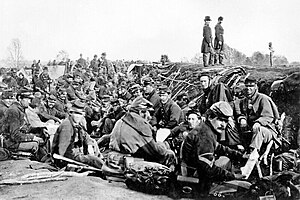 Brooks division soldiers in trenches near Fredericksburg | |||
| date | May 3, 1863 | ||
| A place | Fredericksburg , Virginia | ||
| Total | Union victory | ||
| Opponents | |||
| |||
| Commanders | |||
| |||
| Forces of the parties | |||
| |||
| Losses | |||
| |||


Federal General John Sedgwick was ordered to attack the fortifications of the North Virginia Army at the heights of Marie near Fredericksburg and to go behind the lines of General Robert Lee , who was to be hit from both sides and defeated. During the battle, Sedgwick’s corps managed to storm Mari’s heights and cut off Jubal Earley’s division from the main forces of the Lee’s army, but then Sedgwick began to act indecisively and his attack on Chancellorsville was stopped by the Cadmus Wilcox brigade at Salem-Chech . The next day, General Airlie occupied the Mari heights abandoned by the federals without firing a shot and a battle broke out at Banks Ford , after which Sedgwick retreated to the north bank of the Rappahanok River.
Content
Background
On April 27, 1863, federal commander-in-chief Joseph Hooker launched the Chancellorsville campaign. His plan was to leave a part of his army in the rear and flank of the enemy army. Three federal corps began their eastward movement: the 11th Howard Corps, the 12th Slocam Corps and the 5th Corps of Mead - a total of 39,795 people. The hooker chose those corps whose camps were farthest from enemy positions. The corps, standing in front of the enemy, remained in place: these were the 1st Reynolds corps on the left flank and the Sixth Corps of Sedgwick in the center. Two right corps (II and III) also remained in place [6] .
On the evening of April 28, the VI and I corps were ordered to cross the Rappahanok in order to attract the attention of the southerners. Hooker ordered the capture of the Franklin Crossing and Fitzhugh Crossing near Frederickberg in the wee hours and first hours of the day. It was assumed that at night, until 03:30, bridges would be built. The darkness prevented this plan: when the first boats with soldiers of the VI Corps sailed off the coast near Franklin Crossing, it was already dawn, but the morning fog helped them to cross unnoticed. On the south bank of the river the federals were met by enemy pickets, which made a couple of volleys at the attackers and moved away. At 09:45, three bridges were already built [7] .
By the evening of April 29, General Lee learned about the appearance of the enemy on his left flank, but he still did not fully understand the plan of the northerners and did not know the exact size of their group in the west. To begin with, he sent orders to Generals Anderson and Maclowes . General MacLouse was to take up positions with Fredericksburg and be ready to strengthen the left flank, and General Anderson, whose brigades were scattered on the left flank of the army, was ordered to concentrate on the George Chancellor plantation, where the roads leading from the Rapidan crossings converged, and take how much possibly a strong line of defense [8] . On April 30, General Lee studied the enemy’s position near Fredericksburg and decided that the main attack was not planned by Hooker. He decided to leave part of the troops in positions near Frederiksberg, and to attack the western enemy group with the bulk [9] . At the heights near Fredericksburg, Jubal Earley's division remained, reinforced by the Mississippi Barksdale brigade. Lee ordered Earley to monitor the enemy, restrain his offensive as much as possible, and if defense was not possible, retreat to Guinea Station, covering the railway and warehouses [4] .
On May 1, the three Hooker corps went on the flank of Lee’s army, met with the Anderson and Maclowes corps, and retreated to the heights of Chancellor’s house. On May 2, Jackson attacked Hooker's right flank and defeated his XI Corps [10] .
Despite the defeat of his corps, Hooker decided to take advantage of the situation. Intelligence established that from the west he was attacked by all Jackson divisions except Earley's division (which remained under Frederiksberg), and from the east there are two divisions of General Lee. This meant that part of the enemy’s army (Anderson and Maclowes divisions) were now between the two parts of the Potomac Army and could be attacked from two sides. At 21:00 on May 2, Hooker ordered Sedgwick to advance. This order came to the army headquarters in Falmouth at 22:00, and Butterfield sent it to Sedgwick, who received it at 23:00 [11] .
POTOMAK ARMY HQ, May 2, 1863-22.10
(Received 23:00)
Major General SEGWIK:Major General orders you to cross the Rappahanok at Frederiksberg immediately upon receipt of this order and march along Chancellorsville Road until you connect with him. You must attack and destroy any forces in your path. Leave all the convoys in the rear except for the cart with ammunition and advance to appear in full view of the general at dawn. Apparently, you will find yourself in the rear of the forces commanded by General Lee and the Commander-in-Chief believes that you will break it.
Regards, Your humble servant
Original text- HEADQUARTERS ARMY OF THE POTOMAC, May 2, 1863-10.10 pm(Received 11 pm)
Major-General SEDGWICK:The major-general commanding directs that you cross the Rappahannock at Fredericksburg on the receipt of this order, and at once take up your line of march on the Chancellorsville road until you connect with him. You will attack and destroy any force you may fall in with on the road. You will leave all your trains behind except the pack-mule train of small ammunition, and march to be in the vicinity of the general at daylight. You will probably fall upon the rear of the forces commanded by General Lee, and between you and the major-general commanding he expects to use him up.
I am, very respectfully, your obedient servant
By the time the order was received, all three Sedgwick divisions were already on the south bank, so the order to "cross the Rappahanok" confused Sedgwick. He went to Butterfield and together they adjusted the order to the circumstances. [12]
Meanwhile, when Jackson’s corps was sent to the left flank, only Jubal Earley’s division remained at the heights under Frederiksber. In the afternoon of May 2, Lee sent a staff officer ( Robert Chilton ) to Earley with an oral order: to join the main army, if circumstances allow this. However, Chilton misunderstood his mission and gave Lee's order categorically: he said that Airlie should go on a connection with Lee and do it immediately. Airlie and very surprised at such an order. Earley was sure that the departure of his brigades would be immediately noticed and immediately initiate the advance of the Sedgwick corps. But Chilton insisted and confidently stated that his words contained no error. Earley then left the 21st Mississippi regiment from the Barksdale brigade in a picket line, left the Harry Hayes brigade on high, and sent the rest to the west. Now under Fredericksburg there are only 3,000 people left. At 10:45, Earley's retreat was seen by federal observers. In this situation, General Sedgwick should ferry his divisions through Rappahanok and attack the retreating enemy, but he did not dare to act without a direct order [13] [14] .
Battle
At the time of receiving the order, Sedgwick’s corps was two miles south of Frederiksberg and 10 miles from Hooker's main army. Sedgwick immediately, after agreeing on an order with Butterfield, ordered the offensive. Newton’s division was at the forefront, followed by “Light Division”, then the Howe and divisions. Sedgwick decided to enter Fredericksburg and from there go onto the Orange-Plenk Road leading to Chancellorsville. He could have tried to get around the enemy’s position near Fredericksburg, but apparently he knew little of the roads in this area. Last December, during the battles near Fredericksburg, the Sedgwick corps stood on the left flank of the army and did not know anything about the nature of the area west of the city. At 23:30 Butterfield received reports of the defeat of the XI corps near Chancellorsville and immediately informed Sedgwick about this, adding: “Now everything in the world depends on the speed and decisiveness of your maneuver.” He believed that this would add Sedgwick enthusiasm, but the effect was the opposite: Sedgwick only doubled his caution [12] .
Already on the way to Frederiksberg, the federal army entered into a skirmish with pickets of southerners. At 01:30, Sedgwick informed Butterfield that Frederiksberg was still busy with some parts of the enemy and could hardly get to Chancellorsville by dawn [15] .
At this time, Jubal Airlie's division was between Frederiksberg and Chancellorsville, about a mile from Frederiksberg. Earley managed to contact the army headquarters and report the situation. General Lee wrote him a letter (which has not been preserved), informing him that his order was misunderstood, but left Earley to decide for himself whether to return to Frederiksberg. At this time, the courier from Barksdale reported to Earley about the movements of Sedgwick's divisions, and the messenger from Pendleton informed that Earley would lose all his guns if he did not return immediately. And Earley sent the brigades back. At about 06:00, his division returned to its positions at the heights outside the city, and instead of 15 guns the southerners now had 40. As a result, Sedgwick's task, easily accomplished on the night of May 2, became almost impossible in the morning of May 3 [16] [17] [ 18] .
Following the return of Earley's division, only the Barksdale Brigade was assigned to defend Marie's heights. “With a few batteries and a single infantry brigade, I held the front for at least three miles,” Barksdale wrote in the report, “he stretched from Taylors Hill to the right, to the foot of the hills near Howison’s house.” The 21st Mississippi Regiment stood between the heights of Marie and Plenk Road, and three companies advanced to the stone wall at the foot of the heights of Marie, where the 18th Mississippi Regiment was deployed in line. The 17th Mississippi Regiment stood at Lee Hill, while the 13th Mississippi Regiment was still further to the right. To the right of Marie’s house were 4 guns and two more to the left of the house [19] .
Hooker was very disappointed with the delay of Sedgwick, but decided to keep Chancelorsville's defense until the VI Corps of Sedgwick went to the rear of the army of Lee from Frederiksberg. Sedgwick's corps totaled 23,600, and the division given to it by John Gibbon numbered 3,500 more. Hooker believed that the division of Jubal Airlie (wherever it was) totals 8,400 people, and intelligence reports reported that there was only one brigade at the heights. With this in mind, the offensive of Sedgwick seemed quite possible [20] .
At dawn, at 04:00, Sedgwick's corps passed through the empty Frederiksberg and approached the heights of Marie. Sedgwick ordered General Newton to conduct reconnaissance in battle and Newton sent forward two regiments from the Wheaton brigade: 62nd New York (Anderson Zouaves) and 102nd Pennsylvania. Behind them in the second line were the 23rd and 93rd Pennsylvania regiments. This offensive is sometimes considered the start of the second battle of Frederiksberg. The regiments went 20 steps to the stone wall at the heights of Marie - the same one where the fighting took place in December 1862 - and fell under a rifle salvo, which immediately put them to flight. The 62nd New York Regiment in this battle lost 17 people killed and 48 wounded. Among the wounded was the regiment commander, Lt. Col. Theodore Hamilton. “The discovered enemy forces,” Sedgwick later wrote, “were enough to understand that they would not be able to take their fortifications without heavy losses” [21] [22] [23] .
Since soldiers usually do not like to step on the bodies of their dead and wounded, one of the federal officers came out with a white flag asking for permission to take out the wounded. Colonel Thomas Griffin gave his consent and the northerners evacuated the wounded, while assessing the size of the enemy behind a stone wall. Barksdale then noted in the report that Griffin gave his consent without notifying Barksdale himself [24] .
This intelligence gave Sedgwick confidence, but he was in a difficult position. Governor Warren , who specially arrived from Hooker's headquarters, explained to him that it was necessary not only to recapture the heights of Marie, but also to prevent the retreat of the Earley division to the rest of the Li divisions. Sedgwick for this reason could not get around the right flank of the enemy, and was forced to deal with the left, where there was a stone wall. In December 1862, Sedgwick missed the battle of Fredericksburg , but he knew that General Burnside had lost 6,000 in barren assaults on a stone wall, and Sedgwick did not want to repeat Burnside's mistakes. He began to think about how to get around the wall from the flank. In December 1862, these flanks were covered by artillery, but this time it was much smaller [25] .
Meanwhile, while Sedgwick was planning to bypass Earley's left flank, Earley himself was worried about his right flank. By the stone wall, he left only two Mississippian regiments from the Barksdale brigade. Cadmus Wilcox ’s brigade from Anderson’s division stood on the far left flank. A total of 6,7 miles of front, Airlie had 12,700 men and 46 guns, and at the heights of Marie - 1,200 people and only 8 guns. In December, these positions were held by much more serious forces. But Earley did not anticipate problems in this area and took the attack of Newton's regiments as a distraction. He decided that the northerners were not so stupid as to repeat the frontal attack of a stone wall, and focused his attention on the right flank [3] . Earley saw that the enemy was not crossing directly at Frederiksberg, but to the south, at Hamilton Crossing, closer to his right flank. Given this fact and the events of last December, then Earley’s strategy, according to Gary Halacher, made some sense [26] .
Sedgwick decided to attack the stone wall with Newton’s division, which would be supported by the Howe division on the left and two John Gibbon brigades (Sally and Hall brigades on the right). At 07:40 Sedgwick informed his plan to Butterfield: “I will conduct a general attack of their fortifications: Gibbon on the right, Newton is in the center, and Howe is on the left. If it doesn’t work out, I will try again. ” Gibbon brigades began their offensive, but stumbled upon the Fredericksburg Canal - the one that delayed the advance of the federal army in the previous battle. It was about 10 meters wide and it was difficult to cross without a bridge. They knew about the existence of the canal at the headquarters of the army, but in the VI Corps itself no one knew about it [27] .
The channel interfered with the attack on the left flank of the enemy, and an attack on the right flank of the stone wall was extremely undesirable, since the attackers were flanked by fire from the height of Lee Hill. In this situation, Sedgwick was reluctantly forced to decide on a frontal attack on a stone wall. For these purposes, three assault columns were formed, of which the left was deployed in a battle line, and the other two attacked four people in the convoy [28] :
- Right column under the command of Colonel George Speer: 61st Pennsylvania (May. Dawson), 43rd New York (regiment. Baker), 67th New York (regiment. Cross) and 82nd Pennsylvania (May. Bassett );
- The central column: 7th Massachusetts (regiment. Thomas Jones) and 36th New York (underground. Walsh);
- The left column of Colonel Burnham: the 5th Wisconsin in the rifle chain (regiment. ), the 6th Mansi (sub. Haris), the 31st New York (regiment. Jones) and the 23rd Pennsylvania (regiment . Fly);
(In the Russian-language book by Cyril Malle, Civil War in the USA. 1861-1865, the construction of the columns is described differently: two assault columns in front and an infantry line at the back [29] . Nevertheless, in Sedgwick's report on the Burnham line, it was said that it advanced to the left of the assault columns and Steven Sears describes it as well.)
Around 10:00, at the same time as the defense of the Potomac Army collapsed on a plateau near Chancellor’s house, Sedgwick’s columns launched an offensive. The signal to the beginning was the advance of the right column of Speer. She left Fredericksburg and moved forward along Orange Film Road with the 61st Pennsylvania Regiment at the forefront. They crossed the canal over the bridge, and a command was given to move at an accelerated pace when Airlie's artillery opened fire on them. Only three guns fired. The first volleys killed Colonel Speer. His death immediately disorganized the column [24] .
When we crossed the bridge, - recalled the captain of the 43rd New York, Burhans, two days later, - we went forward with an accelerated step in four lines. The 61st Pennsylvania from our Light Division was ahead of us. When we left the city, the deadliest fire that you can imagine, fell mainly on buckshot, musket bullets and partly shells. Colonel of the 61st Pennsylvania was killed even before we crossed the bridge, and then they faltered, and our attack stopped under fire, which no soldier could stand, and then our regiment could not resist and also began to retreat to the city [30 ] .
The central column left the city along Hanover Street and, using the roughness of the terrain, came quite close to the stone wall, behind which stood the 18th Mississippi Regiment and three companies of the 21st Mississippi Regiment . They opened fire on the vanguard of the 7th Massachusetts Regiment, causing him serious damage. Colonel Jones was wounded, and out of 400 people in the regiment, 22 were killed and 124 wounded. The offensive of the column was slowed down [24] .
The left column was advancing, turning in a battle line. was deployed in a rifle chain. “Guys,” said Colonel Allen, “you see these heights. You must take them. You think you cannot do this, but you can and will. When the 'Forward!' Command is given, you will go at an accelerated pace without firing, and do not stop until the command is given. But such a team will not be. ” A command was voiced to attack and the regiment rushed forward. At this time, the far right companies of the 18th Mississippi Regiment fired on the Vermont brigade from the Howe division, which moved south of the attacking column. An artillery battery at heights also fired on this brigade. The left flank of the Mississippi regiment was distracted by firing on the first two columns. Only a few companies and three guns fired at the advancing Wisconsin. The Wisconsin broke through to a stone wall, where gunfire did not reach them from the heights of Marie, and forced the Mississippians to retreat up the hill. In the 18th Mississippi Regiment, 68 people were killed. 226 people surrendered with Colonel Thomas Griffin. Having seized a stone wall, the feds broke through higher up the slope and the standard bearer of the 6th Manx regiment, John Gray, was the first to set a banner on the heights of Marie [31] .
For the Wisconsins went the 31st New York . One of his privates, a few days later, recalled: “We lay on the ground until one in the afternoon, but meanwhile the batteries started a shootout and the air was darkened by shells and other ammunition. 10 people were injured with us while we lay there. It was one o'clock in the afternoon and our team jumped to their feet, left their satchels and pouches - and immediately, as soon as our heads appeared from behind the hill where we were hiding, such a flurry of bullets fell upon us, shrapnel and buckshots that took our breath away , and many killed. Nevertheless, the brigade went forward, losing people at every turn ... Both of our standard bearers were wounded ... one of the lieutenants took the state flag and carried it to the fort. The flag of the 31st was the first flag hoisted on the rebels' fortifications. The state banner was broken by a whole volley of shrapnel ” [32] .
Another private 31st New York Regiment later wrote: “It was the 31st Regiment that, with its desperate attack, opened the way for the entire VI Corps to Frederiksberg and it was the Light Division (to which it belonged) that took the Fredericks Heights by storm, which they could not take the last time Sumner’s three divisions and Hooker's old division, as well as another division that morning when we attacked ” [32] .
According to military historian , the rapid breakthrough of Sedgwick's columns was surprisingly different from the Burnside attacks on December 13 last year. The attack went so fast that the Hyce and Wilcox brigades did not have time to provide any assistance to Barksdale [17] . During the attack, Barksdale sent a messenger to Wilcox with the message that he was in a difficult position, and asked Wilcox for a regiment. Wilcox immediately sent the 10th Alabama Regiment to help him and set off with him, but on the way he met Hayes's retreating Louisiana brigade . He learned from the Louisiana that the feds had already captured the heights of Marie and that Hayes was retreating to the telegraph road. Wilcox suggested that Hayes form a line of defense to deter the enemy, but Hayes refused, citing his order to retreat [33] .
At 10:30 a signal post reported to the headquarters of the Potomac Army in Falmouth that Marie’s heights had been taken. After 20 minutes, this news was sent to General Hooker [1] . General Hooker on that day was still experiencing the effects of the injury ['' i '' 3] , alternately either in a state of drowsiness or in a state of nervousness. Late in the evening, Governor Warren arrived from Fredericksburg with news of the position of Sedgwick's corps. The hooker was again in a drowsy state, looked tired and without much interest listened to news from Sedgwick, who transmitted that he had done everything he could and could hardly move on. Hooker did not give any instructions for Sedgwick and recommended that he act at his discretion [34] .
Consequences
During this battle, the defenders of the heights of Marie lost 475 people, about a third of their number. The attackers lost 1,100 people, and about 2/3 of these losses fell on the front shelves. Burnham’s left column was especially hard, which lost a third of its composition in a few minutes of attack: 97 people died in Burnham’s column, 401 were injured, 310 went missing, and 808 people were out of order [35] . The 43rd New York Regiment that day lost 66 people [36] , and the 31st New York Regiment - 142 people [37] . Burnham's “Light Division” suffered irreparable losses and after the campaign it was disbanded [38] .
General Earley was on the right flank of his division that morning, expecting a major attack there. Learning about the loss of heights of Marie, he suggested that the goal of Sedgwick is precisely his division. He decided to retreat along the Telegraph Road, covering himself with the railway. After losing the heights, the Louisiana brigade of Henry Hayes was cut off from the Earley division, but the federal army did not develop its success, so Hayes was able to freely go around the heights and join the Earley division. Having retreated two miles by telegraph road, Airlie began to build a new line of defense. His division during the battle did not suffer significant losses - with the exception of losses in two Mississippian regiments at heights. The loss of eight guns was offset from the reserve [39] .
At this time, General Lee was just planning to resume the attack on federal positions near Chancellorsville. He had just knocked out an opponent from the Chancellorsville plateau and was now about to throw him behind the Rappahanok. For this attack, he was going to use the Lafayette Maclowes division. However, at noon, Lieutenant Pitzer arrived at his headquarters from Earley with news that Marie’s heights had been lost. Soon, the chaplain of the 18th Mississippi Regiment, William Owen, arrived and excitedly spoke about the disaster near Frederiksberg. Lee reassured him and said that Sedgwick is a very nice gentleman “and I don’t think that he will create big problems for us” ['' i '' 4] . Lee was forced to cancel his planned attack on Hooker and send the Maclows brigades to Frederiksberg. Lee still did not know that Hooker was waiting for him near Chancellorsville in full combat readiness, and if Lee had thrown his army weakened by battles into the attack, this would inevitably lead to its defeat [40] .
Cadmus Wilcox's brigade did not take part in the battle, but after the federal capture of the heights of Marie, General Wilcox realized that Sedgwick was aiming at the rear of Lee's army. Wilcox immediately threw his Alabama brigade to intercept and went to Orange Plenk Road 3 miles from Fredericksburg near Salem Chech. Since Sedgwick was in no hurry to continue the offensive, Wilcox had enough time to deploy his brigade, report to the headquarters about what was happening and receive a message that MacLouse’s division was going to help him [41] .
At this time, Sedgwick, so successfully taking the heights of Marie, felt more and more insecure. By all rules, he was supposed to pursue a retreating enemy, but orders required him to go to Chancellorsville. This meant turning back to Earley's division. Initially, Sedgwick hoped that the southerners would come under attack from two sides, but in the end he himself was caught between two parts of the enemy army. In addition, the appearance of two Longstreet corps was expected, which could also be behind Sedgwick. Reflecting on this situation, Sedgwick placed his headquarters in Guest's house on Plenk Road and only at noon ordered the Brooks division to advance west. Only at 14:00 this division approached Guest's house. Thus, Sedgwick spent 3.5 hours preparing his offensive [42] .
According to Theodore Dodge, Sedgwick’s offensive at Marie’s altitude went generally well. It was carried out at the level of all other maneuvers of that campaign and could be highly appreciated if more were not expected from Sedgwick. The most important part of Sedgwick's mission was the speed of the offensive, and he moved too slowly. Later in the Governor Warren said that Sedgwick should have acted more decisively, without thinking about the possible consequences, because this was what orders demanded of him. Sedgwick was convicted for not moving the troops to storm immediately upon receipt of the order - at 23:00 on May 2. However, Dodge writes, Sedgwick would then have to advance in unfamiliar terrain, against an adversary who knew every inch of this land in night darkness and fog, and in such a situation the probability of capturing heights before dawn seems unlikely. Dodge considers claims to Sedgwick to be nothing more than an attempt to transfer to him all responsibility for Hooker's failures at Chancellorsville that day. Hooker's order of 22:00 was not well thought out and unrealistic and could not be implemented [17] .
Subsequently, there was also much controversy surrounding Jubal Earley and his role in the battle. Many historians doubt that he was a good candidate for the responsible role that was assigned to him. Historian Gary Gallagher believes that Hill , MacLouse, or Anderson were more suitable for such a task. At the same time, Robert Lee seemed to be satisfied with the actions of Earley and decided that he could be entrusted with managing the army for operations in isolation from the main forces. Apparently, for this reason, Jubal Airlie was commissioned in 1864 to command the 2nd Corps during the offensive in the Shenandoah Valley [43] .
Notes
- Comments
- ↑ 12,000 according to Ferguson [2] , 12,700 according to Sears (which took into account the Wilcox brigade) [3] and 9,000 according to Gallagher [4] .
- ↑ The Virginia Encyclopedia, by the second battle of Fredericksburg, means the assault on the heights of Marie, the battle of Salem-Chech and the battle of Banks Ford [5] .
- ↑ He was seriously injured around 09:00, but did not give command to anyone, and, according to Sears, at 10:00 the Potomac Army was left without a command.
- ↑ I don't think he would hurt us very badly . Lee knew Sedgwick well before the war: Sedgwick served as a major in the 1st Cavalry Regiment, in which Lee was a colonel. [40]
- References to sources
- ↑ 1 2 3 4 Sears, 1996 , p. 357.
- ↑ Furgurson, 1992 , p. 261.
- ↑ 1 2 Sears, 1996 , p. 349.
- ↑ 1 2 Gallagher, 1996 , p. 36 - 64.
- ↑ 1 2 Kristopher White. Second Battle of Fredericksburg (English) . Encyclopedia Virginia. Date of treatment October 20, 2015.
- ↑ Sears, 1996 , p. 137 - 139.
- ↑ Sears, 1996 , p. 154 - 155.
- ↑ Sears, 1996 , p. 167 - 168.
- ↑ Sears, 1996 , p. 188 - 189.
- ↑ Sears, 1996 , p. 172 - 280.
- ↑ Sears, 1996 , p. 303 - 304.
- ↑ 1 2 Sears, 1996 , p. 305.
- ↑ Sears, 1996 , p. 250 - 251.
- ↑ Lee and His Army, 2001 , p. 228.
- ↑ Sears, 1996 , p. 306.
- ↑ Sears, 1996 , p. 283, 311.
- ↑ 1 2 3 Theodore A. Dodge. The Campaign of Chancellorsville . Project Gutenberg. Date of treatment October 20, 2015.
- ↑ Lee and His Army, 2001 , p. 226 - 227.
- ↑ William Barksdale. Reports of Brig. Gen. William Barksdale Date of treatment October 20, 2015.
- ↑ Sears, 1996 , p. 308 - 311.
- ↑ 62nd New York Infantry Regiment . The Civil War in the East. Date of treatment October 20, 2015.
- ↑ Sears, 1996 , p. 347 - 348.
- ↑ Sutherland, 1998 , p. 160.
- ↑ 1 2 3 Sears, 1996 , p. 353.
- ↑ Sears, 1996 , p. 348.
- ↑ Lee and His Army, 2001 , p. 226.
- ↑ Sears, 1996 , p. 350 - 351.
- ↑ John Sedgwick. Report of Maj. Gen. John Sedgwick Date of treatment October 20, 2014.
- ↑ Mal, 2002 , p. 353.
- ↑ 43rd New York Volunteer Infantry Civil War Newspaper Clippings . The New York Military Museum. Date of treatment November 14, 2015.
- ↑ Sears, 1996 , p. 355 - 356.
- ↑ 1 2 31st Regiment New York Volunteers, Civil War Newspaper Clippings . The New York Military Museum. Date of appeal October 25, 2015.
- ↑ Cadmus M. Wilcox. Reports of Brig. Gen. Cadmus M. Wilcox . Date of treatment October 21, 2015.
- ↑ Sears, 1996 , p. 386 - 388.
- ↑ Sears, 1996 , p. 357, 486.
- ↑ 43rd Infantry Regiment . New York State Military Museum. Date of treatment October 20, 2015.
- ↑ 31st Infantry Regiment . New York State Military Museum. Date of treatment October 20, 2015.
- ↑ Sears, 1996 , p. 441.
- ↑ Sears, 1996 , p. 374.
- ↑ 1 2 Sears, 1996 , p. 372.
- ↑ Sears, 1996 , p. 374 - 375.
- ↑ Sears, 1996 , p. 376 - 377.
- ↑ Lee and His Army, 2001 , p. 222.
Literature
- Mal K. M. Civil War in the United States. 1861-1865. - Moscow: AST, 2002. - 590 p. - ISBN 5170018754 .
- Gallagher, Gary W. Chancellorsville: The Battle and Its Aftermath. - Chapel Hill: University of North Carolina Press, 1996 .-- 288 p. - ISBN 0-8078-2275-2 .
- Gallagher, Gary W. Lee and His Army in Confederate History. - Chapel Hill: University of North Carolina Press, 2001 .-- 314 p. - ISBN 978-0-8078-2631-7 .
- Furgurson, Ernest B. Chancellorsville 1863: The Souls of the Brave. - New York: Knopf, 1992 .-- 405 p. - ISBN 0-394-58301-9 .
- Mackowski, Chris, and Kristopher D. White. Chancellorsville's Forgotten Front: The Battles of Second Fredericksburg and Salem Church, May 3, 1863 .-- El Dorado Hills, CA: Savas Beatie, 2013 .-- 432 p. - ISBN 978-1-61121-136-8 .
- Parsons, Philip W. The union Sixth Army Corps in the Chancellorsville Campaign: A Study of the Engagements of Second Fredericksburg, Salem Church, and Banks's Ford, May 3-4, 1863. - Jefferson, North Carolina and London: McFarland and Company, Inc, 2006 .-- 593 p. - ISBN 0-7864-2521-0 .
- Sears, Stephen W. Chancellorsville. - Boston: Houghton Mifflin, 1996 .-- 593 p. - ISBN 0-395-87744-X .
- Sutherland, Daniel E. Fredericksburg and Chancellorsville: The Dare Mark Campaign. - U of Nebraska Press, 1998 .-- 234 p. - ISBN 0803242530 .