“ Encyclopedic dictionary of Brockhaus and Efron ” (abbreviated ESBE ) is a universal encyclopedia in Russian , published in the Russian Empire by the joint stock publishing company FA Brokgauz - I.A. Efron ( Petersburg ) in 1890-1907 . The publication was published in two versions - 41 volumes and 2 additional (a smaller part of the circulation) and 82 and 4 additional in semi-volumes [1] . Polutoma have double numbering - for example, polutoma 49 and 50 (numbers on the spine) on the cover pages are numbered XXV and XXVa.
| Encyclopedic dictionary Brockhaus and Efron (ESBE) | |
|---|---|
 A collection of 86 semi-volumes of Brockhaus and Efron | |
| Author | see text |
| Genre | universal encyclopedia |
| Original language | Russian |
| Original issued | |
| Publisher | JSC "F. A. Brockhaus - I. A. Efron " |
| Release | 1890-1907 |
The first 8 semi-books were edited by I. E. Andreevsky , the rest - edited by K. K. Arsenyev and F. F. Petrushevsky . The encyclopedia contains 121,240 articles, 7800 illustrations and 235 maps.
In 1899 - 1902, the Brockhaus and Efron Small Encyclopedic Dictionary (MESBE) was produced (in 3 volumes); in 1907 - 1909 his second edition was published in 4 volumes.
In 1911 - 1916, the “New Encyclopedic Dictionary” (NES) was issued (29 volumes out of the planned 48 were published, the last article was “ Otto ”).
Since 1987, ESBE materials have been in the public domain .
Creation History
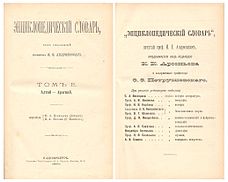
In 1889, at the initiative of Semyon Vengerov [2] , the owner of one of the St. Petersburg printing houses, Ilya Abramovich, signed a contract with the German publishing house FA Brockhaus to translate into Russian the large encyclopedic dictionary Konversations-Lexikon , released by this publishing house [3] . Initially it was supposed to be limited to the translation of this edition, but only with a more detailed description of issues relating to Russia. It was supposed to release only 16-18 volumes.
The first eight volumes (up to the letter “B”), published under the general editorship of Professor Ivan Efimovich Andreevsky , were almost a literal translation with a small adaptation for the Russian reader. These volumes have caused a lot of complaints about the quality of the translation, the general management of the publication also left much to be desired.
After the death of Professor Andreevsky, the editors were headed by Academician Konstantin Konstantinovich Arsenyev and Professor at St. Petersburg University Fedor Fomich Petrushevsky , which marked a new period in the history of the encyclopedia [3] . Starting from volume 9, the translation material goes to the background, it becomes much more actual and statistical material. Particular attention is paid to geographical articles, the editorial states: “Russian cities fit absolutely everything, with the addition of towns, villages and villages with more than 3 thousand inhabitants, or for some reason worthy of attention” [3] .
"Encyclopedic Dictionary" began to be printed in two versions. The first, more luxurious and expensive, consisted of 41 volumes, the second, with a more modest design, of 82 half-books. Having broken its expensive publication in half a dozen, the company made it more accessible to wide sections of readers, thanks to which the circulation was brought to a record time - 130 thousand copies.
Many outstanding scientists and philosophers of that time were invited to the editorial staff: Dmitri Ivanovich Mendeleev , Vladimir Sergeevich Soloviev , Semyon Afanasyevich Vengerov , Andrei Nikolaevich Beketov , Alexander Ivanovich Voeikov and many others. From this point on, the encyclopedia begins to be replenished with original articles, and the focus is on issues relating to the history, culture and geography of Russia. Repression of translated articles by original ones, the emergence of new authors affected the very nature of the publication: it turned from a trivial encyclopedia into a collection of the latest achievements and discoveries in all areas of science and technology [4] .
"Encyclopedic Dictionary" was published from 1890 to 1904. Every year 4-5 volumes were published. Circulation fluctuated quite significantly: from 12 thousand copies in 1890 to 25 thousand in 1897. Polutoma 54 and 55, containing an extensive comprehensive description of Russia (1899), were published in editions of 35 thousand copies [5] . A large circulation at that time caused the dictionary to be widely distributed in the market, despite the rather high price [6] .
By 1907, an additional 4 half-volumes were published, and all the most significant of them were included here, which for various reasons were missed in previous volumes or appeared after the encyclopedia was released. The 82nd half-time ends with the “Portrait Gallery” of editors and staff of the Encyclopedic Dictionary, consisting of 300 portraits of phototypes : from the chief editor to a simple typesetter [7] .
At the same time, in the years 1899–1902, the Small Encyclopedic Dictionary of Brockhaus and Efron was published in three volumes [8] ; in 1907-1909 his second edition was published in four volumes [9] .
In 1911, the New Encyclopedic Dictionary began to be published under the editorship of Konstantin Konstantinovich Arsenyev [6] , which was supposed to cover the same range of knowledge as ESBE, but in a more compact and modern processing. In 1916, due to the difficulties of wartime, the dictionary was terminated on the 29th volume of the originally planned 48 volumes of this publication [2] . Correctional copies of the 30th (“ Padalka ” - “ Perm Diocese ”; incomplete, without beginning) and the 31st volume (“ Perm system ” - “ Poznan Great Principality ”) are kept in the NLR . [10] .
Encyclopedia Features
A particularly large place in the “Dictionary” is occupied by articles on the history of Russia, its science, education, industry, culture [7] ; for example, the article " Russia " occupies two polutoma [3] .
DI Mendeleev was not only the author of the articles, but also edited many of them, directing the chemical engineering and factory departments of the encyclopedia. Moreover, most of the articles written by him personally or in co-authorship were marked not with the name, but with the Greek letter delta (Δ). The article “ Periodic legitimacy of chemical elements ” ended with the words:
In short, the wide applicability of P. law in the absence of an understanding of its cause is one of the signs that he is very new and deeply penetrates into the nature of chemical phenomena, and I, as a Russian, am proud to have participated in its establishment [11] .
- D. Mendeleev .
The periodic system continued to be built and replenished in front of the author's eyes: this is illustrated by the article " didymus ." In it, mentioning that Auer von Welsbach had already laid out this imaginary element on praseodymium and neodymium (in 1882), Mendeleev brings back the old layouts, concluding with their conclusion:
In the aggregate of all the given data, if we consider D. as a chemical individual element, then it should be placed in the fifth group of the DI Mendeleev system.
Another feature of the encyclopedia - a free style of presentation. Elements of fiction are found not only in biographical articles, many of which are read as fascinating stories, but also in scientific ones. In many respects, such relaxedness in the presentation of the material is also a consequence of the involvement of the most prominent scientists of that time in writing articles, because, as you know, the one who is free to orient himself in this field can be the most lucid in explaining something [12] . Moreover, then it was not accepted to edit articles, “combing” them with the same brush, and the author's style remained intact. It should be noted, however, that in articles on topics from history, art, literature, etc., this manner is sometimes combined with a violation of the principle of objectivity: so the authors introduce their own opinions or their own assessments to cover the issue [13] .
When creating an ESBE, it was not without typos, repetitions (articles: " Amsler Samuel " and " Amzler Samuil "; " Anidrozis " and " Anhidrosis or Anidroz "; " Antonsky-Prokopovich Anton Antonovich " and " Prokopovich-Antonsky, Anton Antonovich ", etc. .), as well as curiosities, the most famous of which is referred to as "The Unmindful Dog ."
Today, ESBE materials are in the public domain ; Although the encyclopedia is already outdated in scientific and technical terms and in the coverage of many humanitarian issues, many of its articles are still of exceptional informational, cultural and historical value. Despite the presence of significant alternative projects, such as the Pomegranate Encyclopedia or the “ Big Encyclopedia edited by Yuzhakov, ” the ESBE is recognized as the best pre-revolutionary Russian universal encyclopedia [4] .
In the newest social and anthropological studies, a thesis was expressed about the definite influence that ESBE had on the Soviet encyclopedic tradition [14] .
Authors and Editors
- See also the portrait gallery of editors and staff .
ESBE in culture
Mikhail Bulgakov in 1923 wrote a comic feuilleton "How much Brockhaus can the body endure?" About how "one lazy librarian" answered the question of a mechanic who was eager for knowledge and said that "information about everything decisively" is available in Brockhaus's dictionary. The poor locksmith mastered 5 books,
However, already from the second volume the mechanic has become little to eat, has somehow become inclined and became absent-minded. With a sigh, he changed the book he had read to a new one, and asked the Kultotdelovsky grymsa, entrenched in dusty book barricades, “was there much left?” In the fifth book, strange things began to happen to him. So, in broad daylight, he saw Bann-Abul-Abbas-Ahmed-ibn-Mohammed-Othman-ibn-ala , the famous Arabic mathematician in a white turban, in the street, at the entrance to the workshops.
The mechanic was silent on the day of the appearance of the Arab who wrote “Talkis-amal al-hisab”, guessed what to do intermission, and did not read until the evening. This, however, did not save him from two visits in the silence of a sleepless night - first the cheeky syndic of the free Hanseatic city of Edward Banks , and then the governor of the office of the Little Russian governor Dimitri Nikolayevich Bantysh-Kamensky [15] .
ESBE is mentioned in the novel The Golden Calf . Tom ESBE kept houses at Vasisualiy Lokhankina :
It was easy to think about all this, walking around the room in felt boots, bought Varvar money, and glancing at your favorite cupboard, where the roots of the Brockhouse Encyclopedic Dictionary flickered with church gold. For a long time Vasisualy was stacking in front of the cupboard, shifting his eyes from the spine to the spine.
Editions
Encyclopedic Dictionary
- T. 1 (1): A - Altai. - 1890. - 4, 480 s, 10 l. Il., maps. ( on the website of the RSL )
- T. 1A (2): Altai - Aragvay. - 1890. - 2, 481-954, II p., 19 p. Il., maps. ( on the website of the RSL )
- T. 2 (3): Arago - Autka. - 1890. - 2, 478, 2 s, 17 l. Il., maps. ( on the website of the RSL )
- T. 2A (4): Auto - Banks. - 1891. - 4, 479-946, 2 s, 19 p. Il., maps. ( on the website of the RSL )
- T. 3 (5): Banks - Berger. - 1891. - 2, 480 s, 10 l. Il., maps. ( on the website of the RSL )
- T. 3A (6): Berger - Bis. - 1891. - 2, 481–956, 3 p. Il., maps. ( on the website of the RSL )
- Vol. 4 (7): Bitburg - Bosch. - 1891. - 4, VIII, 472 s, 6 l. Il., maps. ( on the website of the RSL )
- T. 4A (8): Bos - Bunchuk. - 1891. - 6, VI, 473-940, 7 p. silt ( on the website of the RSL )
- Vol. 5 (9): The Boons - Walter. - 1891. - 4, IV, 468, XII pp., 5 p. silt ( on the website of the RSL )
- T. 5A (10): Walter - Venuti. - 1892. - 4, 469-938, 2 s, 8 l. silt ( on the website of the RSL )
- Vol. 6 (11): Venzano - Winona. - 1892. - 4, II, 488, 2 s, 7 p. Il., maps. ( on the website of the RSL )
- T. 6A (12): Vinoslov - Volan. - 1892. - 6, 489-944, 2 s, 15 l. Il., maps. ( on the website of the RSL )
- T. 7 (13): Volapyuk - Vygovsky. - 1892. - 4, 480 s, 10 l. Il., maps. ( on the website of the RSL )
- T. 7A (14): Vyhovsky - Galban. - 1892. - 8, 481-952, 4, 4 s, 4 l. silt ( on the website of the RSL )
- V. 8 (15): Galberg - Germanium. - 1892. - 6, 478, 2 s, 10 l. silt ( on the website of the RSL )
- T. 8A (16): Germany - Go. - 1893. - 8, 479-958, II, 2 p.10 l. Il., maps. ( on the website of the RSL )
- V. 9 (17): Goa - Graver. - 1893. - 6, 474 s, 13 l. silt ( on the website of the RSL )
- T. 9A (18): Gravilat - Davenant. - 1893. - 8, 475-974, II, 2 s, 17 l. Il., maps. ( on the website of the RSL )
- T. 10 (19): Davenport - Desmin. - 1893. - 4, 480 s, 2 l. silt ( on the website of the RSL )
- T. 10A (20): Desmurgy - Domitian. - 1893. - 481-960, II p., 8 p. Il., maps. ( on the website of the RSL )
- T. 11 (21): Domitia - Evreinova. - 1893. - 6, 466 s, 9 l. Il., maps. ( on the website of the RSL )
- T. 11A (22): Evreinovs - Zhilon. - 1894. - 4, 467–958, II, 2 s, 11 p. Il., maps. ( on the website of the RSL )
- V. 12 (23): Veins - Sempach. - 1894. - 6, 480 s, 11 l. Il., maps. ( on the website of the RSL )
- T. 12A (24): Semper - Imid Acids. - 1894. - 8, 481-960, II, 2 s, 6 l. silt ( on the website of the RSL )
- T. 13 (25): Imidoesters - Historical School. - 1894. - 8, 480 s, 7 l. Il., maps. ( on the website of the RSL )
- T. 13A (26): Historical journals - Kalaidovich. - 1894. - 8, 481-960, II, 2 s, 7 l. Il., maps. ( on the website of the RSL )
- T. 14 (27): Kalaka - Kardam. - 1895. - 4, 480 s, 8 l. Il., maps. ( on the website of the RSL )
- T. 14A (28): Kardanahi - Kero. - 1895. - 6, 481-960, II, II p., 5 l. silt ( on the website of the RSL )
- V. 15 (29): Kerosene - Coye. - 1895. - 6, 478 s, 8 l. Il., maps. ( on the website of the RSL )
- T. 15A (30): Koala - Concordia. - 1895. - 2, II, 2, 479-960, II p., 9 p. Il., maps. ( on the website of the RSL )
- T. 16 (31): Concord - Koyalovich. - 1895. - 6, 480 s, 11 l. Il., maps. ( on the website of the RSL )
- T. 16A (32): Koyalovich - Pendant. - 1895. - 6, 481-960, II, 2 s, 16 l. Il., maps. ( on the website of the RSL )
- V. 17 (33): Kultagoy - Ice. - 1896. - 4, 482 s, 16 l. Il., maps. ( on the website of the RSL )
- T. 17A (34): Ledier - Loparev. - 1896. - 6, 483-960, II, 2 s, 15 l. Il., maps. ( on the website of the RSL )
- V. 18 (35): Lopari - Juvenile Criminals. - 1896. - 4, 480 s, 16 l. Il., maps. ( on the website of the RSL )
- T. 18A (36): Childhood - Meishagol. - 1896. - 6, 481–958, II, 2 s, 7 p. silt ( on the website of the RSL )
- T. 19 (37): Mekenen - Mifu-Banya. - 1896. - 4, 476 s, 12 l. Il., maps. ( on the website of the RSL )
- T. 19A (38): Mikhail Order - Moscow Telegraph. - 1896. - 6, 477-960, II, 2 s, 21 l. Il., maps. ( on the website of the RSL )
- V. 20 (39): Moscow University - Corrections for correction. - 1897. - 6, 480 s, 20 l. Il., maps. ( on the website of the RSL )
- T. 20A (40): Mandatory chieftain - Tawning. - 1897. - 8, 481-960, II, 2 s, 14 l. Il., maps. ( on the website of the RSL )
- T. 21 (41): Nibelungs - Neffzer. - 1897. - 4, 480 s, 17 l. Il., maps. ( on the website of the RSL )
- T. 21A (42): Nashville - Opacky. - 1897. - 8, 481-960, II, 2 s, 30 l. Il., maps. ( on the website of the RSL )
- T. 22 (43): Ward - Outsider. - 1897. - 4, 480 s, 18 l. Il., maps. ( on the website of the RSL )
- T. 22A (44): Owen - Patent about fights. - 1897. - 6, 481-960, II p., 27 l. Il., maps. ( on the website of the RSL )
- V. 23 (45): Patents for inventions - Petropavlovsk. —1898. - 4, 474 s, 15 l. Il., maps. ( on the website of the RSL )
- T. 23A (46): Petropavlovsk - By the way. - 1898. - 4, II, 475–958, II, 2 s, 20 l. Il., maps. ( on the website of the RSL )
- T. 24 (47): Imperative mood - Polar coordinates. - 1898. - 4, 474 s, 18 l. Il., maps. ( on the website of the RSL )
- T. 24A (48): Polar Lights - Praia. - 1898. - 4, II, 475–958, II, 2 s, 11 p. Il., maps. Table. ( on the website of the RSL )
- T. 25 (49): Prayaga - Delay of vacation. - 1898. - 4, 478 s, 10 l. Il., maps. ( on the website of the RSL )
- T. 25A (50): Prostatitis - Workhouse. - 1898. - 4, II, 2, 479-958, II, 2 p. ( on the website of the RSL )
- T. 26 (51): Working Book - Resolution. - 1899. - 6, 480 s, 10 l. silt ( on the website of the RSL )
- T. 26A (52): Resonance and Resonators - Rosa di Tivoli. - 1899. - 4, II, 481-960, II, 2 s, 13 l. Il., maps. ( on the website of the RSL )
- T. 27 (53): Razawen - Turnip. - 1899. - 6, 480 s, 22 l. silt ( on the website of the RSL )
- T. 27A (54): Repina - Ryaskoye and Russia. - 1899. - 4, II, 481-532, 1-420, IV p. 51 l. Il., maps. Table. ( on the website of the RSL )
- T. 28 (55): Russia and S - Savarna. - 1899. - 6, 421-874, IV, 2, 1-24 s, 16 l. Il., maps. Table. ( on the website of the RSL )
- T. 28A (56): Savarni - Suharon. - 1900. - 4, II, 25-496, II p., 15 p. Il., maps. ( on the website of the RSL )
- T. 29 (57): Sugar - Seven Wise Men. - 1900. - 8, 468 s, 10 l. Il., maps. ( on the website of the RSL )
- T. 29A (58): Seven Lakes - Symphony. 1900. - 4, II, 469-954, II, 2 s, 16 p. Il., maps. ( on the website of the RSL )
- T. 30 (59): Sim - Slyuzka.— 1900. - 4, 2, 480 s, 9 p. Il., maps. ( on the website of the RSL )
- T. 30A (60): Slyuz - Sofia Paleolog. —1900. - 4, II, 481-960, II, 2 s, 22 p. Il., maps. Table. ( on the website of the RSL )
- T. 31 (61): Sofia - Static. - 1900. - 6, 472 s, 11 l. Il., maps. ( on the website of the RSL )
- T. 31A (62): Statics - Judicial System. - 1901. - 4, II, 473-954, II, 2 s, 10 l. silt ( on the website of the RSL )
- V. 32 (63): Shipping Charges - Taitsy. - 1901. - 4, 480 s, 14 l. Il., maps. ( on the website of the RSL )
- T. 32A (64): Thai - Termites. - 1901. - 4, II, 481-960, II, 2 s, 10 l. Il., maps. ( on the website of the RSL )
- V. 33 (65): Thermal sensations - Tombazi. - 1901. - 4, 478 s, 25 l. Il., maps. ( on the website of the RSL )
- T. 33A (66): Tombby - Truly Cathedral. - 1901. - 4, II, 479-960, II, 2 s, 5 l. Il., maps. ( on the website of the RSL )
- T. 34 (67): Trump - Carbon Calcium. - 1901. - 4, 482 s, 5 l. Il., maps. ( on the website of the RSL )
- T. 34A (68): Carbon - Effort. - 1902. - 6, II, IV, 483-960, II, 2 s, 16 l. silt ( on the website of the RSL )
- V. 35 (69): Usinsk Border District - Phenol. - 1902. - 4, 476 seconds, 7 p. Il., maps. ( on the website of the RSL )
- T. 35A (70): Phenols - Finland. - 1902. - 4, II, 477-960, II p., 10 l. Il., maps. ( on the website of the RSL )
- T. 36 (71): Finland - Franconia. - 1902. - 4, 478 s, 15 l. Il., maps. ( on the website of the RSL )
- T. 36A (72): Franconian Dynasty - Khaki. - 1902. - 4, II, 479-956, II, 2 s, 12 l. Il., maps. ( on the website of the RSL )
- Т. 37 (73): Хаким — Ходоров. — 1903. — 6, 478 с, 18 л. ил., карт. ( на сайте РГБ )
- Т. 37А (74): Ходский — Цензура. — 1903. — 2, II, 479—962, II, 2 с, 11 л. ил., карт. ( на сайте РГБ )
- Т. 38 (75): Цензурный комитет — Человек. — 1903. — 4, 482 с, 9 л. ил. ( на сайте РГБ )
- Т. 38А (76): Человек — Чугуевский полк. — 1903. — 6, II, 483—958, 2, 2 с, 10 л. ил., карт. ( на сайте РГБ )
- Т. 39 (77): Чугуев — Шен. — 1903. — 6, 480 с, 7 л. ил., карт. ( на сайте РГБ )
- Т. 39А (78): Шенье — Шуйский монастырь. — 1903. — 4, II, 481—960, II с., 6 л. ил. ( на сайте РГБ )
- Т. 40 (79): Шуйское — Электровозбудимость. — 1904. — 4, 4, 468 с, 9 л. ил. ( на сайте РГБ )
- Т. 40А (80): Электровозбудительная сила — Эрготин. — 1904. — 4, II, 469—954, 2 с, 13 л. ил. ( на сайте РГБ )
- Т. 41 (81): Эрдан — Яйценошение. — 1904. — 4, 576 с, 7 л. ил., карт. ( на сайте РГБ )
- Т. 41А (82): Яйцепровод — Ѵ. — 1904. — 6, IV, 577—956, 4 с, 6 л. ил., карт., 28 л. портр. ( на сайте РГБ )
Дополнительные тома:
- Т. 1 (1): Аа — Вяхирь. — 1905. — 4, 478 с, 6 л. ил., карт. ( на сайте РГБ )
- Т. 1А (2): Гаагская конференция — Кочубей. — 1905. — 4, 481—956, II, 2 с.3 л. ил., карт. ( на сайте РГБ )
- Т. 2 (3): Кошбух — Прусик. — 1906. — 2, 480 с, 8 л. ил., карт. ( на сайте РГБ )
- Т. 2А (4): Пруссия — Фома. Russia. — 1907. — 2, 481—934, XCVIII, 4 с, 19 л. ил., карт. ( на сайте РГБ )
Новый энциклопедический словарь
- Т. 1: А — Александр Михайлович. — [1911]. — 9 с, 984 стб., 2 с, 28 л. Il., Portr., maps. ( на сайте РГБ )
- Т. 2: Александр Ягеллон — Антидор. — [1911]. — 9 с, 964 стб., 2 с, 27 ил., портр., карт. ( на сайте РГБ )
- Т. 3: Антидот — Асканий. — [1911]. — 6 с, 964 стб., 16 л. Il., Portr., maps. ( на сайте РГБ )
- Т. 4: Аскания — Балюз. — [1911]. — 8 с, 952 стб., 2 с, 21 л. Il., Portr., maps. ( на сайте РГБ )
- Т. 5: Балюстрада — Беранже. — [1911]. — 8 с, 960 стб., 2 с, 11 л. Il., Portr., maps. ( на сайте РГБ )
- Т. 6: Берар — Бобровникова. — [1912]. — 8 с, 960 стб., 2 с, 17 ил., портр., карт. ( на сайте РГБ )
- Т. 7: Бобровников — Брачное право. — [1912]. — 8 с, 976 стб., 2 с, 9 л. ил., портр. ( на сайте РГБ )
- Т. 8: Брачный наряд — Белорусы. — [1912]. — 8 с, 964 стб., 2 с, 29 л. ил., портр. ( на сайте РГБ )
- Т. 9: Белорыбица — Вельможа. — [1912]. — 8 с, 960 стб., 16 л. ил. ( на сайте РГБ )
- Т. 10: Вёльнер — Власть дисциплинарная. — [1912]. — 8 с, 960 стб., 2 с, 26 л. ил., карт. ( на сайте РГБ )
- Т. 11: Власть карательная — Выгорание всходов растений. — [1913]. — 8 с, 960 стб., 2 с, 30 л. Il., Portr., maps. ( на сайте РГБ )
- Т. 12: Выгорецкая пустынь — Генеральный атторней. — [1913]. — 8 с, 960 стб., 2 с, 23 л. ил., портр. ( на сайте РГБ )
- Т. 13: Генеральный двор — Головнин. — [1913]. — 8 с, 960 стб., 2 с, 30 л. ил., карт. ( на сайте РГБ )
- Т. 14: Головнин — Гривица. — [1913]. — 8 с, 940, XXII, XVI стб., 2 с, 39 л. ил., карт., табл. ( на сайте РГБ )
- Т. 15: Гривна — Десмургия. — [1913]. — 9 с, 960 стб., 2 с, 20 л. Il., Portr., maps. ( на сайте РГБ )
- Т. 16: Десна — Душевнобольные. — [1914]. — 8 с, 960 стб., 2 с, 28 л. Il., Portr., maps. ( на сайте РГБ )
- Т. 17: Душевные болезни — Жуки. — [1914]. — 8 с, 964, XII стб., 2 с, 25 л. ил., карт. ( на сайте РГБ )
- Т. 18: Жукова — Ивница. — [1914]. — 8 с, 960 стб., 2 с, 28 л. Il., Portr., maps. ( на сайте РГБ )
- Т. 19: Ивовые — Итальянское искусство. — [1914]. — 8 с, 980 стб., VI, 2 с, 27 л. Il., Portr., maps. ( на сайте РГБ )
- Т. 20: Итамарка — Каринский. — [1914]. — 8 с, 960 стб., 2 с, 20 л. ил., портр. ( на сайте РГБ )
- Т. 21: Каринтин — Кнорринг. — [1914]. — 8 с, 960 стб., 2 с, 18 л. ил., карт. ( на сайте РГБ )
- Т. 22: Кнорр — Которосль. — [1915]. — 8 с, 960 стб., 2 с, 24 л. Il., Portr., maps. ( на сайте РГБ )
- Т. 23: Котошихин — Ламберт. — [1915]. — 9 с, 960 стб., 2 с, 28 л. Il., Portr., maps. ( на сайте РГБ )
- Т. 24: Ламберт — Лубоеды. — [1915]. — 8 с, 960 стб., 2 с, 26 л. ил., портр. ( на сайте РГБ )
- Т. 25: Луб — Мах. — [1915]. — 8 с, 960 стб., 2 с, 15 л. ил., карт. ( на сайте РГБ )
- Т. 26: Мацеевский — Молочная кислота. — [1915]. — 8 с, 960 стб., 2 с, 14 л. Il., Portr., maps. ( на сайте РГБ )
- Т. 27: Молочница — Наручи. — [1916]. — 8 с, 960 стб., 2 с, 18 л. ил., карт. ( на сайте РГБ )
- Т. 28: Нарушевич — Ньютон. — [1916]. — 8 с, 960 стб., 2 с, 20 л. Il., Portr., maps. ( на сайте РГБ )
- Т. 29: Ньюфаундленд — Отто. — [1916]. — 8 с, 960 стб., 2 с, 15 л. ил., карт. ( на сайте РГБ )
- Т. 30: Падалка — Пермская епархия. — [191..]. — 129—960 стб., ил. — Неполный корректурный экземпляр (хранится в РНБ )
- Т. 31: Пермская система — Познанское великое княжество. — [191..]. — 960 стб., ил. — Корректурный экземпляр (хранится в РНБ )
Малый энциклопедический словарь (1907—1909)
- Малый энциклопедический словарь. Т. 1 Вып. 1: А — Гальванотропизм. — СПб.: Брокгауз-Ефрон, 1907. — 1055 с.
- Малый энциклопедический словарь. Т. 1 Вып. 2: Гальванохромия — Кившенко. — СПб.: Брокгауз-Ефрон, 1907. — 1058—2079 с.
- Малый энциклопедический словарь. Т. 2 Вып. 3: Кигн — Початок . — СПб.: Брокгауз-Ефрон, 1909. — 1055 с.
- Малый энциклопедический словарь. Т. 2 Вып. 4: Почва — Иссоп . — СПб.: Брокгауз-Ефрон, 1909. — 1058—2215 с.
Современные переиздания
- Энциклопедический словарь Брокгауз и Ефрон: Биографии: В 12 т. — М.: «Советская энциклопедия» , «Большая Российская энциклопедия» , 1991—1996 (вышло только 6 томов).
- Энциклопедический словарь. В 86 т. Репр. воспр. ed. «Энциклопедический словарь Ф. А. Брокгауза и И. А. Ефрона». — СПб.: Фирма «ПОЛРАДИС», АООТ «Иван Фёдоров», 1993—2003. — ISBN 5-900741-01-X .
- Энциклопедический словарь Брокгауза и Ефрона в 82 т. и 4 доп. т. — М.: Терра, 2001. — 40 726 с.
Notes
- ↑ Энциклопедический словарь Брокгауза и Ефрона . klassikaknigi.info. Дата обращения 6 ноября 2016.
- ↑ 1 2 Брокгауз-Ефрон // Большая советская энциклопедия : в 66 т. (65 т. и 1 доп.) / гл. ed. О. Ю. Шмидт . — М. : Советская энциклопедия , 1926—1947.
- ↑ 1 2 3 4 Брокгауз Ф. А. Энциклопедический словарь Брокгауза и Ефрона . — М. : Рипол Классик, 2013. — 524 с. — ISBN 5458053214 . — ISBN 9785458053211 .
- ↑ 1 2 Выставка к 125-летию издательства «Брокгауз и Ефрон» . Приморский музей имени Арсеньева . Дата обращения 5 марта 2018.
- ↑ Жарков, И. А. Жанровая структура Энциклопедического словаря Ф. А. Брокгауза — И. А. Ефрона, 1890—1907 147 (2000). — тема диссертации и автореферата по ВАК 05.25.04. Дата обращения 5 марта 2017.
- ↑ 1 2 Интеллектуальная поисковая система по словарям. Словарь Ожегова, Даля, Ушакова, Брокгауза и Ефрона, БСЭ (Большая советская энциклопедия) . boloto.info. Дата обращения 5 марта 2018.
- ↑ 1 2 Список товаров по издателям: «Издательство Брокгауза и Ефрона» на сайте магазина антикварных книг obook.ru.
- ↑ Малый энциклопедический словарь [Текст] : с приложением кратких руководств по различным отраслям знания и словарей иностранных языков : [в 3 т.] / Ф. А. Брокгауз, И. А. Ефрон. — СПб. : Издательское дело, Брокгауз-Ефрон, 1899—1902.
- ↑ См. подраздел Малый энциклопедический словарь (1907—1909) .
- ↑ Новый энциклопедический словарь в Викитеке.
- ↑ Периодическая законность химических элементов // Энциклопедический словарь Брокгауза и Ефрона : в 86 т. (82 т. и 4 доп.). - SPb. , 1890-1907.
- ↑ Выставка «Словари и энциклопедии Брокгауз — Ефрон. Часть 1: Энциклопедический словарь. (К 125-летию выхода первого тома)» на сайте Российской государственной библиотеки
- ↑ О. Васильева, И. Тиньгаевач Универсальная энциклопедия — репутация одной из лучших в мире: к 125-летию выхода в свет энциклопедического словаря А. Ф. Брокгауза и И. А. Ефрона // Центральная библиотечная система города Челябинска, 7 августа 2015
- ↑ Федоров П.В. Статуи и монументы: Имперский некрополь Санкт-Петербурга (Смоленское православное кладбище) в зеркале энциклопедической биографии. . - SPb. : МБИ, 2018. — 214 с. — ISBN 978-5-4391-0382-9 .
- ↑ М. А. Булгаков. Сколько Брокгауза может вынести организм? Library.Ru. Дата обращения 5 марта 2018.
Literature
- Кауфман И. М. Русские энциклопедии. Issue 1. Общие энциклопедии. — М., 1960. — 103 с.
- Игорь Жарков «Жанровая структура Энциклопедического словаря Ф. А. Брокгауза — И. А. Ефрона, 1890−1907» (диссертация). 2000
- Зыков Дмитрий . Про энциклопедию Брокгауза и беспамятную собаку // Наука и жизнь . — 2014. — № 11. — С. 85—89.
- Федоров П. В. Статуи и постаменты: Имперский некрополь Санкт-Петербурга (Смоленское православное кладбище) в зеркале энциклопедической биографии. — СПб.: Международный банковский институт, 2018. — 214 с., ил., табл. — ISBN 978-5-4391-0382-9
Links
- Брокгауза и Ефрона энциклопедический словарь / Кауфман И. М. // Брасос — Веш. — М. : Советская энциклопедия, 1971. — С. 45. — ( Большая советская энциклопедия : [в 30 т.] / гл. ред. А. М. Прохоров ; 1969—1978, т. 4).
- Брокгауз-Ефрон // Большая советская энциклопедия : в 66 т. (65 т. и 1 доп.) / гл. ed. О. Ю. Шмидт . — М. : Советская энциклопедия , 1926—1947.
Тексты словаря в Интернете
- Энциклопедический словарь Брокгауза и Ефрона в Викитеке
- Малый энциклопедический словарь Брокгауза и Ефрона в Викитеке
- Новый энциклопедический словарь в Викитеке