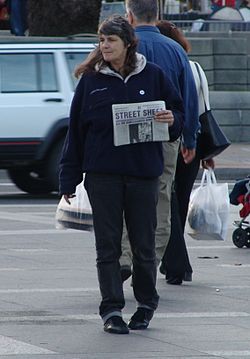
Street newspaper ( English street newspapers or English street papers ; sometimes “street leaflet”) - a newspaper , magazine , or other periodical distributed by homeless or poor people, and published mainly with the aim of supporting them, as well as to change the attitude of society to the homeless, poor and other needy [1] .
Typically, some articles in street newspapers are also written by homeless or poor people [1] .
The principle of operation of all street newspapers is similar: the distributor, who can become a homeless or poor person, buys copies of the publication for about 50% of its cost [2] , and then sells it at the declared price, without the right to change it, and following the rules established by the publication [3 ] .

The first prototypes of street newspapers arose in the late XIX - early XX century. For example, from 1915 to 1920-1930, the Hobo News newspaper for homeless migrants was published in Cincinnati ( Ohio , USA ).
Nevertheless, in a modern format and with the use of a typical business model, street newspapers became widespread only in the late 1990s, since the creation of Street News in New York in 1989 [1] [3] [4] .
In 1991, the most successful street newspaper was born in London - The Big Issue , created by John Bird and Anita Roddick .
In 1994 in Glasgow ( Scotland , Great Britain ), the International Network of Street Papers was formed , uniting 120 street newspapers from 40 countries [5] . In 2008, the International Network of Street Newspapers established its own prize [6] .
Since the mid-2000s, street newspapers, like all print media, have been faced with the problem of leaving readers online. For example, since 2007, the Big Issue circulation fell from 167,000 to less than 125,000 in 2012 [7] . However, in 2013, DW noted that, unlike traditional print media, German street newspapers were increasingly popular, citing the example of the oldest German street newspaper Biss, whose circulation increased to 6 million [8] .

Most street newspapers are not focused on commercial activities and exist on grants, however, some of them operate on the principles of social entrepreneurship , being fully or substantially self-supporting and financially sustainable enterprises [1] [4] .
Among the latter, in particular, one can cite the example of the publication The Big Issue [1] created in 1991 in Great Britain , as well as the Russian street newspaper Put Home , which has been published since 1994.
In addition to providing financial support to those in need, street newspapers perform a number of other functions [1] [4] . For example, they work with the homeless / poor community from within, as well as with society, reporting social problems and suggesting ways to solve them [4] . In addition, among the publishers of street newspapers, art-therapy projects for the homeless, the arrangement of exhibitions of their works and other cultural events are widespread [4] .
The business model of street newspapers is sometimes criticized, in particular for turning an image of a homeless person into a product that is sold as a souvenir [4] .
Notes
- ↑ 1 2 3 4 5 6 Danna Harman. Read all about it: street papers flourish across the US . The Christian Science Monitor (November 17, 2003). Date of treatment May 6, 2015.
- ↑ Some street newspapers allow you to pay after sale.
- ↑ 1 2 Boukhari, Sophie. The Press Takes to the Street . UNESCO Courier (1999). Date of treatment May 6, 2015.
- ↑ 1 2 3 4 5 6 Alexandra OSINA. Work with the homeless, Western experience . Charity.ru (April 29, 2009). Date of treatment May 6, 2015.
- ↑ Silja JA Talvi. Reporting From The Ground Up . In these times (28 June 2008). Date of treatment May 6, 2015.
- ↑ Sanjay Suri. MEDIA: Against Giant Odds, A Touch of Triumph . Inter press service (27 June 2008). Date of treatment May 6, 2015.
- ↑ The Big Issue magazine: Help the homeless! (eng.) . The Economist (January 7, 2012). Date of treatment May 6, 2015.
- ↑ Natalia Koroleva. Street newspapers in Germany are strengthening their position . DV (July 29, 2013). Date of treatment May 6, 2015.