Yoko Tsukasa ( Japanese 司 葉子 : Tsukasa Yoko ); English Yōko Tsukasa , real name is Yoko Shoji ( Japanese 庄 司 葉子 ); genus. August 20, 1934 in the city of Sakaiminato , Tottori Prefecture , Japan ) - one of the most popular Japanese film actresses of the 1950-1970s. Her career includes both dramatic and comedic roles. She starred in films of prominent directors of her time, including such as Yasujiro Ozu , Akira Kurosawa , Kon Ichikawa , Mikio Naruse and Masaki Kobayashi . She was named the best actress of 1966 and was awarded the film award " Blue Ribbon ", " Kinem Jumpo " and " Mainity ".
| Yoko tsukasa | |
|---|---|
| Japanese 司 葉子 English Yōko Tsukasa | |
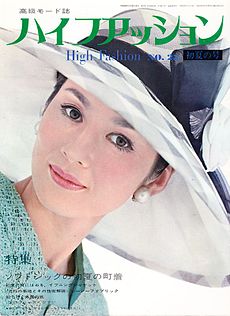 fashion magazine cover ハ イ フ ァ ッ シ ョ ン / Hai fasshon (High fashion), 1965 | |
| Birth name | Yoko Shoji (庄 司 葉子 Shōji Yōko) |
| Date of Birth | August 20, 1934 (85 years old) |
| Place of Birth | Sakaiminato , Tottori Prefecture , Japan |
| Citizenship |  Japan Japan |
| Profession | actress |
| Career | 1954-2005 |
| Awards | |
| IMDb | |
Biography
Early years
The actress was born into the family of coal miner Hanjiro Shoji and his wife Isi, in whom she was her third daughter [1] . At the age of seven, she lost her father [2] . After graduating from high school in 1953, she went to Tokyo, where she entered home economics at Kyoritsu Women's Junior College [3] . In April 1954, she got a job as secretary of the president of the Shin-Nihon Broadcast Company in Osaka (currently MBS) [1] . On May 21 of the same year, a young beautiful girl graced the cover of The Yomiuri Weekly [1] , where she got on the recommendation of a friend. In the same year she made her film debut, playing a major role in Seiji Murayama’s film “You Can't Die”, in which she was invited to see the role on the cover of the magazine [1] . In this film, Yoko played the role of a girl affected by the atomic bombing [2] . The film was rather well received by the public and critics, and the next year the girl will star in ten films, signing a contract with the film company " Touhou ".
Movie career
At the beginning of her film career, Yoko Tsukasa specialized in the roles of beautiful bourgeois girls, so common for films of the film company Tojo [3] . Her elegant appearance and good acting performance soon did the trick and she became one of the most popular stars of her generation [2] . Her partners on the movie screen were such popular stars as Ryo Ikebe , Akira Takarada and Koji Tsuruta .
In the second half of the 1950s, the actress expanded her role, while receiving critical acclaim [3] in such films as “Confrontation of the underworld” ( 1960 , dir. Chihati Okamoto ) and “Blue Beast” ( 1960 , dir. Hiromichi Horikawa). The famous director Yasujiro Ozu Tsukasa played a good daughter in a middle-class family in the films “ Late Autumn ” ( 1960 ) and “ Autumn in the Kohayagawa Family ” ( 1961 ). Other prominent directors she worked with were Mikio Naruse - Cirrus Clouds ( 1958 ), Night Stream ( 1960 , directed by Yuzo Kawashima ), Woman's Place ( 1962 ), Crash ( 1966 ), and Scattered the clouds ”( 1967 ); Akira Kurosawa - the role of Nui in the film "The Bodyguard " ( 1961 ), where the famous Toshiro Mifune acted as her partner.
For the role in the film Noboru Nakamura "Kinokawa" ( 1966 ), the actress was named the best in 1966 [2] and was awarded the three most prestigious national film awards " Blue Ribbon ", " Kinema Jumpo " and " Minichi ". Her psychologically complex roles in the already mentioned films of Naruse “Crash” and “Broken Clouds” are also noted by the praise of critics [4] . These two works of the actress, along with her performance as the concubine of Iti Sasahara in the film Masaki Kobayashi's “ Riot of Samurai ” ( 1967 ) are considered among the most significant in her career [4] .
In addition to the dramatic roles mentioned, Tsukasa throughout her career has performed in many comedy films of the Toho company. Since the mid -1960s, the actress began acting in television series, and from the mid -1970s on the stage [3] . During her career in cinema, the actress starred in more than a hundred films [5] . However, after 1980 she appeared on the movie screen extremely rarely.
Personal life
Since 1969, Yoko Tsukasa has been married to Eisuke Aizawa, having given birth to a daughter, Yoko Aizawa (相 沢 葉子) [4] .
Prizes and nominations
- Blue Ribbon Film Award
- 17th Award Ceremony (for 1966) - Prize for Best Actress in the movie "Kinokawa" [6]
- Mainity Film Award
- The 21st awards ceremony (for 1966) - the prize for best actress in the film "Kinokawa" [7] .
- Film award " Kinem Jumpo "
- 1967 - Award for Best Actress in 1966 - in the film "Kinokawa" [6] .
Filmography
| Filmography Yoko Tsukasa [8] [5] | ||||||
|---|---|---|---|---|---|---|
| Year | Russian name | original name | Romaji name | English name at international box office | Producer | Role |
| 1950s | ||||||
| 1954 | “ You can't die ” | 君 死 に 給 う こ と な か れ | Kimi shi ni tamou koto nakare | Forever be mine | Seiji murayama | Kumiko |
| 1955 | “ Peaceful Life ” (two-part film) | 天下 泰 平 | Tenka taihei | All is well | Toshio Sugie | Akiko Mori |
| The Eternal Jug | 不滅 の 熱 球 | Fumetsu no nekkyu | The immortal pitcher | Hideo Suzuki | Yuko Yonei | |
| “ Snow Flames ” (“Love in the Snow”) | 雪 の 炎 | Yuki no honoo | Love in the snow | Hisanobu Marubayashi | Yuko Aoyagi | |
| “ No response from car 33 ” | 33 号 車 応 答 な し | 33-go-sha oto nashi | No Response from Car 33 | Senkiti Taniguchi | Atsuko | |
| “ Fat Man ” (“Mother and Son”) | お え ん さ ん | Oen-san | Mother and son | Isiro Honda | Tamako Izumi | |
| “ Three brides for three sons ” | 初恋 三人 息 子 | Hatsukoi san-nin masuko | Three Brides for Three Sons | Nobuo Aoyagi | Sumie Hanamura | |
| " Love Story " | 愛 の 歴 史 | Ai no rekishi | Love story | Kajiro Yamamoto | Ayako Yashiro | |
| “ Marriage Relations ” | 夫婦 善哉 | Meoto zenzai | Love is shared like sweets | Shiro Toyoda | Fudeko | |
| “ Kiss ” (short story 2 - “The Girl in the Fog”) | く ち づ け | Kuchizuke: Ni-wa, kaettekita wakadanna | The First Kiss (segment 2 - Girl in the Mist) | Hideo Suzuki | Yoshiko | |
| " Tactics of love " | 帰 っ て 来 た 若 旦 那 | Kaettekita wakadan'na | Tactics of love | Nobuo Aoyagi | Kyoko Kikuchi | |
| 1956 | "The boss of the president " | へ そ く り 社長 | Hesokuri shachô | The president's boss | Yasuki Chiba | Yuko Otsuka |
| “ Everything is sold ” | 花嫁 会議 | Hanayome kaigi | All sold out | Nobuo Aoyagi | Jiro Nakanishi | |
| "---" | チ エ ミ の 初恋 チ ャ チ ャ 娘 | Chiemi no hatsukoi chaccha musume | Nobuo Aoyagi | Kyoko Harada | ||
| " Awesome daughter " | 見 事 な 娘 | Migotona musume | Everyone's Sweetheart | Harumi Mizuho | Kiriko Takahara | |
| “The boss of the president. Part 2 " | 続 へ そ く り 社長 | Zoku hesokuri shacho | The president talks bank | Yasuki Chiba | Yuko Otsuka | |
| Triple Engagement | 婚約 三 羽 烏 | Konyaku sanbagarasu | Three Youngmen and a Dream Girl | Toshio Sugie | Reiko | |
| " Blue Bud " ( short-cut ) | 青 い 芽 | Aoi me | Hideo Suzuki | bride | ||
| " Modern desire " | 現代 の 欲望 | Gendai no yokubo | Seiji maruyama | Setsuko Iizuka | ||
| " President Harikiri " | は り き り 社長 | Harikiri shacho | Kunio Watanabe | Harue Matsuno | ||
| " The case of a woman " | あ る 女 の 場合 | Aru onna no no baai | Harumi Mizuho | Mitsuko Misono | ||
| " Brother and sister " | 兄 と そ の 妹 | Ani to sono musume | Brother and sister | Xue Matsubayashi | Fumiko mamia | |
| " Summer of the solar eclipse " | 日 蝕 の 夏 | Nisshoku no natsu | Hiromichi Horikawa | Anzuko | ||
| 1957 | “ Petals of Oblivion ” | 忘却 の 花 び ら | Bokyaku no hanabira | Toshio Sugie | Ayuko Itinomy | |
| " Capital of Beauty " | 美貌 の 都 | Bibo no miyako | Xue Matsubayashi | Chikako Izumi | ||
| “ Petals of oblivion. Part 2 " | 忘却 の 花 び ら 完結篇 | Bôkyaku no hanabira: Kanketsuhen | Toshio Sugie | Ayuko Itinomy | ||
| " Risky Hero " | 危 険 な 英雄 | Kiken na eiyu | A dangerous hero | Hideo Suzuki | Yoko mihara | |
| " Hold on this night " | そ の 夜 の ひ め ご と | Sono yo no himegoto | The night holds a secret | Keigo Kimura | Haruko Endo | |
| " Samurai of our university " | 大学 の 侍 た ち | Daigaku no samurai tachi | Schooldays | Nobuo Aoyagi | Junko Mizuno | |
| Blue Mountains (two-part film) | 青 い 山脈 / 続 青 い 山脈 | Aoi sanmyaku | The blue mountains | Xue Matsubayashi | Yukiko Shimazaki | |
| 1958 | “ President. Part 1 " | 社長 三代 記 | Shachô sandaiki | President 1 | Xue Matsubayashi | Akika Nakamura, Secretary |
| " City of love " | 愛情 の 都 | Aijo no miyako | City of love | Toshio Sugie | Aiko hayakawa | |
| “ President. Part 2 " | 続 社長 三代 記 | Zoku shachô sandaiki | President 2 | Xue Matsubayashi | Akika Nakamura, Secretary | |
| Tokyo Vacations | 東京 の 休 日 | Tôkyô no kyûjitsu | A holiday in Tokyo | Kajiro Yamamoto | Yoko hori | |
| " Flower " | 花 の 慕 情 | Hana no bojo | The flower | Hideo Suzuki | Kozue Domoto | |
| " The Story of a Warm Spring Wind " | 風流 温泉 日記 | Furyu onsen nikki | Xue Matsubayashi | Kyoko Arisaka, Yone's daughter | ||
| Cirrus Clouds | 鰯 雲 | Iwashigumo | The summer clouds | Mikio Naruse | Michiko | |
| " Owl sermon " | み み ず く 説法 | Mimizuku seppo | Owl preaching | Seiji Hisamatsu | Kazuko | |
| 1959 | " The path under plane trees " | す ず か け の 散 歩 道 | Suzukake no sanpomichi | The path under the plane trees | Hiromichi Horikawa | Kumiko Katsuki |
| "---" | 花 の れ ん | Hana noren | Shiro Toyoda | Kyoko | ||
| "---" | 愛妻 記 | Aisai-ki | Record of Loving Your Wife | Seiji Hisamatsu | Yoshi Miyahara | |
| " University dolls " | 大学 の お 姐 ち ゃ ん | Daigaku no oneechan | University dolls | Toshio Sugie | Michiko Koda | |
| Samurai Saga | 或 る 剣 豪 の 生涯 | Aru kengo no shogai | Samurai saga | Hiroshi Inagaki | Ms. Otii / Princess Chiyo | |
| " 28 university guys " | 大学 の 28 人 衆 | Daigaku no nijuhachi-nin shu | The college ruggers | Nobuo Aoyagi | Takako Miyazaki | |
| "The annals of the gang of the Sengoku era " | 戦 国 群盗 伝 | Sengoku gunto-den | Saga of the vagabonds | Toshio Sugie | Tazu | |
| " Young lovers " | 若 い 恋人 た ち | Wakai koibitotachi | The young lovers | Yasuki Chiba | Kazuo Tsuda | |
| " Birth of Japan " | 日本 誕生 | Nippon tanjô | The birth of japan | Hiroshi Inagaki | Princess Oto Tachibana | |
| 1960s | ||||||
| 1960 | “ The confrontation of the underworld ” | 暗 黒 街 の 対 決 | Ankokugai no taiketsu | The last gunfight | Kihati okamoto | Sally |
| " Ruthless city " | 非 情 都市 | Hijotoshi | Hideo Suzuki | Chiaki Namiki | ||
| " Blue beast " | 青 い 野 獣 | Aoi yaju | The blue beast | Hiromichi Horikawa | Ayako Eito | |
| " Night stream " | 夜 の 流 れ | Yoru no nagare | Evening stream | Mikio Naruse , Yuzo Kawashima | Miyako Fujimura | |
| New Women's University | 新 ・ 女 大学 | Shin onna daigaku | New ladies' university | Seiji Hisamatsu | Kasumi Nishikawa | |
| " People living at the ends of the world " | 地 の 涯 に 生 き る も の | Chino hate ni ikiru mono | The angry sea | Seiji Hisamatsu | Saeko | |
| " Late Autumn " | 秋日 和 | Akibiyori | Late autumn | Yasujiro Ozu | Ayako Miva | |
| " Tysingura employees " | サ ラ リ ー マ ン 忠臣 蔵 | Sarariiman Chushingura | Salary man chushingura | Toshio Sugie | Keiko | |
| 1961 | “ Chushingura employees. Part 2 " | 続 サ ラ リ ー マ ン 忠臣 蔵 | Zoku sararîman Chûshingura | Salary Man Chushingura, Part 2 | Toshio Sugie | Keiko |
| " Eternity of love " | 別 れ て 生 き る と き も | Wakarete ikiru toki mo | Eternity of love | Hiromichi Horikawa | Mity | |
| " Bodyguard " | 用心 棒 | Yôjinbô | Yojimbo | Akira Kurosawa | Well | |
| "The challenge of life " | 愛 と 炎 と | Ai to honoho to | Challenge to live | Eijo Sugawa | Saeko Sawada | |
| " Night in Hong Kong " | 香港 の 夜 A Night in Hongkong | Honkon no yoru | A night in hong kong | Yasuki Chiba | Keiko Kimura | |
| " Autumn in the Kohayagawa Family " | 小早川 家 の 秋 | Kohayagawa-ke no aki | The end of summer | Yasujiro Ozu | Noriko, the youngest daughter | |
| 1962 | "---" | サ ラ リ ー マ ン 清水 港 | Sarariman shimizu minato | The Masterless 47 - Part? | Xue Mitsubayashi | Kyoko Miyakoda |
| " Woman 's place " | 女 の 座 | Onna no za | A woman's place | Mikio Naruse | Natsuko Ichikawa | |
| “ Women in their place ” | そ の 場所 に 女 あ り て | Sonoobasho no onna arite | Woman of design | Hideo Suzuki | Ritsko Poison | |
| "---" | 続 サ ラ リ ー マ ン 清水 港 | Zoku sararîman shimizu minato | Xue Matsubayashi | Kyoko Miyakoda | ||
| " Cool night " | 夜 の 傾斜 | Yoru no keisha | Slope of night | Seiichiro Utikawa | Yasuko Aso | |
| " Comedy - Onsen Station " | 喜劇 駅 前 温泉 | Kigeki ekimae onsen | Comedy - Hot Spa in Front of the Train Station | Seiji Hisamatsu | Natsuko | |
| " The wandering diary " | 放浪 記 | Hourou-ki | A wanderer's notebook | Mikio Naruse | ||
| " 47 Ronin " (" Chusingura ") | 忠臣 蔵 | Chûshingura | Chushingura / 47 Ronin | Hiroshi Inagaki | Yozen'in | |
| "The stolen salary " | 月 給 泥 棒 | Gekkyû dorobo | Anything for success | Kihati okamoto | Kazuko Sayama | |
| " Gusts of Wind at Hot Springs - Clerk's Diary " | 風流 温泉 番 頭 日記 | Furyu onsen: banto nikki | Elegant Spa - A Head Clerk's Diary | Nobuo Aoyagi | Osige | |
| 1963 | “ Many get stronger next to a woman ” | 女 に 強 く な る 工夫 の 数 々 | Onna ni tsuyoku naru kufû no kazukazu | Yasuki Chiba | Eiko Suda | |
| “ Women are called wives ” | 妻 と い う 名 の 女 た ち | Tsuma toiuna no onnatachi | Women Called 'Wives | Masanori Kakei | Yukiko Tsuma | |
| Donburi Pond | 丼 池 | Domburi-ike | Donburi pond | Seiji Hisamatsu | Katsumi Muroi | |
| “ We are men on a salary ” | わ れ ら サ ラ リ ー マ ン | Warera sarariman | We are salary men | Seiji murayama | Yoko komuro | |
| 1964 | The Gentleman Story of the President of the Company (two-part film) | 社長 紳士 録 | Shachô shinshiroku | A Company President's Gentleman's Story | Xue Matsubayashi | Fusayo Ozawa |
| “ I am during a medical examination ” | た だ い ま 診察 中 | Tadaima shinsatsu-chu | I Am a Medical Examiner | Nobuo Aoyagi | Yumiko Murakawa | |
| "---" | 天才 詐欺 師 物語 狸 の 花道 | Tensai sagishi monogatari: Tanuki no hanamichi | The Story of an Ingenious Swindler - Raccoon Dog's Central's Path | Kajiro Yamamoto | Toshiko Sudo | |
| "---" | 西 の 王 将 東 の 王 将 | Nishi no ôshô, higashi no taishô | Western King - Eastern Leader | Kengo Furusawa | Yuriko Oikawa | |
| " Modern gentleman " | 現代 紳士 野 郎 | Gendai shinshi yaro | Modern gentleman | Seiji maruyama | Fueco | |
| “The Seven Deadly Sins in the Housing Complex ” (film almani, short story 1: “The Sin of Civilization” and short story 7: “The Sin of Vanity”) | 団 地 七 つ の 大 罪 (虚 栄 の 罪 / 文明 の 罪) | Danchi: Nanatsu no taizai (episo ー do "Bunmei no tsumi"; "Kyoei no tsumi") | Seven Deadly Sins in a Housing Complex | Yasuki Chiba , Masanori Kakei | Hanako | |
| 1965 | “ The Book of Five Tricks of the President-Gangster ” (two-part film) | 社長 忍 法帖 | Shachô ninpôchô | Five Gents Trick Book | Xue Matsubayashi | Kyoko Ishikawa |
| " Turnips and carrots " | 大 根 と 人参 | Daikon to ninjin | Radishes and carrots | Minoru Shibuya | Haruko | |
| " Back staircase " | 裏 階段 | Urakaidan | The back stairs | Umetsugu Inoue | Rie Kaido | |
| “ Start with it. ” | こ ゝ か ら 始 ま る | Kokkura suzumaru | Start here | Takashi Tsuboshima | Akiko Hanai | |
| 1966 | " The story of the president of the company " (two-part film) | 社長 行 状 記 | Shachô gyôjôki | A Company President's Life Story | Xue Matsubayashi | Yoko kojima |
| " Accident " | ひ き 逃 げ | Hikinige | Moment of terror | Mikio Naruse | Kinuko Kakinuma | |
| Kinokawa | 紀 ノ 川 | Kinokawa | The river kino | Noboru Nakamura | Sintani Khan | |
| Daphne | 沈 丁 花 | Jinchoge | The daphne | Yasuki Chiba | Umeko Ueno | |
| 1967 | “ Discover Japan with Five Gentlemen ” | 社長 千 一夜 | Shachô senichiya | Discover Japan with 5 Gents | Xue Matsubayashi | Sumie Kimura |
| Sasaki Kojiro | 佐 々 木 小 次郎 | Sasaki kojiro | Kojiro | Hiroshi Inagaki | Us | |
| Samurai Riot (Risen) [comm. one] | 上 意 討 ち 拝 領 妻 始末 | Jôi-uchi: Hairyô tsuma shimatsu | Samurai rebellion | Masaki Kobayashi | Iti Sasahara | |
| “ Five gentlemen prefer geishas ” | 続 社長 千 一夜 | Zoku shachô senichiya | Five Gents Prefer Geisha | Xue Matsubayashi | Sumie Kimura | |
| " Broken clouds " | 乱 れ 雲 | Midaregumo | Two in the Shadow / Scattered Clouds | Mikio Naruse | Yumiko | |
| 1968 | “ Spring is in full bloom ” (“Devils in the Law”) | 春 ら ん ま ん | Haru ranman | Devils-in-law | Yasuki Chiba | Namiko |
| “The prosperity of the president of the company ” (two-part film) | 社長 繁盛 記 / 続 社長 繁盛 記 | Shachô hanjôki / Zoku shacho hanjôki | Five Gents and Karate Grandpa / Five Gents and a Chinese Merchant | Xue Matsubayashi | Natsuyu Honjo | |
| Admiral Yamamoto | 連 合 艦隊 指令 長官 | Rengô kantai shirei chôkan: Yamamoto Isoroku | Admiral yamamoto | Seiji maruyama | Sumie Kimura | |
| 1969 | “ Presidential Addresses to the Devil ” (two-part film) | 社長 え ん ま 帖 / 続 社長 え ん ま 帖 | Shachô enmachô / Zoku shachô enmachô | 5 Gents Fly to Kyushu / 5 Gents Fly to Kyushu. Part ii | Xue Matsubayashi | Eiko saijou |
| Shogun 's Gold | 御用 金 | Goyôkin | Official gold | Hideo gosya | Sino | |
| " Battle in the Sea of Japan " | 日本海 大海 戦 | Nihonkai daikaisen | Battle of the japan sea | Seiji maruyama | ||
| Shinsengumi | 新 選 組 | Shinsengumi | Band of assassins | Tadashi Savashima | Tsune | |
| 1970s | ||||||
| 1970 | “The president of the company is learning the alphabet ” (two-part film) | 社長 学 ABC / 続 社長 学 ABC | Shachô gaku ABC / Zoku shachô gaku ABC | 5 Gents Fly to Taiwan / 5 Gents Fly a Kuniang | Xue Matsubayashi | Toyoko Tamba |
| Japanese Yakuza | 日本 一 の ヤ ク ザ 男 | Nippon ichi no yakuza otoko | A japanese yakuza | Kengo Furusawa | Toshiko Maeno | |
| 1971 | " Revived Earth " | 甦 え る 大地 | Yomigaeru daichi | The earth is born again | Noboru Nakamura | Minako |
| “ I hear the whistle ” | 父 ち ゃ ん の ポ ー が 聞 え る | Tô-chan no pô ga kikoeru | I hear the whistle | Katsumune Ishida | Hatsue Sugimoto | |
| 1974 | “---” (two-part film) | 流 れ の 譜 第一 部 動乱 第二部 夜 明 け | Nagare no fu: Doran, Yoake | Masahisa Sadanaga | Marueda Sugawara | |
| Prophecies of Nostradamus | ノ ス ト ラ ダ ム ス の 大 予 言 | Nosutoradamusu no daiyogen | Propecies of Nostradamus: Catastrophe 1999 | Toshio Masuda | Nobuo Nishiyama | |
| 1977 | Gokumon Island | 獄門 島 | Gokumon-to | The devil's island | Kon Ichikawa | Katsuno |
| 1974 | " The queen bee " | 女王 蜂 | Joôbachi | Queen bee | Kon Ichikawa | Tsutayo |
| " Insight " | 残照 | Zansho | Twilight | Yoshiyuki Kawasaki | Hisako Tono | |
| 1980s | ||||||
| 1980 | "---" | 遥 か な る 走路 | Harukanaru sôro | Junya Sato | Asako | |
| 1981 | Commemorative Blue Jeans | ブ ル ー ジ ー ン ズ メ モ リ ー | Buru ji nzumemori | Blue jeans memory | Yoshiyuki Kawasaki | Shizuko Tagawa |
| 1983 | “The Life and Work of Yasujiro Ozu ” (doc.) | 生 き て は み た け れ ど 小津安二郎 物語 | Ikite wa mita keredo - Ozu Yasujirô den | The Life and Works of Yasujiro Ozu | Kazuo Inoue | interview with actress |
| 1986 | "The haze of love " | 愛 の 陽 炎 松竹 | Ai no kagerou | Haruhiko Mimura | Katsuko Nisitani | |
| 1990s | ||||||
| 1992 | "---" | 勝利者 た ち | Shôrishatachi | Xue Matsubayashi | Akiko Shirai | |
| 2000s | ||||||
| 2001 | "---" | DRUG | Drug | Drug | Hiroshi Sugawara | Kyoko Tanba |
| 2003 | Happy ears | 福 耳 | Fukumimi | Lucky ears | Tisui takigawa | Sen kanzaki |
| 2005 | “ In Memory of Mikio Naruse ” (doc.) | 成 瀬 巳 喜 男 記憶 の 現場 | Naruse mikio kioku no genba | Tomoya Isis | interview with actress | |
Comments
- ↑ The film was shown at the Soviet box office in May 1969 under the name "Risen", r / u Goskino USSR No. 2060/69 (until April 1, 1976) - published: "Catalog of films of the current fund. Issue II: Foreign Feature Films ”, Inf.-advert. bureau kinofikatsii and film distribution committee on cinematography under the Council of Ministers of the USSR, M.-1972, p. 22.
Notes
- ↑ 1 2 3 4 司 葉子 on the Kinenote website (Japanese)
- ↑ 1 2 3 4 司 叶子 on baidu.com (Chinese)
- ↑ 1 2 3 4 Hirano, Kyoko (2000). TSUKASA, Yoko in International Dictionary of Film and Filmmakers, ed. by Tom Pendergast, 4 volumes, Detroit [etc.]: St. James Press, 4th edition 2000, vol. 3: Actors and Actresses. pp. 1218-1219.
- ↑ 1 2 3 Yōko Tsukasa on Eiga Wiki
- ↑ 1 2 司 葉子 on the JMDb (Japanese Movie Database) website (Japanese )
- ↑ 1 2 IMDb-Awards
- ↑ Winners of the 1966 Work Prizes (Japanese) on the official website of the Mainity Prize (Japanese)
- ↑ Yôko Tsukasa on imdb.com
Links
- Yoko Tsukasa on the Internet Movie Database
Literature
- Hirano, Kyoko (2000). TSUKASA, Yoko in International Dictionary of Film and Filmmakers, ed. by Tom Pendergast, 4 volumes, Detroit [etc.]: St. James Press, 4th edition 2000, vol. 3: Actors and Actresses. pp. 1218-1219.