Valentin Olberg (1907, Zurich - August 25, 1936, Moscow ) - a member of the German Communist Party, a leader of the Trotskyist opposition , history teacher at the Gorky Pedagogical Institute, the main accused at the First Indicative Moscow trial .
| Valentin Pavlovich Olberg | |
|---|---|
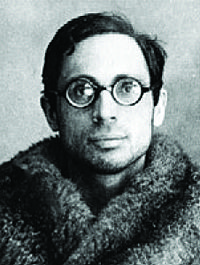 Prison photograph, January 1936. | |
| Date of Birth | 1907 |
| Place of Birth | Zurich |
| Date of death | August 25, 1936 |
| Place of death | Moscow |
| Citizenship |  Russian empire Russian empire  Latvia Latvia  Germany Germany  Honduras Honduras |
Biography
Born in Zurich into the family of an emigrant from the Russian Empire, a Social Democrat, the Menshevik Paul Olberg (Shmushkevich) (1878–1960), the author of the letters Letters from Soviet Russia (Stuttgart, 1919) and the Peasant Revolution in Russia. The old and new policies of Soviet Russia ”(Leipzig, 1922), who moved after Hitler came to power in Sweden. Mother - midwife and masseuse Paulina Beskina Israel, in 1936 she lived in Riga. After the revolution, Valentin together with his family received the citizenship of independent Latvia.
In Germany
In 1929, along with his father received German citizenship. From 1928 to 1932 a member of the Communist Party of Germany . According to Isaac Deutscher, Valentin Olberg in Germany was a member of the left (Trotskyist) opposition in the Communist Party of Germany [1] . However, Trotsky himself wrote that in 1930 Olberg made an attempt to join the German left opposition in Berlin, which was then called the “minority of Leninbund ”. However, he was not accepted, as he had previously been in the KKE and collaborated with pro-Stalinist publications. Having been refused, Olberg appealed to the "Wedding Opposition" ( Landau's group), where he was accepted. After the unification of the two groups, he finds himself in the German left (Trotsky) opposition [2] . I corresponded with Trotsky and Lev Sedov , their letters speak about the activities of the German left opposition group and about the distribution of the Opposition Bulletin in various countries, including the USSR [3] . Olberg met and carried out small assignments of Sedov, who was living in Berlin at the time (he found the necessary books for him, newspaper cuttings). In early 1930, Olberg offered Trotsky his services as a secretary, for which he had to come to the island of Principo , where Trotsky exiled from the USSR. Trotsky, who was cautious, asked the spouses Franz and Alexander Pfemfert to form an opinion about Olberg. On April 1, 1930, Franz Pfemfert wrote to Trotsky: “Olberg made a very unfavorable impression on me. He does not inspire confidence. ” The question of moving to Trotsky was dropped [2] . Of particular concern to the Trotskyists was Olberg's heightened interest in their ties with the opposition in the USSR.
In April-May 1931, the Landau Group, and with it Olberg, was excluded from the ranks of the German Left Opposition. In February 1932, Olberg applied for re-admission to the organization, but was not accepted [2] [4] . He taught at the Marxist Workers School in Berlin (1930-1932). Judging by the copy of the “personal record on personnel records”, filled with Olberg when he started working in the USSR and kept in the investigation, in 1932 Olberg graduated from the history department of the Higher Social School in Brussels, received a doctorate degree [5] . The author of the scientific work "The History of German Social Democracy in 1914" (the place of publication is unknown).
In Czechoslovakia
In 1933, Valentine Olberg was deprived of German citizenship. At the end of March 1933, he left for the USSR, remained in Moscow until mid-May, after which he moved to Stalinabad (Tajikistan), where he taught history [6] . Olberg’s stay in Stalinabad is confirmed by A. Orlov . On November 29, 1933, upon receiving a library card at the Slavic Library in Prague, he introduced himself as an associate professor at the Pedagogical Institute in Stalinabad, and he also called himself a German citizen [7] (although German citizenship was denied). It is known that in 1933-1934 in Czechoslovakia, he lived in great poverty [1] . In 1934 he received a temporary (for three years) passport of the Republic of Honduras in the Berlin Embassy of this country. In the above-mentioned “personal record for personnel registration” it is said that in 1934 he served as an assistant professor at the Institute. Hegel in Prague [8] . In March 1935, he left for the USSR again, but he stayed there for only a few days [6] . Finally, on July 7, 1935, when he received another (?) Tourist visa, Olberg left for the USSR on his Honduran passport that month.
In the USSR
In the USSR, the younger brother, Valentine, engineer Pavel Olberg, already lived and worked in Gorky. Valentine was hired as a teacher in the history of the revolutionary movements of the Gorky Pedagogical Institute. Later, the Trotskyist "Opposition Bulletin" wrote: "We allow ourselves to state with all categorization: Olberg could get a visa in the USSR, go there and get a job there only with the assistance of the Soviet authorities, including the GPU."
Arrest
On January 5, 1936, Valentine was arrested, along with his wife Betty and brother Pavel were arrested.
It can be considered precisely established that Olberg did not immediately agree with the role that the investigator offered him. His case contains an appeal to the investigator, written more than two weeks after his arrest:
After your last interrogation on 21/1, I was overwhelmed by something awful,
painful fear of death. Today I am somewhat calmer. I, it seems, can stipulate myself and do everything to put an end to the torment. But I am clearly unable to build on myself, slander myself and say a deliberate lie, that is, I am a Trotskyist, an emissary of Trotsky, etc. I came to the Union on my own initiative, now — in prison I already realized that it was insanity, the crime. I regret it bitterly. I have made unhappy not only myself, but my wife, brother. Now I understood what my step was wrong, that is, the arrival in the USSR according to incorrect data and the concealment of my Trotsky past [9] .
Apparently, Olberg soon agreed with the role of the “emissary Trotsky”. He became the main defendant at the first demonstration process in Moscow, held August 19-24, 1936.
Role in the First Moscow Process
Rehabilitated on July 13, 1988, by a decision of the Plenum of the USSR Supreme Court [10]
Olberg's behavior on the process
Stalin version . In a closed letter of the Central Committee of the CPSU (b) "On the terrorist activities of the Trotsky-Zinoviev counterrevolutionary bloc," which Stalin personally ruled, it is said
Version of Alexander Orlov :
Version of Vsevolod Vikhnovich :
Family
- The first wife (before 1932) was Sulamif (Sofya, Sonya) Alexandrovna Olberg-Brown (1909, Berlin - 1937, Sandarmokh ), a member of the German Communist Party in 1929-1936. She was married to the “Trotskyist Olberg”, but separated from him in 1932. She led along with him Russian circles for German engineers who were going to work in the USSR. After the divorce, she married a Soviet citizen and moved to Moscow. She worked as a typist-translator on the Executive Committee of MOPR , she lived in Moscow at Sandunovsky lane, 3, apt. 7. Arrested on February 23, 1936 as a member of the “terrorist group of V. Olberg, emissary of L. Trotsky and an agent of the Gestapo”. In her case were a few dozen of her students. O. L. Adamova-Sliozberg, who was sitting with her in the same cell, recalled that Sonya had testified to more than 70 German engineers. Face-to-face betting followed the same pattern: “Carl or Friedrich who understands little ... rushed to her and said: - Frau Olberg, confirm that I was just learning Russian in your circle! The investigator posed the question: - Do you confirm that Karl, the name, was a member of the Olberg circle? Sonya answered: - Yes. Karl signed: - Yes. [11] »On November 10, 1936, the Military Collegium of the USSR Supreme Court was convicted under Art. Art. 17-58-8, 58-11 of the Criminal Code of the RSFSR for 10 years in prison. Served the sentence in Solovki. The special troika of the NKVD LO was sentenced on October 10, 1937 to capital punishment. Shot in Sandarmokh (Karelian Autonomous Soviet Socialist Republic) on November 4, 1937 [12] .
- The second wife (from 1933) - Betty O. Olberg (nee Zirman ), a citizen of the Republic of Honduras, moved to the USSR in November 1935, was arrested in Gorky at the same time as her husband. Sentenced to 10 years in prison. She was in Karlag together with the wife of the prominent German communist Heinz Neumann Margarita Buber-Neumann , who later left memories. In 1940, Betty Olberg and Margarita Buber-Neumann were issued by the Gestapo NKVD. The last time they saw each other was in the prison of the city of Lublin . Betty's fate is unknown [13] .
- Brother - Pavel Pavlovich Olberg (August 5, 1909, Helsingfors - October 3, 1936, Moscow), a German citizen, moved to the USSR in November 1934, engineer of the Soyuzmuk Gorky Trust, arrested on the same day as his brother [14] .
Followed repression
- Aronovsky (Aranovsky) Abram Ivanovich (Ionovich), born Riga , employee of Glavsevmorput, arrested on March 15, 1936 [14] .
- Banov Alexey Vasilyevich , head. Department of Physics at the Gorky Pedagogical Institute, Professor, was arrested on April 10, 1936 [15] .
- Bocharov Efrem Mikhailovich , a teacher at the Gorky Pedagogical Institute.
- Bocharov Yuri Mikhailovich , a professor at the Moscow Pedagogical Institute. Bubnova [16]
- Bostedt Karl Karlovich , born Kiel (Germany), senior designer of the plant. Stalin, arrested on January 26, 1936 [14] .
- Volkov Platon Ivanovich , Trotsky's son-in-law, the husband of his daughter Zinaida , by the time of his arrest, was a worker of the Omsk Oblast-Trust, arrested on February 19, 1936. [17]
- Vuyovich Vyslav Dmitrievich , a Serb by nationality, is the director of the central laboratory of Sredazmaslo in Tashkent, arrested in Moscow on July 15, 1936 [18] .
- Alexander Vladimirovich Gertsberg, Chairman of the All-Union Technoexport Association, was arrested in December 1934 on charges of participating in a candidate for the Congo. Zinoviev organization. Contained in a special prison in Suzdal. Etapirovan to Moscow, was sentenced on October 2 and October 3, 1936 shot.
- Ivan Gorshenin , head of the consolidated planning sector of the Gosplan of the RSFSR, was arrested on December 12, 1934, and was sentenced on October 2 and executed on October 3, 1936.M. L. Elin, 1936
- Elin Mark Lvovich , secretary of the Dzerzhinsky city committee of the CPSU (b), lived in the city of Gorky, arrested on April 13, 1936. [19]
- Kantor Alexander Kharitonovich , an associate professor at the Gorky Pedagogical Institute, was arrested on February 22, 1936. [20]
- Yakov Arkadyevich Kievlenko , consultant of the city administration of the Northern Regional Office of the State Bank, resident of Arkhangelsk, was arrested on April 3, 1936 [14] .
- Anatoly Viktorovich Laktionov , a student at the Gorky Pedagogical Institute, was arrested on February 26, 1936. [21]
- Lentsner Naum Mikhailovich , deputy head of OBLZU, resident of Dnepropetrovsk, arrested on April 1, 1936 [14] .
- Maslennikov, Ivan Alekseevich , and. about. Associate Professor of the Gorky Pedagogical Institute, arrested on April 10, 1936. [22]I. Yu. Nelidov, 1936
- Ivan Y. Nelidov , Associate Professor of the Gorky Pedagogical Institute [23] . A. Orlov reported that the investigator Kedrov did not succeed in obtaining the confessions of Nelidov [24] , nevertheless, he was shot along with everyone.
- Nikolai Evgenievich Nilender , Dean of the Faculty of Natural Sciences at the Gorky Pedagogical Institute, was arrested on April 10, 1936. [25]
- Raspevak Sergey Petrovich , a teacher at the Gorky Pedagogical Institute, was arrested on April 3, 1936. [26]
- Leyba Haimovich Rozenblyum , Head. the cult department of the Minsk newspaper Zvezda, arrested on January 5, 1936
- Sokolov Anatoly Sergeevich , Associate Professor of the Department of History of the USSR Gorky Pedagogical Institute, previously the rector of the Ural University, was arrested on February 22, 1936. [27]
- Ivan Kuzmich Fedotov , Rector of the Gorky Pedagogical Institute, was arrested on January 10, 1936. [28]Z. I. Friedman, 1936
- Friedman Zoroh Iosifovich , born March 13, 1908 in the city of Friedrichstadt, Courland Governorate; without definite occupation, arrested on May 17, 1935 [14] (that is, before V. P. Olberg moved to the USSR).
- Yakov Abramovich Furtichev , professor of philosophy at the Gorky Institute of Marxism-Leninism, was dismissed as expelled from the party during the party purge. In 1936, the teacher of the Gorky Pedagogical Institute.
- Shtykgold Gabriel Petrovich , Head of the Foundry of the Gorky Automobile Plant Molotov, arrested March 22, 1935
On October 16, 1936, the Military Collegium of the Supreme Court of the USSR considered one more case connected with the “Olberg case” on which, among others, were convicted:
- Makhmudbekov, Shamil Habib-bek oglu , student of the Gorky Institute of Marxism-Leninism. Lecturer in the history of the All-Union Communist Party (Bolsheviks) in the Higher Communist School of Agriculture, the head of the course before the retraining of propagandists Arrested on March 23, 1936 [29] , shot on October 16, 1936
- Polyakov Alexander Tikhonovich , a former teacher of the Gorky Institute of Marxism-Leninism [30] , director of the regional school of party propagandists, was arrested on May 9, 1936, shot on October 16, 1936 [31] .
- Mergin Yan Karlovich , in 1918 an investigator of the Cheka in Moscow, in 1919 an employee of the Cheka in Latvia. Left in 1920 for underground work. In 1921 he was arrested and exiled to Russia. Professor, Head of the Economics Department of the Gorky Institute of Marxism-Leninism. Convicted for 10 years ITL. He served time in Solovki, from 1939 in Norillag. Released in 1946, was in exile in Norilsk by 55 exiled exiled. Head clinical department of sanitary epidemiological station. In 1955 he left Norilsk after rehabilitation, died in 1970. [30] [32] .
In Czechoslovakia
- Vladimir Tukalevsky , Librarian of the Russian Department of the Slavic Library in Prague. At the trial in Moscow, V. P. Olberg showed: “I learned from Tukalevsky as an agent of the fascist secret police from my brother. He received his passport through Tukalevsky and a certain Bend from the Consul General of Honduras in Berlin who arrived in Prague at that time ... ” V.N. Tukalevsky was dismissed from his job, tried to justify himself in the newspapers, his explanation was published in “Národní osvobození” (Narodni liberation), but he was not restored to the service of Tukalevsky. In December 1936, V.N. Tukalevskiy died from transient cancer [33] .
Literature
- Vsevolod Vikhnovich. The fate of the Olberg family. (Between two myths) // From the depths of time. 1997. № 9. S. 131-137.
- Vikhnovich V.L. 2000 years of the history of the Jews of Russia. (From the beginning of the New Era to the present). SPb. 2012. p. 371-379. ISBN 978-5-94396-117-5
- [five]
Notes
- ↑ 1 2 Deutscher I. Trotsky in exile. Moscow. 1991 pp. 102-103.
- ↑ 1 2 3 L. Trotsky. The Moscow process - the process of October. // Bulletin of the Opposition (Bolshevik-Leninists). No. 52-53.
- ↑ Trotsky Archives. Houghton Library, Harvard University. ## 9437-9442, 3664-3674, 12881-12886. [one]
- ↑ Russian sources often state that Olberg was “expelled for fractional activities” [2]
- ↑ Quoted from: [3] . Discover the "Higher Social School" in Brussels failed. It is not clear how Olberg managed to finish the university and defend his doctoral dissertation in Brussels, while being constantly in Germany.
- ↑ 1 2 ATTEMPTS WHICH WERE NOT. Opposition Bulletin No. 52-53
- ↑ UNKNOWN LETTER OF I. F. ANNENSKY
- ↑ Quoted from: [4] . Traces of this institution could not be found.
- ↑ Koshel P. History of Investigation in Russia
- ↑ The memory of powerlessness
- ↑ Adamova-Sliozberg O. L. Path. - M.: Return, 1993. - 254 p.
- ↑ Victims of political terror in the USSR
- ↑ Wolfgang Leonhard . The shock of the pact honey Stalin and Hitler. Memories of contemporaries from the USSR, Western Europe and the USA. L .: Overseas Publications Interchange Ltd. 1987
- ↑ 1 2 3 4 5 6 Burial at Donskoy Cemetery - list by year. 1936. October
- ↑ Victims of political terror in the USSR. Banov Alexey Vasilyevich.
- ↑ Bocharov Yuri Mikhailovich
- ↑ Victims of political terror in the USSR. Volkov Platon Ivanovich.
- ↑ Genealogical Research Center
- ↑ Victims of political terror in the USSR. Firs.
- ↑ Victims of political terror in the USSR. Kantor Alexander Kharitonovich.
- ↑ Victims of political terror in the USSR. Laktionov Anatoly Viktorovich.
- ↑ Victims of political terror in the USSR. Maslennikov Ivan Alekseevich.
- ↑ Victims of political terror in the USSR. Nelidov Ivan Y.
- ↑ own.ru/information/hide/5891.html Squeezing the testimony of the NKVD in cases of Sokolov and Nelidov Archived August 6, 2013.
- ↑ Victims of political terror in the USSR.
- ↑ Victims of political terror in the USSR. Raspevak Sergey Petrovich
- ↑ V. A. Mazur . “Trotskyite Sokolov” On the 110th anniversary of the birth of the rector of the Ural University A. S. Sokolov // News of the Ural State University, No 37, 2005
- ↑ Victims of political terror in the USSR
- ↑ Makhmudbekov Shamil Habib-ogly - teacher, repressed
- ↑ 1 2 DO NOT BE READABLE. On the repression of the 30s - early 50s in the Nizhny Novgorod region
- ↑ Victims of political terror in the USSR. Polyakov Alexander Tikhonovich
- ↑ Martyrology Mer-Mey
- ↑ Blue Alexander. Empire shard destroyed - and did not notice