Poluta (Pelageya-Polina [1] ) Alexandrovna Bodunova ( Belorussian. Paluta Alyaksandrana Badunova ; September 7 1885 , the town of Novobelitsa, Gomel district of the Mogilev province - November 29, 1938 , Minsk , BSSR ) - activist of the Belarusian national movement, Minister of the Government of the Belarusian People’s Republic , Secretary of the Central Committee of the Belarusian Socialist Revolutionary Party . May 25, 1938 was sentenced to capital punishment for "activities in the United anti-Soviet underground." November 29, 1938 was shot in Minsk. In 1989, rehabilitated [1] .
| Poluta Alexandrovna Bodunova | |
|---|---|
| Paluta Alyaksandraўna Badunova | |
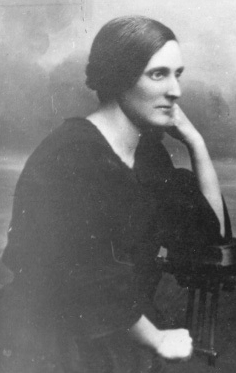 Poluta Bodunova at a conference of representatives of Belarusian left-wing radical organizations in Gdansk, 1923 | |
| Birth name | Pelageya Alexandrovna Bodunova |
| Date of Birth | September 7, 1885 |
| Place of Birth | Gomel County , Mogilev Province , Russian Empire |
| Date of death | November 29, 1938 (53 years old) |
| Place of death | Minsk , BSSR |
| Citizenship | |
| Occupation | political leader |
| Education | |
| The consignment | BSG BPS-R |
| Main ideas | independence of Belarus dictatorship of the proletariat |
Biography
Pelageya Bodunova was born in 1885 in the town of Novobelitsa of the Gomel district of the Mogilev province (now part of the city of Gomel ) into a petty bourgeois family. At the age of 20, she graduated from the Buinichsky Teacher’s School with a degree in home teacher of the Russian language and geography. She taught from 1905 to 1912 in rural schools of the Gomel district, then in the Zemstvo school of the town of Ut [1] .
In 1917, Bodyunova studied at the Higher Historical and Literary Courses in Petrograd. She joined the Belarusian socialist community and after the February Revolution was elected to the Petrosoviet . In the summer of 1917, Bodunova left for her homeland to promote the ideas of the Belarusian national liberation movement. In the fall of 1917, the Great Belarusian Council was formed, and Baununova was included in its leadership. During the preparation of the All-Belarusian National Congress, she dealt with issues of refugees and disabled people. The work of the congress was interrupted by the Bolsheviks, opposition deputies moved to an illegal position [1] .
After the failure of the Brest negotiations with Germany and the departure of the Bolsheviks from Minsk, supporters of the national state again took power into their own hands and formed an interim government - the People’s Secretariat. Bodunova became the only woman in his composition, taking care of custody issues. As a member of the government, she became the founder of the Belarusian People’s Republic . In the newly formed Rada of the BNR, Bodunova entered the left-wing oriented to internal forces, opposing the pro-German right [1] .
In 1918, due to disagreements over relations with Germany, the Belarusian socialist community split into three parties. Bodunova joined the Belarusian Party of Socialist Revolutionaries and became secretary of the central committee. The new party defended national sovereignty, the interests of the peasantry and the proletariat, and advocated the nationalization of land and enterprises. She put forward the slogan of the struggle against both Germany and Soviet Russia. The actions of the Soviet government: the accession of the Mogilev and Vitebsk provinces to the RSFSR, the creation of the Lithuanian-Belarusian Soviet Socialist Republic - strengthened the party's anti-Bolshevik sentiments and tipped Poland to the side, which offered broad autonomy to a single Belarusian entity. However, after Poland occupied the territory of Belarus, the predatory nature of the intentions of the western neighbor became clear, and the Belarusian Socialist Revolutionaries began the fight against the Polish invasion. A rebel committee was created in Minsk, which was headed by Polut Bodunov. Soon she was arrested, and after her release she left for Lithuania . The Belarusian Socialist-Revolutionaries found themselves in an illegal situation throughout Belarus: both Soviet and Polish [1] .
In this situation, the Belarusian Socialist Revolutionaries joined the Bolsheviks in the anti-Polish struggle. In the negotiations in Smolensk, at which this issue was examined, Bodunova took an active part. But success in confronting Poland brought to the fore the old question: about Belarusian statehood. To resolve the contradictions, Bodunova went to Moscow at the head of a special delegation. As a result of the negotiations, it was possible to strengthen the military alliance, but the future of Belarus was to be determined after the victory over the Poles. In July 1920, the Soviet Socialist Republic of Belarus was proclaimed in Minsk, which included 6 counties of the Minsk province, which did not suit the Socialist Revolutionaries, and their open confrontation with the Bolsheviks began. An emergency commission arrested activists, including Bodyunova. She spent six months in custody, and only the request of the member of the Central Committee of the Communist Party of Belarus, Alexander Chervyakov, allowed her to return to Minsk. Attempts to unite the Socialist-Revolutionaries who did not agree with the party’s policy and made concessions to the Bolsheviks were unsuccessful, and Bodyunova decided to emigrate. In 1923, she illegally crossed the Polish border and after three months of imprisonment she reached Prague [1] .
In Prague, Bodyunova became embroiled in a conflict among political emigrants, finding herself in opposition to former supporters, including Tomasz Gribu , and after the appeal of the Soviet Belarusian authorities to return, she decided to go. Bodunova returned to Minsk in 1926, and since 1930 she lived in Gomel. At the same time, she remained implacable with respect to the Soviet regime, and therefore remained under supervision. In 1932, she tried to travel abroad again by contacting the International Organization for Assistance to the Revolutionaries , but was refused. September 3, 1937, for open criticism of the system, Bodunova was arrested and sentenced to 10 years in forced labor camps. But six months later, on May 25, 1938, already in prison in Minsk, she received a new sentence in the case of the anti-Soviet underground in Belarus, this time mortal (execution). Basunova’s testimony, allegedly under torture, formed the basis. The sentence was carried out on November 29, 1938 [1] .
Personal life
Parents of Poluta Bodyunova had seven children: two sons and five daughters. Both sons, Alexander and Danila, received higher education at St. Petersburg University . Sister of Poluta, Maria, just like she became a teacher. The other sister, Anatolia, is the mother of the Hero of the Soviet Union Georgy Skleznev [1] .
The actual husband of Poluta Bodunova was Tomasz Grib , the Minister of Agriculture of the Byelorussian People’s Republic and an associate of the Byelorussian Socialist Revolutionary Party [1] , whom she met in 1917.
According to contemporaries, Poluta Bodunova had a literary talent. Notebooks of verses by Bodyunova were seized during the arrest and, apparently, destroyed [1] .
Notes
- ↑ 1 2 3 4 5 6 7 8 9 10 11 Lebedev, Valentina. Poluta Bodunova // Grandfathers: digest of publications on Belarusian history. - Minsk, 2014. - Issue. 13 . - S. 156-166 .