The diplomatic mission of Austria-Hungary in Montenegro ( Montenegrin. Austrougarsko poslanstvo [comm. 1] ) is the diplomatic representation of Austria-Hungary in Montenegro , located in the former capital of Montenegro - Cetinje . Currently, the mission building houses the Institute for the Protection of Monuments of Culture of Montenegro.
| Building | |
| Diplomatic mission of Austria-Hungary in Montenegro | |
|---|---|
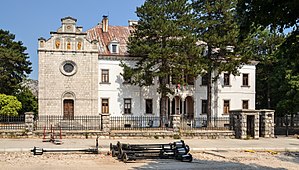 Rear facade from the side of Voivoda God Street | |
| A country |  Montenegro Montenegro |
| Location | Cetinje , st. Baya Pivlyanina |
| Project author | |
| Building | 1898 |
History
Diplomatic relations between Austria-Hungary and the Principality of Montenegro were established in 1879. In 1896, the Montenegrin prince Nikola allocated land for the construction of foreign missions in Cetinje. The diplomatic mission of Austria-Hungary in 1898 was temporarily housed in a private house. The site for the construction of the building was chosen specifically for the mission away from other diplomatic missions at the end of Bai Pivlyanin Street. In 1898, the construction of a two-story stone building was completed. At the grand opening of the new building was attended by the heir to Montenegro, Daniel . In 1899, a chapel adjoining the building was consecrated. The final work on interior decoration was completed only in 1903. The building served its purpose until the beginning of the First World War, when on August 5, 1914, the Austro-Hungarian envoy Edward Otto received a notice announcing Austria-Hungary to declare war on Montenegro. On the same day, the Austro-Hungarian mission left Cetinje [1] . Subsequently, before the Second World War, the was located here, which gave the name to the adjacent park. C 1993 is the object of cultural values of Montenegro [2] . Currently, the mission building houses the institute for the protection of cultural monuments of Montenegro [3] .
Architecture

The author of the project was the Croatian engineer (1828–1911), the Italian architect Corradini worked on the interior design.
The main entrance is a porch decorated with three arches. Above the porch is a balcony on the second floor. The second entrance to the building is located on the right side of the building (eastern facade), and is also decorated with arches. A Catholic chapel, built of Neo-Romanesque stone, is directly adjacent to the building on the left. The front facade of the chapel is decorated with figures of saints, including the Virgin Mary. Most of the mission building is now painted white (previously, the facade looked stone [4] ). Adjacent to the building is the green zone, now the city park “Division”, surrounded on all sides by a fence made of stone parapet and a forged fence [3] .
Notes
- Comments
- ↑ From the Serbian poslanstvo - “mission”, the word ambasada is used to designate an embassy in Serbian. See. Russian-Serbian and Serbian-Russian dictionary, published by "Obod".
- Sources
- ↑ Pisarev, Yu. A. Serbia and Montenegro in the First World War. - M .: Science, 1968. - p. 53.
- ↑ Studija zaštite kulturnih dobara . - Cetinje: Uprava za zaštitu kulturnih dobara, 2013. - p. 88. Archival copy of June 22, 2015 on the Wayback Machine
- ↑ 1 2 Pejović, Vesko. Znamenitosti Cetinja Neopr . // cetinje-mojgrad.org. The appeal date is April 28, 2015.
- ↑ Kako je podignuta zgrada Austrougarskog poslanstva Neopr (Not available link) . // cdm.me. The appeal date is April 28, 2015. Archived March 4, 2016.