The crash of L-188 in Boston - a major aviation accident that occurred on Tuesday evening, October 4, 1960 in Boston ( Massachusetts ). The Lockheed L-188A Electra turboprop airliner of the American airline Eastern Air Lines (EAL) made a passenger flight from Boston to Philadelphia , but suddenly less than half a minute after takeoff, it fell to Boston Bay , killing 62 people. The cause of the disaster was called a collision with a flock of starlings , resulting in the failure of several engines, which led to asymmetry of power, as well as loss of speed and lift [2] .
| Flight 375 Eastern Air Lines | |
|---|---|
 At the crash site | |
| General information | |
| date of | October 4, 1960 |
| Time | 17:40 EDT |
| Character | Engine failure and take-off during take-off |
| Cause | Collision with birds |
| A place |  Boston Bay , Logan Airport , Boston ( Massachusetts , USA ) Boston Bay , Logan Airport , Boston ( Massachusetts , USA ) |
| Dead | |
| Aircraft | |
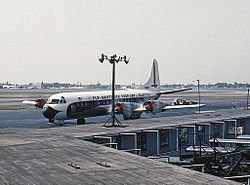 Lockheed L-188A Electra from Eastern Air Lines | |
| Model | Lockheed L-188A Electra |
| Airline | Eastern Air Lines (EAL) |
| Departure point | Logan , Boston ( Massachusetts ) |
| Stopover |
Greenville ( South Carolina ) |
| Destination | Atlanta ( Georgia ) |
| Flight | EA375 |
| Board number | N5533 |
| Date of issue | June 8, 1959 (date of transfer to EAL) |
| Passengers | 67 |
| Crew | 5 |
| Dead | 62 |
| Survivors | 10 |
This is the largest aviation accident that occurred as a result of a collision with birds [3] [4] .
Content
- 1 Aircraft
- 2 crew
- 3 Disaster
- 4 Investigation
- 4.1 Studying the runway
- 4.2 Exploring Debris
- 4.3 Engine tests
- 4.4 Data Analysis
- 4.5 Causes of the disaster
- 5 Consequences
- 6 notes
- 6.1 Comments
- 6.2 Sources
- 7 Literature
- 8 References
Aircraft
Lockheed L-188A Electra with registration number N5533 (serial number - 1062) was received by Eastern Air Lines on June 8, 1958 . His total operating time was 3526 hours 29 minutes. Each of its four power plants consisted of an Allison 501-D13 turboprop engine equipped with an Aeroproduct model A644IFN-606 propeller. The total operating time of the first engine (extreme left) was 2515 hours 54 minutes, the second (inner left) - 2707 hours 46 minutes, the third (inner right) - 2783 hours 6 minutes, and the fourth (extreme right) - 3144 hours 4 minutes [5] .
Crew
The flight crew (in the cockpit) consisted of two pilots and a flight engineer [5] :
- The aircraft commander is 59-year-old Curtis W. Fitts . Since December 13, 1934, he has been with the EAL Airlines as an operating pilot qualifier for Martin 2-0-2 , 4-0-4 , Convair 240 , -340 , -440 , Douglas DC-4 , DC-6 , DC-7 , Lockheed Constellation and Lockheed L-188 Electra . His total flight experience was 23,195 hours, including 1,053 hours on the Lockheed L-188.
- The co - pilot is Martin J. Calloway . Since October 5, 1953, he has been with the EAL airline as a current pilot pilot Martin 2-0-2 , 4-0-4 , Convair 240 , -340 , -440 . His total flight experience was 5820 hours, including 201 hours on Lockheed L-188.
- Flight Engineer - Malcolm M. Hall. In the airline EAL since December 7, 1953, he had existing qualifications of glider and engine maintenance technicians. Total flight experience was 7796 hours, including 369 hours on Lockheed L-188.
Two stewardesses worked in the cabin [6] :
- Joan Berry
- Patricia Davies
Holocaust
The N5533 arrived in Boston at 3:33 p.m. [* 1] with flight EA-444 from New York . This flight was carried out without deviations, after which the crew began to prepare for flight EA-375 on the route Boston - Philadelphia - Charlotte - Greenville - Atlanta . According to the plan, the flight to Philadelphia was supposed to take place along the Victor 3 and Victor 147 air corridors; the flight level was defined as 10,000 feet (3,000 m ) [2] . A total of 67 passengers and 5 crew members were on board, and the total fuel weight in the tanks was 24,900 pounds (11,300 kg). The total weight of the airliner was defined as 97,987 pounds (44,446 kg), which was within the acceptable range. The weather conditions at this time were good: variable cloud cover with a height of 6000 feet (1800 m ) and 12 000 feet (3700 m ), southeast wind of 11 knots, visibility up to 15 miles [7] .
At 17:34 flight 375 took a position at the beginning of the runway, while the dispatcher gave instructions for taking off - to go through the intersection Natik at an altitude of 3000 feet (910 m ) and maintain the take-off course for a couple of minutes. Also, the crew from the actual weather conditions and the weight of the aircraft determined the speed V 1 (decision), V R (lifting the front pillar) and V 2 (lifting off the ground) as 104, 116 and 121 knots respectively. The plane taxied to lane 9 of Logan Airport and at 17:39 it started to take off for takeoff. According to eyewitnesses, flight 375 performed a normal run of about 2,500 feet (760 m ) in length , detached from the lane, and then, rising to a height of 30 feet (9.1 m ) to 40 feet (12 m ), removed the chassis and then continued to climb [7] .
However, the liner barely continued to rise, when suddenly a cloud of gray smoke appeared at engine No. 1 (far left), while other witnesses described a fireball at engine No. 2 (inner left). The car first darted to the left, after which it returned to its previous course of 030 °, while the speed was already low. Having risen to a height of 100 feet (30 m ) to 200 feet (61 m ), Elektra began to enter the left bank, which quickly reached a right angle of 90 °. Two witnesses with an interval of one second managed to photograph the plane. In these photographs, the N5533 was at an altitude of approximately 121 feet (37 m ) and a course of 030 °, while its left roll rapidly increased (in the photo it was 8.5 ° and 14 °), as well as its nose (9 ° and 14 °). Then the nose quickly went down, after which the airliner rotating counterclockwise crashed into the water almost 7,000 feet (2,100 m ) from the start of take-off and 2,000 feet (610 m ) to the left of the center line of strip 9 [7] [8] .
The disaster occurred at 17:40, 47½ seconds after the start of take-off [8] . Since the crash site was 600 feet (180 m ) from the shore, boats rushed towards it to help save the survivors [3] . However, only nine passengers and both flight attendants were saved [6] . Later, one of the passengers died from his injuries. Thus, a total of 62 people died in the crash: 59 passengers and all 3 members of the flight crew [2] .
Investigation
Runway study
According to reports, shortly after the incident, a large number of bird remains were found in lane 9 in the area between the intersections with taxiway 33 and runway 33. A study of the corpses showed that they were starlings , and only 75 birds were found on the cover of the strip. Also, experts were able to determine that all the birds died in the second half of October 4 , that is, about the same time as the disaster of flight 375 occurred [8] .
Exploring Debris
Already on the night of the incident, the US Coast Guard began combing the water area and the bottom at the crash site, which allowed to quickly raise a significant part of the liner. Although, according to eyewitnesses, the plane fell vertically, it was found from the study of the wreckage that the fall did occur with a slight slope to the left and the left wing plane, which separated, first hit the water. Also, on impact, the right plane with both engines separated. All four engines were raised and studied. Propeller No. 1 was feathery , and the engine itself did not work at the moment of impact, and its turbine and compressor remained relatively intact. The other three engines were working at the moment of impact on the water, and the blades of their propellers were installed in their normal working position. No signs of engine overheating were found, nor were signs of mechanical failure. As tests showed, with the exception of power plants, all other aircraft systems, including instruments in the cockpit, as well as control planes, worked fine until they hit the water [9] [10] .
With further study of the design of the airliner, investigators finally found important evidence - in the nacelle of the air intake through which air was supplied to cool the generators with oil coolers of the first and fourth engines (extreme ones), several feathers were found. Another feather was found in the air channel of the cooling system of the generator of the third engine (right inner). Also in the gas paths of engines No. 1 , 2 and 4, organic residues that were identified as parts of the birds were found. A study of the individual feathers found confirmed that they belonged to starlings - the same birds whose corpses were found on the strip. In engine No. 3 , no bird parts were found [9] .
Engine Testing
According to eyewitnesses, when taking off at a low altitude, smoke and flame appeared from the engines. Further, a large number of dead birds were found on the runway, and some parts of the birds were found in engines. This indicated that birds got into the engines, but it was still necessary to determine how much this affected the operation of turboprop engines. Then tests of Allison 501-D13 engines , that is, of the same model as on a crashed plane, were conducted for collisions with live starlings. According to the test results, the following conclusions were made [11] [12] :
- The Allison 501-D13 model showed a high structural strength, which did not collapse when it fell inside the starlings.
- In the nominal or take-off mode of operation of the engine, if an individual bird got inside, a slight drop in thrust occurred, while up to 90% of power was saved.
- When two starlings hit inside, the shaft power in the nominal mode eventually fell by 15%, and during take-off - by 10%. Even with the initial short-term drop in traction, the engines produced at least 50% of the power.
- The ingress of four starlings at once during take-off operation led for a second or three to a power drop of 50% or more, after which the power stabilized at 85%.
- Six starlings when entering the engine led to the fact that after restoration, the engine lost up to 23% of power. At the same time, during the first four seconds the power fell by more than 50%, and in one of the cases the engine even failed. In one test, power less than 50% was maintained for 7 seconds, which during normal operation would have triggered an emergency stop system.
- Immediately eight starlings, when they get inside the engine, trigger the automatic feathering system. In two tests, the engine could not be restarted, and in another test, after restarting, the temperature began to rise rapidly in the engine, which caused the engine to stop.
- The ingress of eight starlings into the engines, but in groups of four birds, made it difficult to restart, while in one test the temperature in the engine began to rise rapidly, and in the second test the engine started to work and give out at least 50% of power only after 10 seconds. In both cases, the automatic feathering system worked.
Data Analysis
According to available testimony, a flock of birds fed at the airport, which was scared off by a take-off plane, after which some birds got inside three of the four engines. The first engine (far left) fell first, which “swallowed” at least four starlings, resulting in a flame failure or a drop in traction of less than 500 pounds (230 kg), which led to the operation of the propeller autofluidization system No. 1 . Even more birds, about six, fell into the second engine, as a result of which there was a sharp drop in traction in it, but the crew may have immediately tried to restart this engine, which resulted in a flame behind the engine, which eyewitnesses saw. According to tests, after five to six seconds the engine should go into mode, but the power at the same time fell by half from the nominal. Probably, very few birds got into the fourth engine, since eyewitnesses did not notice anything special in its operation, and therefore the power drop was relatively small [13] .
During the investigation, a version was put forward that since the birds got into engines No. 1 , 2 and 4, they could get into the remaining No. 3 . The reason for the lack of bird remains in this engine could be explained by the fact that they could be eaten by marine inhabitants, since the engines were removed from the water after four hours. However, the fact that No. 3 was just the first engine lifted from the bottom indicated against this version, and the bird’s remains were preserved on the remaining three, which lay in the water a little longer. Based on this, it was concluded that this engine worked normally up to a collision with water [13] .
Given that on the left side the engines either stopped or a significant power drop occurred, while both right engines continued to develop take-off power or close to it, this caused a significant thrust imbalance, resulting in a turning moment to the left. Electric and hydraulic systems at this moment worked fine, as they received power from a normally operating power plant No. 3 . This was also evidenced by the fact that feathering of propeller No. 1 worked, that is, the hydraulic system controlling propeller pitch functioned. Despite the possible failure of three generators, an emergency power supply circuit from one generator turned on, which means that the devices in the cab continued to work normally, as did the control systems [13] [14] .
A series of tests was conducted to determine the flight characteristics of the Lockheed L-188 aircraft in the event of a failure or loss of power on several engines at once. Among others, studies were conducted on the maximum allowable roll in the event of failure of one or two engines on one side without loss of control, as well as the maximum asymmetry of thrust at which it was possible to continue flying at low speed. Tests were also carried out under conditions when the first engine was plugged and the second was in autorotation mode. According to the results of the second type of testing, it was concluded that the control of the aircraft in this case is preserved, unless the total engine power on the right side of the wing does not exceed the maximum power of one engine, which is 3800 horsepower (2800 kW). In the case of flight 375, when the first engine was plugged, the second had a significant drop in power, the fourth also had a drop in power, but already much less, and the third engine continued to operate in takeoff mode, the aircraft was actually uncontrollable [15] .
More thorough tests showed that the above is true only if the aerodynamic drag is relatively small. But in the case of the N5533, the flaps were still released in the take-off position, because of which the resistance was quite large. However, high aerodynamic drag with low engine power led to another danger - loss of flight speed. When studying photographs taken by eyewitnesses ( see above ), it was determined that the first speed of the aircraft was 118 knots, and the second 103 knots, that is, in a second the speed fell by 15 knots and continued to decrease. For the wing configuration captured in the photo and taking into account the weight of the aircraft, the minimum flight speed was defined as 108 knots, that is, in fact, on the second photo, the speed of the liner was lower than the stall speed. Due to the thrust imbalance, the fuselage turned slightly to the left and, like a screen, covered a part of the left wing plane, which further reduced the air flow on the plane, that is, increased the stall. Tests carried out during the investigation showed that the N5533 at this moment was out of control of the crew [16] .
Now it was necessary to determine the time reserve for the crew to correct the situation. Forty-seven and a half seconds elapsed from the moment of the take-off to the moment of the crash, of which twenty seconds were run in the strip up to speed V 2 . Total in the air airliner was twenty-seven and a half seconds. A collision with birds occurred six seconds after the moment of separation at a speed of about 133 knots (for a speed increase of 2 knots / sec). For about a second, the carcasses of birds penetrated the engines, after which it took another six seconds for the engines, with the exception of the first, to be able to restore power. There were fourteen and a half seconds left before the disaster, but from them the last three seconds of an uncontrolled fall can be thrown back. In total, the crew had only eleven to twelve seconds to fix the emergency [16] .
It is worth noting that a unique and at the same time dangerous situation has developed with flight 375. All engines were operating in takeoff mode, when seven of the four engines “swallowed” several birds after seven seconds from the moment they got off the ground. At the same time, the propeller feathering occurred on the first engine, that is, a complete loss of power, which is not dangerous in itself and is provided for by the design of the aircraft. But at the same time, in the second engine, a flame failure occurred with a significant drop in power, and in the fourth there was only a slight drop in power, and its power recovered much faster than the second engine was restarted. There was a strong traction imbalance that turned the car to the left, while there was also a strong drop in flight speed, and the restarted second engine no longer had time to fix it. The liner quickly lost translational speed, after which, going to stall, he tilted to the left and lowered his nose, after which he rushed down. The height at this moment was no more than 150 feet (46 m ), which is not enough for Lockheed Electra type aircraft to gain the necessary speed and exit the dive [17] .
It is possible that in a collision with a flock of birds, the cockpit lantern was damaged. Although confirmation of this version in the study of the wreckage was not found due to the destruction of the glazing of the cabin, but it is quite likely. Crashing into the glazing, the birds could stain the glass, thereby impairing the visibility of the pilots, and they could also clog the air pressure receivers , which would lead to a distortion of the speed readings. In combination with the strong noise that arose when the birds hit the plane, all this could lead to temporary disorientation of the crew, which would worsen the already emergency situation [18] .
When studying safety aspects, it was noted that a large number of victims were facilitated by the fact that many seat belts burst when the airliner collided with a water surface [18] .
Causes of the disaster
The cause of the disaster, according to the commission of inquiry, was a unique situation when, during takeoff, the plane collided with a flock of birds, while several birds got inside the engines, leading to their failure or loss of power. This led to the fact that there was a loss of speed, and then the transition to stall with loss of control [18] .
Consequences
Air accidents due to aircraft collisions with birds have occurred before, including those reported by Orville Wright in 1905, and Cal Rogers was the first victim of this factor when, in 1912, when flying in the area of Long Beach ( California ) the seagull got into control cables and got stuck in them, after which Rogers plane crashed to the ground. You can also recall the crash of IL-14 near Makhachkala on December 10, 1969 (17 dead), when a collision with a flock of geese or herons, which pierced the cockpit lantern, incapacitating the pilots, after which the airliner fell into the Caspian Sea, was called the probable cause. All this, as a rule, was a collision of relatively small aircraft with large birds, but in the case of Boston the situation was diametrically opposite - a large airliner with powerful engines collided with small birds that could simply fly off from the blades without causing harm. However, instead, immediately in three engines a failure or malfunction occurred, after which the plane crashed into the water [19] [20] .
The aircraft Lockheed L-188 Electra began to carry out passenger flights in January 1959, but two years have not passed, and four major accidents have already happened, including the Boston one. Moreover, if in the first ( New York ) the crew was to blame, which did not follow the height and crashed into the river, then in the second and third (near Buffalo and Cannelton, respectively), the aircraft itself was destroyed in the air. And in the fourth (Boston) crash, the airliner completely destroyed some starlings. All this greatly spoiled the reputation of Electra [21] . As a result, in early 1961, the release of these aircraft was discontinued [22] .
In society, there was an opinion about the L-188 as an unsuccessful aircraft, but in many respects its role was played by the fact that it was one of the first-born of turboprop aircraft. Indeed, starting with the Wright brothers' aircraft, piston engines were used in aviation, which were quite reliable and relatively unpretentious to many factors. But gas turbine engines ( turboprops and turbojets ) that appeared at the turn of the 1950s and 1960s were of a completely different level. Compared to piston engines, turbine engines had a higher rotational speed and produced greater specific power, which made them more attractive for use on aircraft. However, a new type of engine brought to the aviation and new dangers. High rotational speeds led to a significant increase in the flutter of the propellers, which increased the oscillations of the engines and could lead to the destruction of the wing. And the gas-air duct was now open, because of which foreign objects could get into it, for example, as in this case, carcasses of birds, which could cause a flame failure , leading to engine shutdown. Not only the L-188 aircraft, but also, for example, the Vickers Viscount , which can be noted the catastrophe that occurred on January 18, 1960 in Charles City (50 dead), when all engines failed due to falling into them, suffered from this. ice [23] . Among Soviet aircraft, the Il-18 can be cited as an example, in which in the early years engine fires were widespread, for example, the accident of August 17, 1960 near Kiev (34 dead) [24] .
All these incidents have shown what dangers gas turbine engines may face and that even a flock of small birds can lead to the crash of a large airliner. As a result, repeated tests of turboprop engines were carried out, as a result of which a number of rules were changed and new provisions were introduced, thanks to which it was possible to increase the reliability of these engines and reduce their vulnerability to various factors [25] .
Notes
Comments
- ↑ North American Eastern Daylight Saving Time (EDT) is indicated hereinafter.
Sources
- ↑ https://aviation-safety.net/database/record.php?id=19601004-0
- ↑ 1 2 3 Report , p. one.
- ↑ 1 2 Logan Airport Electra Crash, the Worst Bird Strike in History . Celebrate Boston. Date of treatment April 28, 2015.
- ↑ ASN Aircraft accident Lockheed L-188A Electra N5533 Boston-Logan International Airport, MA (BOS ) . Aviation Safety Network . Date of treatment April 28, 2015.
- ↑ 1 2 Report , p. fourteen.
- ↑ 1 2 Electra Plane Crash Kills 61 (Eng.) , The Windsor Star (October 5, 1964), C. 1. Date of treatment April 28, 2015.
- ↑ 1 2 3 Report , p. 2.
- ↑ 1 2 3 Report , p. 3.
- ↑ 1 2 Report , p. four.
- ↑ Report , p. 5.
- ↑ Report , p. 6.
- ↑ Report , p. 7.
- ↑ 1 2 3 Report , p. 8.
- ↑ Report , p. 9.
- ↑ Report , p. 10.
- ↑ 1 2 Report , p. eleven.
- ↑ Report , p. 12.
- ↑ 1 2 3 Report , p. 13.
- ↑ Flawed Assumptions . US Federal Aviation Administration . Date of treatment June 21, 2015.
- ↑ Related Accidents / Incidents . US Federal Aviation Administration . Date of treatment June 21, 2015.
- ↑ March 17, 1960, 3:15 pm - 18,000 feet over Tell City, Indiana. (eng.) . EMARKAY. Date of treatment June 3, 2015.
- ↑ Construction List - L-188 Electra Plane Logger. Date of treatment June 3, 2015.
- ↑ Prevailing Cultural / Organizational Factors . US Federal Aviation Administration . Date of treatment June 21, 2015.
- ↑ Accident of the Il-18B 235 AOON GVF in the Kiev region . airdisaster.ru. Date of treatment May 12, 2013. Archived May 20, 2013.
- ↑ Lessons Learned . US Federal Aviation Administration . Date of treatment June 21, 2015.
Literature
- EASTERN AIR LINES, INC., LOCKHEED ELECTRA L-188 N 5533, LOGAN INTERNATIONAL AIRPORT, BOSTON, MASSACHUSETTS, OCTOBER 4, 1960 (inaccessible link) . Civil Aviation Council (July 31, 1962). Date of treatment April 28, 2015. Archived January 29, 2016.
Links
- Eastern Airlines, Inc. Flight 375, Lockheed Electra L-188, N5533 . US Federal Aviation Administration . Date of treatment June 21, 2015.