GLUT1 ( GLUT-1 , type 1 glucose transporter ) is a unidirectional glucose transporter . In humans, it is encoded by the SLC2A1 gene [2] . GLUT1 facilitates the facilitated transfer of glucose across the plasma membrane of mammalian cells [3] .
| carriers of dissolved substances 2 (light glucose transporter), number 1 | |||||||||||||
|---|---|---|---|---|---|---|---|---|---|---|---|---|---|
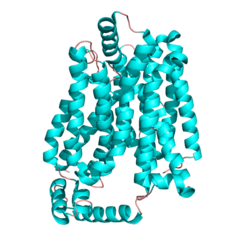 The crystal structure of GLUT1 in humans. PDB [1] | |||||||||||||
| |||||||||||||
| Identifiers | |||||||||||||
| Symbol | ; DYT17; DYT18; DYT9; EIG12; GLUT; GLUT1; GLUT1DS; HTLVR; Ped | ||||||||||||
| External IDs | IUPHAR : ChEMBL : GeneCards : | ||||||||||||
| |||||||||||||
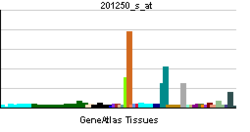
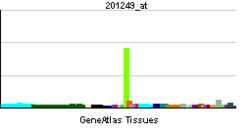
| RNA expression profile | |||||||||||||
 | |||||||||||||
 | |||||||||||||
| Orthologists | |||||||||||||
| View | Person | Mouse | |||||||||||
| Entrez | |||||||||||||
| Ensembl | |||||||||||||
| Uniprot | |||||||||||||
| RefSeq (mRNA) | |||||||||||||
| RefSeq (protein) | |||||||||||||
| Locus (UCSC) | |||||||||||||
| Search PubMed | |||||||||||||
Widely distributed in fetal tissues. In adults, the maximum expression is observed in red blood cells , as well as in endothelial cells of barrier tissues, such as the BBB .
Content
- 1 discovery
- 2 Function
- 3 Structure
- 4 Clinical relevance
- 5 Interactions
- 6 Inhibitors
- 7 See also
- 8 Notes
- 9 Literature
Discovery
GLUT1 was the first glucose transporter detected. GLUT1 is extremely conservative. [2] In humans and mice, the homology of this protein is 98%. The homology with other glucose transporters is 40%.
Function
The energy-producing metabolism in red blood cells depends on a constant influx of glucose from the blood plasma , in which the glucose concentration is maintained at about 5 mmol / L. Glucose penetrates red blood cells through a glucose transporter due to facilitated diffusion, with a penetration rate of 50,000 times the rate of simple transmembrane diffusion. Red blood cell glucose transporters (GLUT1) are integral membrane proteins with 12 hydrophobic segments, each of which is thought to be a helix crossing the membrane. The detailed structure of GLUT1 is not yet known, but one of the promising models suggests that several helices located next to each other form a transmembrane channel with hydrophilic residues that can bind to glucose along the channel [4] .
GLUT1 is responsible for the assimilation of basal glucose, which is necessary to ensure the respiration of all cells. GLUT1 expression levels in cell membranes increase with decreasing glucose levels, and vice versa.
GLUT1 is also an important receptor involved in the absorption of vitamin C , especially in mammals that do not produce it. In mammals producing vitamin C, GLUT4 is often expressed instead of GLUT1 [5] .
Structure
GLUT1 follows the Michaelis – Menten equation and contains 12 alpha-helices crossing the membrane, each of which consists of 20 amino acid residues. The analysis shows that the spirals are amphiphilic , polar on the one hand, and hydrophobic on the other. Six of these alpha helices bind together in the membrane, creating a channel in the center through which glucose can pass. Hydrophobic regions are located outside the channel, next to the tails of the membrane fatty acids.
Clinical Importance
Mutations in the SLC2A1 gene are responsible for GLUT1 deficiency, also known as De Vivo disease , a rare autosomal dominant disease [6] . This disease is characterized by a low concentration of glucose in the cerebrospinal fluid ( hypoglycorachia ), a form of neuroglycopenia arising from impaired glucose transport through the blood-brain barrier.
GLUT1 also acts as a receptor for the human T-lymphotropic virus , due to which the virus penetrates into cells [7] .
The possibility of using GLUT1 as an accurate histochemical marker for infant hemangioma has also been demonstrated [8] .
Interactions
The interaction of GLUT1 with the GIPC1 protein has been demonstrated [9] .
There are two types of GLUT1 protein in the brain: 45k and 55k. GLUT1 45k is found in astroglial cells, and GLUT1 55k is found in the capillaries of the brain and is responsible for the transport of glucose from the blood through the blood-brain barrier. The lack of the latter leads to a decrease in glucose in the cerebrospinal fluid (less than 60 mg / dl), which can lead to seizures.
DERL3, a recently discovered GLUT1 protein inhibitor, is methylated in collateral cancer. With this cancer, DERL3 methylation appears to mediate the Warburg Effect [10] .
Inhibitors
Fasentin, a small molecule inhibitor of the intracellular domain of GLUT1, prevents glucose uptake [11] .
See also
- Carbohydrate metabolism
Notes
- ↑ Deng Dong , Xu Chao , Sun Pengcheng , Wu Jianping , Yan Chuangye , Hu Mingxu , Yan Nieng. Crystal structure of the human glucose transporter GLUT1 // Nature. - 2014 .-- May 18 ( t. 510 , No. 7503 ). - S. 121-125 . - ISSN 0028-0836 . - DOI : 10.1038 / nature13306 .
- ↑ 1 2 Mueckler M., Caruso C., Baldwin SA, Panico M., Blench I., Morris HR, Allard WJ, Lienhard GE, Lodish HF Sequence and structure of a human glucose transporter (Eng.) // Science: journal . - 1985 .-- September ( vol. 229 , no. 4717 ). - P. 941-945 . - DOI : 10.1126 / science.3839598 . - PMID 3839598 .
- ↑ Olson AL, Pessin JE Structure, function, and regulation of the mammalian facilitative glucose transporter gene family (English) // Annu. Rev. Nutr. : journal. - 1996. - Vol. 16 . - P. 235-256 . - DOI : 10.1146 / annurev.nu.16.070196.001315 . - PMID 8839927 .
- ↑ Nelson DL, Cox MM. Lehninger, Principles of Biochemistry . - WH Freeman and Company, 2008. - ISBN 978-0-7167-7108-1 . Archived March 19, 2015 on Wayback Machine
- ↑ Montel-hagen A., Kinet S., Manel N et al. Erythrocyte Glut1 Triggers Dehydroascorbic Acid Uptake in Mammals Unable to Synthesize Vitamin C // Cell : journal. - Cell Press 2008. - Vol. 132 , no. 6 . - P. 1039-1048 . - DOI : 10.1016 / j.cell.2008.01.0.042 . - PMID 18358815 .
- ↑ Seidner G., Alvarez MG, Yeh JI, et al. GLUT-1 deficiency syndrome caused by haploinsufficiency of the blood – brain barrier hexose carrier (Eng.) // Nat. Genet. : journal. - 1998. - Vol. 18 , no. 2 . - P. 188-191 . - DOI : 10.1038 / ng0298-188 . - PMID 9462754 .
- ↑ Manel N., Kim FJ, Kinet S., Taylor N., Sitbon M., Battini JL The ubiquitous glucose transporter GLUT-1 is a receptor for HTLV (Eng.) // Cell : journal. - Cell Press 2003 .-- November ( vol. 115 , no. 4 ). - P. 449-459 . - DOI : 10.1016 / S0092-8674 (03) 00881-X . - PMID 14622599 .
- ↑ North PE, Waner M., Mizeracki A., Mihm MC GLUT1: a newly discovered immunohistochemical marker for juvenile hemangiomas (Eng.) // Hum. Pathol. : journal. - 2000 .-- January ( vol. 31 , no. 1 ). - P. 11-22 . - DOI : 10.1016 / S0046-8177 (00) 80192-6 . - PMID 10665907 .
- ↑ Bunn RC, Jensen MA, Reed BC Protein interactions with the glucose transporter binding protein GLUT1 CBP that provide a link between GLUT1 and the cytoskeleton (Eng.) // Molecular Biology of the Cell : journal. - 1999 .-- April ( vol. 10 , no. 4 ). - P. 819-832 . - DOI : 10.1091 / mbc.10.4.819 . - PMID 10198040 .
- ↑ Lopez-Serra, P. et al. A DERL3-associated defect in the degradation of SLC2A1 mediates the Warburg effect. Nat. Commun. 5: 3608 doi: 10.1038 / ncomms4608 (2014). https://www.ncbi.nlm.nih.gov/pubmed/24699711
- ↑ Wood TE, Dalili S., Simpson CD, Hurren R., Mao X., Saiz FS et al. A novel inhibitor of glucose uptake sensitizes cells to FAS-induced cell death. (Eng.) // Mol Cancer Ther: journal. - 2008. - Vol. 7 , no. 11 . - P. 3546-3555 . - DOI : 10.1158 / 1535-7163.MCT-08-0569 . - PMID 19001437 .
Literature
- North PE, Waner M., Mizeracki A., Mihm MC GLUT1: a newly discovered immunohistochemical marker for juvenile hemangiomas (English) // Hum. Pathol. : journal. - 2000 .-- January ( vol. 31 , no. 1 ). - P. 11-22 . - DOI : 10.1016 / S0046-8177 (00) 80192-6 . - PMID 10665907 .
- Hruz PW, Mueckler MM Structural analysis of the GLUT1 facilitative glucose transporter (review). (English) // Mol. Membr. Biol. : journal. - 2002. - Vol. 18 , no. 3 . - P. 183-193 . - DOI : 10.1080 / 09687680110072140 . - PMID 11681785 .
- Baumann MU, Deborde S., Illsley NP Placental glucose transfer and fetal growth. (unspecified) // Endocrine. - 2003. - T. 19 , No. 1 . - S. 13-22 . - DOI : 10.1385 / ENDO: 19: 1: 13 . - PMID 12583599 .
- Mobasheri A., Richardson S., Mobasheri R., et al. Hypoxia inducible factor-1 and facilitative glucose transporters GLUT1 and GLUT3: putative molecular components of the oxygen and glucose sensing apparatus in articular chondrocytes. (English) // Histol. Histopathol. : journal. - 2006. - Vol. 20 , no. 4 . - P. 1327-1338 . - PMID 16136514 .
- Kozhanova T.V. , Zhilina S.S., Meshcheryakova T.I., Ayvazyan S.O., Osipova K.V., Sushko L.M., Lukyanova E.G., Prityko A.G. Type I glucose transporter deficiency syndrome (de Vivo disease): clinical and genetic aspects. // Medical genetics. - 2016. - No. 7 . - S. 28-32 . - ISSN 2073-7998 .