The crash of the Boeing 727 near Cincinnati - a major aviation accident that occurred on Monday evening November 8, 1965 in the area of the North Kentucky airport in Cincinnati (located in neighboring Ohio ). An American Airlines Boeing 727-23 airliner, with 62 people on board, completed a flight from New York when it crashed into trees during an approach, resulting in collapse, killing 58 people.
| American Airlines Flight 383 | |
|---|---|
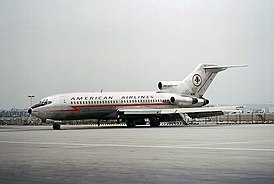 American Airlines Boeing 727-23 | |
| General information | |
| date of | November 8, 1965 |
| Time | 19:02 EST |
| Character | Collision with trees |
| Cause | Crew error |
| A place |  near North Kentucky Airport , Cincinnati ( Kentucky , United States ) near North Kentucky Airport , Cincinnati ( Kentucky , United States ) |
| Aircraft | |
| Model | Boeing 727-23 |
| Airline | American airlines |
| Departure point | La Guardia , New York |
| Destination | Northern Kentucky , Cincinnati |
| Flight | AA383 |
| Board number | N1996 |
| Date of issue | June 15, 1965 (first flight) |
| Passengers | 56 |
| Crew | 6 |
| Dead | 58 |
| Survivors | four |
Content
- 1 crew
- 2 Aircraft
- 3 Disaster
- 4 Investigation
- 4.1 Approach
- 4.2 Possible factors
- 5 reasons
- 6 See also
- 7 notes
- 7.1 Comments
- 7.2 Sources
- 8 Literature
Crew
The flight crew (in the cockpit) actually consisted of two aircraft commanders (FAC) and a flight engineer [1] [2] :
- The aircraft commander is 46-year-old David J. Teelin . In the airline American from January 6, 1946, May 1, 1956 promoted to aircraft commander. He was qualified as a pilot of the aircraft Douglas DC-6 / 7 , Convair 240/340/440 , Lockheed L-188 Electra , Boeing 727 and BAC 1-11 . The total flight experience was 16,387 hours, including 225 hours on the Boeing 727 type. Tilin was appointed crew commander for this flight, but according to reports, when he left New York, he was in the right seat, that is, in the place of the second pilot. Also, as was determined from the records of the radio conversations, it was he who had a dialogue with the landing controller.
- The aircraft commander is 39-year-old William J. O'Neill . In the airline American from May 1, 1951, April 8, 1957 promoted to commander of the aircraft. He was qualified as a pilot of the aircraft Douglas DC-6 / 7 , Convair 240 and Boeing 727 . B727 received pilot qualification from the second time on October 19, 1965. The total flight experience was 14,400 hours, including 35 hours on the type of Boeing 727.
- Flight Engineer - 33-year-old John T. LaVoie . At American Airlines since November 10, 1956, as flight engineer since May 22, 1958. The total flight experience was 6047 hours, including 307 hours on the type of Boeing 727.
Three stewardesses worked in the cabin [2] :
- 25-year-old Toni F. Ketchell ( born Toni F. Ketchell ). At American Airlines since March 9, 1965.
- 22-year-old Mary E. Campbell. At American Airlines since September 8, 1964.
- 22-year-old Joyce B. Chimel . At American Airlines since April 6, 1965.
Aircraft
Boeing 727-23 with registration number N1996 (serial number - 18901, serial - 153) was still relatively young. According to the official report of the commission of inquiry investigating the incident, board N1996 was launched on June 29, 1965. But according to other sources, this is actually the date the aircraft arrived at American Airlines, and he made his first flight a couple of weeks earlier - on June 15th. The total operating time of the liner was 938 hours [2] [3] .
Holocaust
The aircraft performed a regular domestic passenger flight AA-383 from New York ( La Guardia Airport ) to Cincinnati ( North Kentucky Airport ) [4] . According to the plan, the departure was supposed to be at 17:00 [* 1] , but the fact is that the N1996 was originally reserved for a completely different flight. The bustle with a change in flight for the airliner led to the fact that he was able to leave the platform only at 17:20. According to the flight plan submitted by the crew, after departure from New York, the liner had to follow to Phillipsburg ( New Jersey ), then along the air corridor J49 to Allegheny, along J80 to Dayton and J43 to Cincinnati. The flight level was defined as 350 (altitude 35,000 feet (11,000 m ) above sea level), the alternate airport is Standford, . The crew consisted of 6 people, and 56 passengers sat in the cabin. Also at La Guardia Airport, 3,358 gallons of jet fuel were poured on board, with a total fuel supply of 38,000 pounds (17,000 kg). The total weight of the Boeing was defined as 120,980 pounds (54,880 kg) with a centering of 25.5% of the MAR , which was within acceptable limits. At 5:38 p.m. flight 383 took off [5] [6] .
After departure, flight 383 went to Phillipsburg in accordance with the plan, but after passing it, the crew requested and received permission to change the flight route: along corridor J78 to Charleston, and then along J24 to Cincinnati. However, then, at a distance of one hundred miles from Charleston, the crew requested and received another change of route - to VOR York Lighthouse (65 miles northwest of Charleston), and from it directly to Cincinnati [5] .
At 18:45, the crew reported the estimated landing time at North Kentucky Airport at 19:05. To this, the dispatcher in Covington set up the altimeters for 30.01 inches (760 mm) of mercury and set the pressure at the airport level with an elevation of 815 feet (248 m ). At 6:55 p.m., the crew contacted the approach dispatcher, while being 27 miles southeast of the destination airport. At 18:57:38 the plane reported: ... we’re leaving from five to four [a decrease from a height of 5000 feet (1500 m ) to 4000 feet (1200 m )], and can we switch to visual flight , since we are observing an airfield? To this, the approach manager conveyed: ... continue the approach, visual approach is allowed on the one-eight lane. Precipitation at the western border of the airport and ... moving south . The crew confirmed the receipt of information, to which the dispatcher gave permission to reduce to 2,000 feet (610 m ) at the discretion of the crew [5] .
At 6:58:41 p.m., the approach dispatcher informed flight 383 that he was being observed on the radar six miles southeast of the airport, and also instructed to switch to a communications dispatcher (Cincinnati Tower). The crew established communication with the landing controller, after which the following dialogue occurred [5] [7] :
| 18:59:06 | AA383 | Cincinnati Tower, this is American three eighty three. We are six [miles] southeast and perform a visual approach. |
| 18:59:15 | Cincinnati tower | American three eighty-three, Cincinnati Tower, strip one eight, [wind] two three zero degrees, five [knots], altimeter three exactly. |
| 18:59:21 | AA383 | Got it, strip one eight. |
| 18:59:23 | Cincinnati tower | Permission to perform visual landing on lane one eight, American three eighty three. |
| 18:59:28 | AA383 | We are allowed to land. I get it. |
| 18:59:29 | AA383 | And how far west is the precipitation line now? |
| 18:59:30 | Cincinnati tower | Somewhere around six [miles]. We just don't have anyone in that area. |
| 18:59:35 | AA383 | Okay |
| 18:59:40 | Cincinnati tower | If we have a wind shear, I will let you know if you should decide whether to interrupt the call. |
| 18:59:44 | AA383 | Thank you very much! We will be very grateful. |
| 19:00:06 | Cincinnati tower | Amerikan three eighty three, we have now begun to light rain. |
| 19:00:11 | AA383 | Okay |
| 19:01:11 | Cincinnati tower | American three eighty three, are you still watching the strip? Yes? |
| 19:01:14 | AA383 | With difficulties. Now the course-glide path system would help. |
| 19:01:19 | Cincinnati tower | American three eighty-three, approaching lights, flashers and strip lights are now at maximum intensity. |
| 19:01:22 | AA383 | Okay |
Said at 19:01:22 "Okay" was the last known radio message from the board N1996 [7] .
According to staff at the airport control tower, the navigation lights of flight 383 were first seen four miles east-southeast of the airport and were fairly visible. In general, at the time of the initial connection with board N1996, clouds with lightning were observed to the northwest of the airport, while in the east and northeast it was quite clear, although the west wind drove clouds with precipitation to this sector. The airliner followed the pattern in a northerly direction, then flew a mile east of the radio mast [* 2] of the WCKY radio station, after which it made a standard left turn and headed west with a decrease. When the plane was about two to three miles northeast of the airport, it disappeared from view, covered in rain [7] .
According to an eyewitness in the area of the incident, there was still no heavy rain. After a standard U-turn, the Boeing began to perform a descent and seemed to make a normal approach, if it weren’t for one “but” - it was too low. Then the plane entered a left turn, after which it hooked trees on the right wing plane at 665 feet (203 m ) above sea level (225 feet (69 m ) below the airfield), and then crashed into a hillside. When two passengers hit, and sitting in front of the stewardess Ketchell was thrown out, but they survived. Also in the front of the cabin a passenger flew an American Airlines pilot, who, after hitting the ground and stopping, saw a flame move across the plane from the rear to the front, so he quickly jumped out. A few seconds later, an explosion thundered, destroying the airliner and killing everyone who was still inside [8] [9] .
The catastrophe happened already at night at 19:01:27, and the place of the fall was located a couple of miles north of the end of strip 18 and a quarter mile to the left of the continuation of its axis. In total, 58 people died in the accident: both pilots, a flight engineer, two flight attendants and 53 passengers [9] . This is the second incident in the history of the Boeing 727 after the crash on Lake Michigan three months earlier. Also, at the time of the events, the crash of flight 383 was the largest in terms of death, both in Kentucky ( North Kentucky Airport is located on its territory) and with the participation of Boeing 727 [10] .
Investigation
Studying the history of the aircraft, the commission came to the conclusion that the one before the collision with the trees was fully operational, and all its systems worked quite normally. The crew had the necessary qualifications and was prepared for the flight. It is worth noting that from the moment the radio broadcast between the landing manager and the crew and until the first hit on the trees took only five seconds (19:01:22 and 19:01:27, respectively), that is, the crew did not suspect to the last that should already be below the level of the aerodrome [11] .
Approach
One of the factors that disrupted the normal approach was normal rain. Based on the testimony of eyewitnesses, clouds with lightning that were moving from the south-west to the north-east with an approximate speed of 25 knots were observed in the area of the incident. According to observations made from 19:02 to 19:03, that is, a minute after the crash, in strip 18, visibility dropped from 5-7 miles to less than 1 mile, after which the truth increased to 2 miles. Cloud cover also declined from 4,000 feet (1,200 m ) to about 2,500 feet (760 m ), and some clouds fell altogether to 1,500 feet (460 m ). Turbulence in the area of the incident was not observed, and if it was, it was weak enough to lead to disaster. Over the Ohio River at the time of the incident, light rain was observed. Theoretically, during the approach, the Boeing flew into the rain, while visibility dropped to a couple of miles, or even less, which depends on the precipitation. In general, actual weather conditions were generally predicted by the weather forecast that the crew received before departure [11] .
Having studied the implementation of the approach scheme, it was determined that having completed the third turn at an altitude of 2,000 feet (610 m ) (1,110 feet (340 m ) above the aerodrome), flight 383 began to decline at a normal vertical speed of 800 feet (240 m ) per minute. During the fourth turn, the plane was already at an altitude of 210 feet (64 m ) above the level of the airfield, after which it reached the landing line 20 seconds before the accident and increased its speed of descent to 2100 feet (640 m ) per minute, falling to a lower river valley airfield level, after which 10 seconds before hitting the trees, the vertical speed dropped to 625 feet (191 m ) per minute. Such a deviation from the approach scheme could be caused by an incorrect configuration of the liner. According to the instructions, a reduction from 5,000 feet (1,500 m ) to 2,000 feet (610 m ) was to be carried out with spoilers released and with low engine gas. However, in the case of flight 383, the reduction was performed in the flight configuration with the spoilers removed, because of which the entrance to the circuit was performed at a speed of 210 knots. This configuration of reduction was indicated in the instructions issued by the airline, although the translational speed was still a bit too big. The last turn was carried out at a speed of 170 knots with those released by 15 °, when the flaps were already extended to 25 °, while the vertical speed of descent increased simultaneously. It is possible that the crew intentionally released flaps to increase aerodynamic drag to reduce flight speed. In 10 seconds, the speed really dropped to 160 knots, after which the nose of the aircraft was raised, as a result of which the speed dropped to 145 knots, and the vertical speed of decline decreased to 625 feet (191 m ) per minute [12] .
Possible factors
After analyzing the situation, the commission decided that the crew, performing a landing approach at night in worsening weather conditions, tried to release the flaps to reduce the forward speed. Although investigators were puzzled by this situation - two experienced pilots, both qualified as an aircraft commander, simply could not notice an increase in the vertical speed of descent and did not even conduct a periodic cross-check of altimeters. A decrease to a safe altitude could go unnoticed if the pilots tried to visually land, looking for a strip, and therefore did not follow the instruments. During the investigation, the following factors were considered [13] :
- Reduced visibility
- Rain was approaching the landing zone, at the border of which lightning was observed, while visibility was falling. Yes, in the area of the incident at the time of the disaster, the rain was still weak, and the lighting of the strip worked fine. But the crew had information that heavy rain was approaching, accompanied by a decrease in visibility, and therefore could monitor the runway without looking away, trying not to lose sight of it, that is, almost ceasing to look at the main devices [14] .
- Relief features
- During the landing approach to runway 18, the aircraft followed over the Ohio River Valley, which is located 400 feet (120 m ) below the level of the airfield, while gradually rising to the beginning of the runway. Also, the southern bank of the river is covered with forest and there were no light sources on it that could help the crew understand the nature of the terrain beneath them. In such conditions, individual elevations above the valley could be mistaken for elevations above the level of the airfield. Since from the third to the fourth turn the flight was parallel to the river, and the airport was to the left of the airliner, the pilots obviously periodically looked to the left to determine their location relative to the airfield. Under such conditions, the lights along the river were visible with side vision, while their height relative to the airfield could be misunderstood. Although both pilots were already considered quite experienced and had flown to Cincinnati more than once, one should not forget that the flight was performed at night, when the terrain from the air looks completely different, and therefore can disorient [14] .
- Error reading altimeter
- Board N1996 was equipped with drum-type altimeters, which have been successfully used for several years. When studying the wreckage, investigators could not find signs that the main altimeters on the part of the commander and co-pilot did not work correctly, or had incorrect settings, including setting the pressure. There was also no evidence that the pilots read the altimeter readings incorrectly, but this is not excluded. Drum-type altimeters display thousands of feet on a small drum in the center, while hundreds of feet on a dial. That is, when determining the height, you first need to see the values of thousands of feet on the drum, and then on the dial to determine hundreds of feet. However, from practice it was known that when a reading of hundreds of feet above "900", the next figure of thousands of feet could be observed on the drum. This is especially dangerous at an actual height of about 900 feet (270 m ), since the drum does not have the number “0”, and the number “1” is already visible. Because of this, the altitude of 900 feet (270 m ) by mistake the pilot can read as 1900 feet (580 m ), that is, much higher. There can also be difficulties in reading negative altitude readings, as in the case if the altimeters were set to the level of the airfield and the plane sank much lower. Although the likelihood that the pilots could misunderstand the altitude readings is extremely small, American Airlines also set altimeters on airplanes with special shading on the drums in the altitude range from +1000 feet (300 m ) to −1500 feet ( 460 m ). But do not forget that the crew tried to go on a visual landing, only occasionally casting short-term glances at the instruments, and therefore an error in reading the testimony could still arise [14] [15] .
- High crew load
- As already mentioned above, both pilots were quite experienced and qualified. But during the approach, they did not fully comply with the checklist before landing and did not even release the chassis. That is, it can be understood that the pilots were very busy with the idea of landing in time before the visibility deteriorated significantly, as well as a decrease in the translational speed, which was higher than the established rules. Also, a certain role was played by the fact that both pilots knew each other well and even before that they flew together seven times, as a result of which they began to trust one another unnecessarily. Tilin in this flight was supposed to fulfill the duties of commander, but actually sat in the right seat, essentially playing as if in the " second pilot ". There was only one altimeter in front of him, but Tilin could not look at him, because, having too much confidence in O'Neill sitting in the left armchair, he could stop monitoring the instruments, instead looking out for the airfield. But it is possible that O'Neill believed that Tilin was following the height, and therefore focused on reducing the translational speed. There was also a flight engineer in the cockpit, but at that time he focused on reading the checklist and did not follow the readings of the altimeters. That is, in the cockpit there was no interaction between crew members now and everyone did not know what others were doing, because of which no one actually controlled the flight altitude [16] [17] .
- Aircraft design
- When studying the design of the Boeing 727, its relatively high aerodynamic drag was noted, and when flaps were released by 40 °, a rapid decrease in translational speed was observed with a significant increase in the vertical speed of descent. At the same time, it was noted that the Boeing 727 is a reliable and fairly obedient aircraft, well-established in operation. Studies conducted by NASA did not find any deviations in the design of this type of airliners that could contribute to the creation of an emergency [18] .
Reasons
After analyzing the possible factors, the investigators came to the conclusion that the design of the aircraft did not become one of the factors of the disaster, and the violations were only in the actions of the crew, especially the pilots [18] .
In general, we can assume that the emergency began to develop in New York, where flight 383 was delayed for 20 minutes, which is why the crew tried to catch up after the departure, for which they even requested a route straightening. Also, when approaching the North Ketukki airport, the crew had information already at night that weather conditions were getting worse. In these conditions, a visual flight could still be performed, but without a clear picture of the weather situation at the airport, it would be quite reasonable to switch to instrument flight. However, the pilots continued to perform visual flight, despite the deterioration of visibility, and after the last turn and exit to the landing line focused their eyes on the runway without controlling the flight altitude. 13 seconds before a collision with trees, the car sank below the level of the airfield. At this moment, the situation could still be corrected, since the rules and instructions established by the airline made it possible to notice a mistake, and the flight technical characteristics of the Boeing made it possible to stop the decline and begin to climb. But the crew in this situation actually did not follow the instructions, and therefore, continuing to perform visual approach did not correct the emergency, which quickly turned into a disaster [18] [19] .
11 months after the Cincinnati disaster, a final report was released on October 7, 1966, according to which the cause of the disaster was a crew error that did not control altimeter readings when performing a visual approach in conditions of reduced visibility [19] .
See also
- The Convair 880 disaster near Cincinnati - occurred after 2 years 18 days in almost the same place and for similar reasons
- Accident with Boeing 727
Notes
Comments
- ↑ Hereinafter, North American Eastern Time (EST)
- ↑ Located at a distance of three miles east-north-east of the airport control tower
Sources
- ↑ Report , p. 6.
- ↑ 1 2 3 Report , p. 7.
- ↑ Registration Details For N1996 (American Airlines) 727-23 . Plane Logger. Date of treatment April 26, 2015.
- ↑ Report , p. one.
- ↑ 1 2 3 4 Report , p. 2.
- ↑ Report , p. 8.
- ↑ 1 2 3 Report , p. 3.
- ↑ Report , p. four.
- ↑ 1 2 Report , p. 5.
- ↑ ASN Aircraft accident Boeing 727-23 N1996 Cincinnati-Greater Cincinnati, OH . Aviation Safety Network . Date of treatment April 26, 2015.
- ↑ 1 2 Report , p. eighteen.
- ↑ Report , p. 19.
- ↑ Report , p. twenty.
- ↑ 1 2 3 Report , p. 21.
- ↑ Report , p. 22.
- ↑ Report , p. 23.
- ↑ Report , p. 24.
- ↑ 1 2 3 Report , p. 25.
- ↑ 1 2 Report , p. 26.
Literature
- BOEING 727, N1996, NEAR THE GREATER CINCINNATI AIRPORT, CONSTANCE, KENTUCKY, NOVEMBER 8, 1965 (inaccessible link) . Civil Aviation Council (October 7, 1966). Date of treatment April 21, 2015. Archived January 29, 2016.