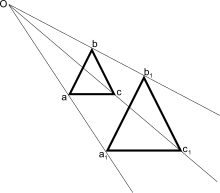
The center of similarity (or the center of homothety ) is the point from which at least two geometrically similar figures can be seen as (extension / contraction) of each other. If the center is external , two figures are directly alike - their angles are the same in the sense of rotation. If the center is internal , two figures are reflections of each other in size - their angles are opposite.

Polygons

If two geometric shapes have a center of similarity, they are similar to each other. In other words, they must have the same angles at the corresponding points and differ only in their relative sizes. The center of similarity and two figures do not have to belong to the same plane. It can refer to a from the center of similarity.
The centers of similarity can be external or internal. If the center is internal, two geometric shapes are mirror-sized mirrored images of each other. In technical terms, they have the opposite chirality . The clockwise angle of one shape will correspond to the angle counterclockwise to the other. And vice versa, if the center of similarity is external, two figures are directly proportional to each other - their angles have the same meaning.
Circles
The circles are geometrically similar to each other and mirror symmetrical. A pair of circles has both types of similarity centers, external and internal, unless the centers coincide or the circles have the same radius. These special cases are treated as general cases . These two centers of similarity lie on a straight line passing through the centers of two given circles, which is called the line of centers (Figure 3). Circles with a zero radius can also be included in the consideration (see special cases), as well as negative radii, and the roles of the external and internal centers of similarities change.
Similarity Center Calculation
For a given pair of circles, the inner and outer centers of similarity can be found in various ways. In analytical geometry, the inner similarity center is the weighted average of the centers of the circles, where the weight corresponds to the radius of the opposite circle - the distance from the center of the circle to the inner similarity point is proportional to the opposite radii. If we denote the centers of circles and as and and their radii as and , and the center of similarity , we have:
The external center can be obtained from the same equation if one of the radii is taken negative. Whatever radius we accept as negative, we will have the same equation:
Summarizing, if we take the radii with the same sign (both positive or both negative), we get the inner center, while the radii with different signs (one positive and the other negative) will give an external center of similarity. Note that the equation for the inner center remains true for any values (unless both radii are equal to zero or the radii add up to zero in total), but the equation for the outer centers requires the radii to be different, otherwise we get division by zero.
In elementary geometry, if two parallel diameters are drawn, one in a circle, they will be the same angle α with the line of centers. The straight lines A 1 A 2 and B 1 B 2 drawn through the corresponding endpoints of the radii, which are homologous currents, intersect each other and the line of centers in the external center of similarity. The straight lines A 1 B 2 and B 1 A 2 drawn through one endpoint and the opposite endpoint intersect each other and the line of centers in the inner center of similarity.
Special Cases
If the circles have the same radius (but different centers), there is no external center of similarity in the affine plane - in analytical geometry this leads to division by zero, and in classical geometry the lines and the lines of the centers are parallel (both for secant lines and for tangents), and therefore cannot intersect. The external center of similarity can be defined in the projective plane as a point at infinity corresponding to the intersection of lines.
If the circles have the same center, but different radii, the external and internal centers of similarity coincide with the common center of the circles. This can be seen from the analytical formula, as well as the limit of two centers of similarity when the centers move towards each other while maintaining the radii until the centers coincide.
If one radius is zero and the other is not equal to zero (point and circle), both the external and internal centers of similarity coincide with the point (center of the circle of zero radius).
If two circles are identical (have one center and the same radii), the inner center of similarity is their common center, but there is no well-defined external center. In the limit, when two circles of equal radius move towards each other until the centers coincide, the external center of similarity is at infinity and therefore can be anywhere, and therefore no external center of similarity exists for such circles.
If both radii are zero (two points), but the points are different, the external center of similarity can be defined as a point at infinity corresponding to a line passing through the line of centers, but in this case there is no internal center.
Homologous and antihomologous points
In the general case, a ray emanating from the center of similarity intersects each circle in two places. Of these four points, two are homologous if the radii drawn from them make up the same angle with the line of centers, i.e. points A 1 and A 2 in Figure 3. Points that lie on the same line with the center of similarity but are not homologous are called anti- homologous, [1] as, for example, points Q and P in Figure 4.
Pairs of antihomologous points lying on a circle
If two rays from one center of similarity intersect circles, any set of antihomologous points lies on the circle.
Let the triangles EQS and EQ′S ′ be given (Figure 4).
They are similar because they have a common angle ∠QES = ∠Q′ES ′ and , since E is the center of similarity. From this similarity it follows that ∠ESQ = ∠ES′Q ′ = α . By the inscribed angle theorem, ∠EP′R ′ = ∠ES′Q ′ . ∠QSR ′ = 180 ° -α , since this is an additional angle for ∠ESQ . In the quadrangle QSR′P ′ ∠QSR ′ + ∠QP′R ′ = 180 ° -α + α = 180 ° , which means that the quadrangle is inscribed . It follows from the secant theorem that EQ • EP ′ = ES • ER ′.
In the same way, it can be shown that PRS′Q ′ can be inscribed in a circle and EP • EQ ′ = ER • ES ′.
The proof is similar to the proof for the inner center of similarity I.
PIR ~ P′IR ′ ; therefore, ∠RPI = ∠IP′R ′ = α . ∠RS′Q ′ = ∠PP′R ′ = α (inscribed angle theorem). The segment RQ ′ is visible at the same angle from P and S ′ which means that R, P, S ′ and Q ′ lie on a circle. Then from the intersecting chord theorem IP • IQ ′ = IR • IS ′. In a similar way, it can be shown that QSP′R ′ can be inscribed in a circle and IQ • IP ′ = IS • IR ′.
Link to the Radical Axes
Two circles have radical axes , straight lines consisting of points, from which the segments from point to point of tangency of both circles have the same length. In general, any point on the radical axis has the property that its degrees with respect to circles are equal. The radical axis is always perpendicular to the center line, and if two circles intersect, their radical axis passes through the intersection points of the circles. For three circles, three radical axes can be defined, for each pair of circles ( C 1 / C 2 , C 1 / C 3 and C 2 / C 3 ). It is remarkable that these three radical axes intersect at one point, the radical center . The tangent lines drawn from the radical center to all three circles will have the same length.
Any two pairs of antihomologous points can be used to find a point on the radical axis. Let two rays be drawn from the external center of similarity E , as in Figure 4. These rays intersect two given circles (green and blue in Figure 4) in two pairs of antihomologous points, Q and P for the first ray, and S and R for the second ray. These four points lie on one circle that intersects both given circles. By definition, the line QS is the radical axis for the new circle and the green circle, while the straight line P′R ′ is the radical axis for the new circle and the blue circle. These two lines intersect at the point G , which is the radical center of three circles - a new circle and two original ones. Thus, the point G also lies on the radical axis of the two original circles.
Tangent circles and antihomologous points
For any pair of antihomologous points of two circles, there is a third circle that touches the original circles at the antihomologous points.
The converse is also true - any circle tangent to two other circles touches them at antihomologous points.
Let our two circles have centers O 1 and O 2 (Figure 5). Let E be their external center of similarity. We construct an arbitrary ray from the point E , which intersects two circles at the points P, Q, P ′ and Q ′ . Extend O 1 Q and O 2 P ′ to the intersection (at the point T 1 ). It is easy to show that the triangles O 1 PQ and O 2 P′Q ′ are similar. These triangles are isosceles because O 1 P = O 1 Q ( radius ), therefore ∠O 1 PQ = ∠O 1 QP = ∠O 2 P′Q ′ = ∠O 2 Q′P ′ = ∠T 1 QP ′ = ∠ T 1 P′Q . But then T 1 P′Q will also be isosceles, and it is possible to construct a circle centered at T 1 and a radius T 1 P ′ = T 1 Q. This circle touches the two original circles at the points Q and P.
The statement is proved similarly for another pair of antihomologous points ( P and Q ′ ), as well as for the case of an internal similarity center.
If we construct tangent circles for each possible pair of antihomologous points, we get two families of circles - for each center of similarity. The family of circles for the external center of similarity is such that the circles of this family either contain both original circles inside themselves, or not one (Figure 6). On the other hand, the circles from the family for the inner center always contain one of the original circles (Figure 7).
All circles from the family of tangent circles have a common radical center and it coincides with the center of similarity.
In order to show this, imagine two rays from the center of similarity intersecting given circles (Figure 8). There are two tangent circles T 1 and T 2 that touch the original circles at antihomologous points. As we have already shown, these points lie on the circle C , and therefore these two rays are radical axes for C / T 1 and C / T 2 . The intersection point of these radical axes must also lie on the radical axis T 1 / T 2 . This intersection is the center of similarity of E.
If two tangent circles are tangent at antihomologous points lying on a line through the similarity point, as in Figure 5, then because of the similarity . But then the degrees of the point E with respect to the two tangent circles are equal, which means that E belongs to the radical axis.
Three-Circle Similarity Center
Any pair of circles has two centers of similarity, so three circles will have six centers of similarity, two for each pair of (different) circles. Interestingly, all these six points lie on four lines, three points on each line. Here is one way to show it.
We represent three circles on the plane (Figure 9). Add for each center of the circles a point on the perpendicular to the plane, spaced from the original center by a distance equal to the corresponding radius. Points can be added on either side of the plane. Three points obtained determine the plane. In this plane we construct three lines through each pair of points. These lines intersect the plane of circles at the points H AB , H BC and H AC . Since the geometric locus of the points that belong to both non-parallel planes is a straight line, these three points will lie on one straight line. From the similarity of the triangles H AB AA ′ and H AB BB ′, we see that (here r A, B are the radii), and therefore H AB is the center of similarity of two corresponding circles. We can do the same for H BC and H AC .
Repeating the process for various combinations of similarity centers (in our method they are determined by the sides from which we select points relative to the plane), we get four straight lines — three similarity centers on each straight line (Figure 10).
There is another method of proof.
Let C 1 and C 2 be a pair of conjugate circles to all three source circles (Figure 11). By conjugacy here we mean that the circles belong to the same family for one of the pair of source circles. As we have already seen, the radical axis of any two tangent circles from the same class passes through the center of similarity of the two original circles. Since tangent circles are common to all three pairs of initial circles, their similarity centers lie on the radical axis C 1 and C 2 , i.e. on one straight line.
This property is used in the general solution of Joseph Diaz Gergonn of the Apollonius problem . If three circles are given, one can find similarity centers, and then the radical axes of the pairs of the desired circles. Naturally, there are infinitely many circles with the same radical axes, so more work is needed to determine exactly which pair of circles is the solution.
See also
- Similarity
- Homothety
- Radical axis of two circles , Radical center
- The Apollonius Challenge
Notes
- ↑ Weisstein .
Literature
- Johnson RA. Advanced Euclidean Geometry: An Elementary treatise on the geometry of the Triangle and the Circle. - New York: Dover Publications, 1960.
- Paul Kunkel. The tangency problem of Apollonius: three looks. - 2007. - T. 22 , no. 1 . - S. 34–46 . - DOI : 10.1080 / 17498430601148911 .
- Eric W. Weisstein. Antihomologous Points . MathWorld --A Wolfram Web Resource.