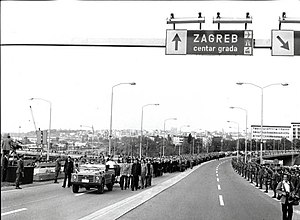

The death of Josip Broz Tito , the first and only President of the Socialist Federal Republic of Yugoslavia and the General Secretary of the UCC Central Committee, occurred on May 4, 1980 . This was a turning point in the history of Yugoslavia: after Tito’s many years of rule, power passed to collective leadership in the person of the SFRY Presidium . Historians consider this event as a prerequisite for the disintegration of Yugoslavia , since subsequent events rather quickly demonstrated the inability of the new collective leadership to solve economic problems and keep the country from conflicts on a national basis.
On May 7, 1980, Tito would have turned 88 years old. The funeral of Tito took place on May 8, 1980 in Belgrade : 211 delegates from 128 countries of the world were present. These burials are among the most famous burials of world leaders in history. Josip Broz Tito is buried in his winter residence " Flower House ". The grave of Tito was visited by more than 17 million people.
Content
Illness
Tito's condition worsened seriously in 1979. One of the causes of the disease was long-term smoking . Then he participated in the work of the Sixth Conference of the Non-Aligned Movement in Havana , and spent New Year's Eve at his residence in Karadjordjevo (Bachka-Palanka community). Speaking with a New Year's address on Yugoslav television , Tito addressed the people not standing, as usual, but sitting. On January 3, 1980, Tito was hospitalized at the clinical center of Ljubljana to check the blood vessels in his legs. Arteriography showed clogging of the arteries in the thighs and lower legs, but the state of the president remained satisfactory, and on 5 January Tito was discharged with a recommendation for further intensive treatment.
A consultation of physicians was gathered, attended by doctors of medical sciences. Among them were eight Yugoslav doctors: Bogdan Bretsel , Miolub Kichich , Miro Koshak , Jovan Ristic , Djordje Popovich , Stanislav Makhkota , Predrag Lalevich and Ivo Obrez . To help them, they rushed to the American professor of medicine Michael Debeyki and Soviet specialist in vascular surgery, MD, professor Marat Knyazev . At the council they made a decision: urgent surgical intervention is necessary to prevent the progression of the disease. Tito refused at first, but then agreed and even organized a dinner for a delegation of doctors. Dusan Dragosavac , deputy chairman of the Central Committee of the Union of Communists of Yugoslavia, was present at the dinner [1] . A number of doctors of medical sciences were involved in the operation - consultants Ludwig Ravnik , Jozze Hindeshek , Chedomir Krstic and Rado Kveder , as well as personal doctors of Josip Broza Zvonimir Dietrich , Radoslav Djordjevic , Svetislav Chelikich , Damir Khranilovich , Mladen Radmilovich and Milomir Smiromich .
DeBakey and Knyazev advised to improve the arterial balance in his left leg to prevent its amputation. The first operation on the vessels of the left leg took place on the night of January 12-13 in the cardiovascular surgery department of the Ljubljana Clinical Center. A few hours after the operation, the blood circulation in the left leg unexpectedly stopped, leading to the death of tissues. On January 20, Tito amputated his left leg. After the second operation, the condition improved temporarily, and on January 28, Broz was transferred from the Department of Cardiovascular Surgery to a regular ward. In late January - early February, Marshal Tito continued to perform his duties: the Villa Srna was built specifically for this, near Morovich [2] .
On the night of February 9-10, the condition of the kidneys deteriorated and digestive upset was found. On February 11, signs of heart failure were identified. The patient's condition became severe: the failure of the kidneys on the night of February 13-14 forced the doctors to immediately resort to hemodialysis . At the end of February, Tito suffered pneumonia: high fever and bleeding in the stomach, intestines and lungs also led to sepsis, which intensified during the month of March. In April, Tito suffered a shock and fell into a coma due to liver damage and subsequent jaundice.
In the second and third decades of February, the state of health was classified as severe, since March 9th - very severe, since April 18th - extremely severe, on April 22nd - critical with shock and coma. On the morning of May 4, doctors recorded a pronounced cardiovascular insufficiency and weak heart function.
Preparing for a funeral broadcast
On January 5, 1980, the Belgrade Television announcer Milan Vukos , Editor-in-Chief Dusan Mitevich and Director Moma Martinovic, arrived in the building of the Federal Executive Chamber and spoke with the Vice Chairman of the Council, Dragolyub Stavrev . The meeting took place around midnight in the strictest secrecy. Stavrev said that he was not aware of the situation with Marshal Tito and urged them to prepare a message and a plan for the funeral if Josip Broz did die. The plan was codenamed “D + 4 Day” and was deciphered as follows: for four days after Tito's death, it would be necessary to work out a plan for the farewell ceremony and the funeral to the smallest details. The ceremony was to be held in the House of Flowers, in the winter garden, which was part of the villa in house 15 on Uzhitskaya Street. State television has never reached this territory before: the placement of cameras was coordinated by the leadership of the Yugoslav People’s Army .
Momo Martinovic was ordered by Milan Vukos to be the director of the funeral broadcast and made a plan: 10 cars and 39 television cameras were allocated to journalists to cover the funeral. After submitting the plan, the Director General convened all the best directors of Yugoslav television for a private meeting and informed them of information from the Executive Chamber. The team was reviewing the funeral of Winston Churchill , John Fitzgerald Kennedy and other well-known politicians. Borivoye Mirkovich , director of the second program of Belgrade Television , even received a video of the funeral of Louis Mountbetten from the BBC : this ceremony was named one of the best, and Tito’s funeral plan was prepared for it. Miodrag Zdravkovic received a decree: to read the report of the Central Committee of the Union of Communists of Yugoslavia about the death of Tito. However, the plan was kept in strict secrecy until the last day of Tito's life.
May 4 - 8
Death
On May 4, 1980, on Sunday at 15:05 Belgrade time, at the Clinic for Cardiovascular Diseases of the Clinical Center in Ljubljana, three days before his 88th birthday, Josip Broz Tito died without suffering the consequences of the operation and not getting out of the coma. At 18:00, an extraordinary meeting of the Presidium of the SFRY and the Central Committee of the Union of Communists of Yugoslavia was held, at which a statement was made about the death of the President of the SFRY and the head of the Union of Communists of Yugoslavia. According to the SFRY Constitution , the decision was made: Lazar Kolishevsky , acting deputy head of the Presidium, was appointed acting head of the Presidium and head of state. Tsvietin Mijatović , representative of the Bosnian and Herzegovina CP , was appointed deputy head of the Presidium. Stevan Doronsky was appointed Chairman of the Presidium of the UCCU Central Committee, according to the UCC Statute. The meeting of the Federal Executive Council announced seven-day national mourning in the country.
Mourning
On May 4, 1980, in the evening, the television broadcast was interrupted for 30 seconds, and the screens on the televisions turned black. Miodrag Zdravkovic, chief broadcaster of Belgrade Television, read the following text:
Comrade Tito died. This evening was reported by the Central Committee of the Union of Communists of Yugoslavia and the Presidium of the Socialist Federal Republic of Yugoslavia to the working class, workers and citizens, peoples and nationalities of the Socialist Federal Republic of Yugoslavia.
Original Text (Serb.)Umro јe friend Tito. This evening was held by the Central Committee of Sávez, the communist Ogloslavich and the Chairperson to the Socialist Federal Republic of Ogoslavia, the Radical Committee, the happy people and the grandee, the narodim and narodnosti of the Socialist Federalist Republican Ogloskalasi, the Socialist Federalist Republiku the Ogreslave, the Socialist Socialist and the Socialist
After this brief report, the Presidium of the SFRY and the Presidium of the UCC Central Committee reported in a joint statement:
Severe pain and deep sadness shook the working class, all the workers and citizens of the SFR of Yugoslavia, each of our people, the worker, the intellectual, the pioneer, the soldier, the mother and the girl ... Tito was a fighter for the interests and historical goals of the working class and all the working people, for the noblest ideals and aspirations of our peoples and nationalities. Tito is our dearest friend. For seven decades it has been burning in the revolutionary labor movement. For six decades he strengthened the ranks of the Yugoslav communists. For more than four decades he has performed in the most honorable manner the most important duty in our Party. He was a heroic leader in the great national liberation struggle and the socialist revolution. For three and a half decades, he stood at the head of our socialist state and led our land and our struggle for a new human society in world history, expressing itself and reaffirming itself as our largest historical figure.
Original Text (Serb.)Tashka bol and oak woods of the potter's radishku klasu, light glad љuda and garane of the SFR clowns, svakog nasheg choveka, radnik, intellectual, pionir, vochnik, makku and girlљ Happy Judah, for the ideal and the integrity of our people and nationality. Tito is our annoying friend. Sedam decenie gore уe near a revolutionary stationary condom. The sixth of the decenis of јacauo of the editors of the Communist. We see one way of evaluating vrchio ј not on the worthy start of negotiation with our Party. Bio “her heroes of the war with the great national liberator Borbi and socialist revolution. Three and on the basis of the stalemate of our socialist druzhava and uvea our land and our struggle for a new “yudo friendship” with a secular history, distortion of our own and our own historical history.
The message was transmitted around 6:50 pm immediately after the meeting of the top state leadership on television and radio, and in the late evening already appeared in all print publications.
During the day, state television broadcast football matches of the Yugoslav Championship . In the evening, a split derby was to be held between the teams Hajduk (Split) and Crvena Zvezda ( Belgrade ), which they were going to broadcast on national television. At the 41st minute of the match, three people took to the pitch and urged the referee to stop the meeting. Spite’s mayor Ante Skataretiko , taking the microphone, informed the stadium about the death of Tito. The news came as a shock to viewers, players and judges: some of the players (such as Zlatko Vujovic ) even sat on the grass, bursting into tears. After the message, the players and the referees gathered in the center of the field to honor the memory of the leader. After the stadium’s official announcer said “Let him rest in peace,” a whole stadium (50,000 fans) began to sing a song with the words: “Comrade Tito, we swear that we will never turn away from your path” ( Serb. Friends Tito mi ti se cunemo, yes sa tvog putikad is not a secret ). The match was finished a bit later.
On May 5, the coffin with the body of Josip Broz Tito arrived at the Blue Train from Ljubljana to Belgrade and was placed in the main room of the Assembly of Yugoslavia, where all government officials and ordinary citizens gathered to say goodbye to the leader of Yugoslavia. The civil memorial service was organized by the workers' organizations: all their members were obliged to arrive at the memorial service. Some people waited 15 hours to get into the building. Some of the citizens became ill, but the medical teams were on duty around the clock and immediately sent the patients to the hospital.
On May 7, more than 200 foreign delegations arrived at the union parliament building to bid farewell to the marshal. Memorial service ended May 8 at 8:00 in the morning.
Funeral
At 12:00 on May 8, after the guard of honor, consisting of members of the SFRY Presidium and the Presidium of the Central Committee of the SKYU, 8 admirals and generals of the JNA carried the coffin with the body of Josip Broz Tito. Stevan Doronsky gave a speech in memory of Tito, after which the column moved along Prince Milos Street and the October Revolution Boulevard up to the Museum on May 25. The last speech was made by Lazar Kolishevsky in front of the House of Flowers and the stands intended for foreign statesmen. To the sounds of the " Internationale " after 3:00 pm, the coffin was brought into the House of Flowers. The television did not show the moment when the coffin was lowered into the ground, so some people doubted whether Josip Broz Tito was really buried. Questions were also caused by the fact that there was no red five-pointed star on the tomb.
For the next 10 years, every year, on May 4, at 15:05, sirens were turned on in all Yugoslavia to commemorate the day of Tito’s death. A minute of silence was thus declared.
Present at the funeral
124 foreign delegations arrived at the funeral: 38 heads of state (kings and presidents), 5 princes, 7 vice-presidents, 6 heads of parliament, 10 prime ministers, 3 deputy prime ministers, 12 foreign ministers, 20 members of governments and 21 state activist, as well as leaders of the communist and socialist parties. At the funeral were:
- Leonid Ilyich Brezhnev , Chairman of the Presidium of the Supreme Soviet of the USSR, Secretary General of the CPSU Central Committee.
- Andrei Andreevich Gromyko , Minister of Foreign Affairs of the USSR.
- Walter Mondale , Vice President of the United States.
- Lilian Carter , mother of US President Jimmy Carter .
- Averell Harriman , US Special Representative to Great Britain and the USSR during the Second World War .
- Hua Guofeng , Premier of the State Council of the People’s Republic of China.
- Ji Pengfei , Secretary General of the State Council of the People’s Republic of China.
- Kurt Waldheim , UN Secretary General.
- Indira Gandhi , Prime Minister of India.
- Anwar Sadat , President of Egypt.
- Todor Khristov Zhivkov , General Secretary of the Central Committee of the Bulgarian Communist Party and Chairman of the State Council of the People’s Republic of Bulgaria.
- Janos Kadar , General Secretary of the Central Committee of the Hungarian Socialist Workers Party.
- Gustav Husak , President of the Czechoslovak Socialist Republic.
- Wojciech Jaruzelski , Minister of National Defense of the Polish People's Republic.
- Edward Gierek , First Secretary of the Central Committee of the Polish United Workers' Party.
- Kenneth Kaunda , President of Zambia.
- Sandro Pertini , President of Italy.
- Francesco Cossiga , Italian Prime Minister.
- Kim Il Sung , President of the DPRK, Secretary General of the Central Committee of the Korean Labor Party.
- Margaret Thatcher , British Prime Minister.
- Philip, Duke of Edinburgh , husband of Queen Elizabeth II .
- Peter Carington , Minister for Foreign Affairs of the United Kingdom, 6th Baron Carrington.
- Fitzroy Macklin , Major General of the Armed Forces of the United Kingdom, a friend of Josip Broz Tito and head of the British military mission in the Balkans.
- William Dikin , historian, author of works on the history of Socialist Yugoslavia.
- Erich Honecker , Chairman of the State Council of the German Democratic Republic and Secretary General of the Central Committee of the Socialist Unity Party of Germany.
- Muammar Gaddafi , leader of the Libyan revolution.
- Hussein ibn Talal , King of Jordan.
- Saddam Hussein , President of Iraq.
- Nicolae Ceausescu , President of Romania and General Secretary of the Central Committee of the Romanian Communist Party.
- Helmut Schmidt , Chancellor of the Federal Republic of Germany.
- Carl Carstens , President of the Federal Republic of Germany.
- Hans-Dietrich Genscher , Minister of Foreign Affairs of Germany.
- Ahmed Sekou Toure , President of Guinea.
- Andrew Peacock , Australian Foreign Minister.
- Robert Mugabe , Prime Minister of Zimbabwe.
- Masayoshi Ohira , Prime Minister of Japan.
- Rudolf Kirchschleger , President of Austria.
- Bruno Kraisky , Chancellor of Austria.
- Chadley Bendjedid , President of Algeria.
- Rabah Bitat , Acting President of Algeria before Benjedid came to power.
- Sultan Ali Keshtmand , Deputy Prime Minister of Afghanistan.
- Jean , Grand Duke of Luxembourg.
- Raymond Barr , Prime Minister of France.
- Jean-Francois-Poncet , Minister for Foreign Affairs of France.
- Henrik, Prince of Denmark , husband of Queen Margrethe II .
- Birendra , King of Nepal.
- Olaf V , King of Norway.
- Urho Kekkonen , President of Finland.
- Mohammed Zia-ul-Haq , President of Pakistan.
- Hafez Asad , President of Syria.
- Adolfo Suárez , Prime Minister of Spain.
- Baudouin I , King of Belgium.
- Carl XVI Gustav , King of Sweden.
- Achille Silvestrini , secretary of the General Affairs Council of the Roman Curia.
Notes
- ↑ Specialist consults on Tito , Lodi News (7. 1. 1980.).
- ↑ Raj u koji Broz nije stigao Neopr . Blic (2 Maj 2010). Date of appeal 2 Maj 2010.
Literature
- Auguslavia of Titus 1980 . Novinsky Agency "Tanug", Beograd and NIRO "Komunist", Beograd 1980. Godina.
- Beat the hour live with Titus . “Mladost” Zagreb and “Enlightenment” Zagreb, 1981. Godina.
- Titova last bit . “Narodna kigiga” Beograd 1981. Godina.