Ottoman Vardar Macedonia , in the historiography of modern Northern Macedonia Ottoman Macedonia ( Macedonian Ottoman Macedoniaедa ) is the history period of modern Northern Macedonia , during which its territory was ruled by the Ottoman Empire .
Background
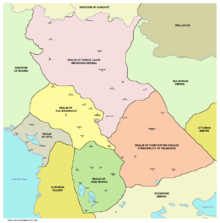
At that time, when the Ottoman state began to emerge in Anatolia, the territory of modern Northern Macedonia was ruled by Serbs and Byzantines. The largest expansion of the Serbian power occurred under Stefan Dushan , who in 1334 extended Serbian power to the territory of modern Northern Macedonia and Albania, but after his death in 1355 civil strife broke out, and the territory of modern Northern Macedonia was divided into areas controlled by independent feudal lords. By 1365, two strong independent Serbian powers were formed, led by two brothers: Uglesh took the title of despot, the capital of his possessions was in the Greek Serra , and Vukashin proclaimed himself king, Prilep was the capital of his possessions. In 1370, the son of Vukashin, known as Kralevich Marko , became co-ruler of his father.
The establishment of Ottoman
In 1371, Uglesh and Vukashin fell in the battle of Maritsa . Marco, who inherited the throne of Prilepsky kingdom, recognized himself as a vassal of the Ottomans. After the death of Marco in 1395, the kingdom was annexed, and the Ohrid Sanjak was formed on its territory. A little earlier, in 1392, the Skopsky Sanjak was formed. The southwestern part of the territory of modern Northern Macedonia was part of Byzantium, it was controlled by Thessaloniki Manuel II Paleologue (son of Emperor John V Paleologue ).
The northeastern part of the territory of modern Northern Macedonia was ruled by Konstantin Dejanovich , who, after the battle of Maritsa, was also forced to recognize Ottoman suzerainty. In 1395, he had to participate in the Ottoman campaign in Wallachia, where he died in the battle of Rovinj . After the death of Konstantin Dejanovich, his possessions were also annexed by the Ottomans.
History of Ottoman Northern Macedonia
XV-XVI centuries
After the Battle of Angora, there were three revolts in the territory of modern Northern Macedonia: Mustafa Celebi (the son of the Sultan Bayazid who claimed the Ottoman throne) revolted in 1409-1413, then in 1416 these lands became the arena of the Bedreddin Simavi Uprising , and here in 1416-1432 the rebellion of Duzme Mustafa was raging. Although these uprisings were of an intra-Ottoman character, the Christian population of Northern Macedonia also took part in them.
During the Skanderbeg revolt, a huge Ottoman army passed through the territory of modern Northern Macedonia, devastating the land on the way to Debar .
In the XVI century there were several uprisings caused by exorbitant requisitions, but they were brutally suppressed. The main form of resistance to Ottoman rule was the departure into the Hajduk .
XVII century
After the defeat of the Turks near Vienna in 1683 the offensive of the anti-Turkish Holy League began . In 1689, Austrian troops reached Skopje and the , however, the commander of the troops, General died of the plague, and his troops were driven back by the Turks to the north.
18th century
The truncated Ohrid Archbishopric, located mainly within the territory of today's Northern Macedonia, in the 18th century became the center of the birth of the Bulgarian national movement . However, by this time the ruling posts in it were for the most part firmly occupied by Greek fanariots , supporters of Greek national or imperial restoration ideas. By the middle of the century, the position of the archbishopric was rather difficult; its debts were great. The Patriarch of Constantinople was able to convince the Sultan that independent churches among the Slavs are harmful and dangerous, and even insolvent. In January 1767, the Turkish sultan took the diocese from the archbishopric and handed it over to the Patriarchate of Constantinople . On May 17, 1767, Archbishop Arseny II signed the act of his resignation, which meant the end of autocephaly.
XIX century
In 1843, in response to Tanzimat’s reforms , an began, encompassing Skopje , Tetovo and Pristina . In 1844, the uprising was completely crushed.
In the second half of the 19th century there were uprisings of the Macedonian (in Bulgarian historiography - Bulgarian) population - the Razlovsky uprising , the and the Kresnensko-Razlozhsky uprising . They were also crushed by the Ottoman authorities.
WMO
On October 23, 1893, the Macedonian Revolutionary Inner Macedonian-Odrinsk Revolutionary Organization was created , which set as its goal the armed struggle for the liberation of Macedonia from the Ottoman Empire. In the cities and villages of Macedonia, a network of illegal committees and circles has been created. In 1898-1903, the armed groups of the WMO carried out about 130 battles with Turkish punishers.
XX century
After the creation of the Bulgarian principality, Macedonia became the main goal of its foreign policy: Bulgaria sought to obtain the territories that were promised to it in the San Stefan world . In addition to Bulgaria, Greece claimed the southern part of Ottoman Macedonia , which had a compact Greek population and represented the territory of Historical Macedonia itself . Serbia also claimed the northern part of Ottoman Macedonia
In 1903, the Ilindensky uprising took place, as a result of which the Krushev Republic was formed, however, the uprising was brutally crushed by the Ottoman authorities. The Young Turkish revolution , which took place in 1908, was also supported by the Christian inhabitants of Macedonia (in particular, such a prominent figure of the VMORO as Yane Sandansky took the side of the new authorities). As a result of the Balkan wars, the Ottoman Empire lost all of geographical Macedonia, whose territory was divided between Serbia, Bulgaria and Greece. The territory acquired by Serbia, was named Vardarska Banovina and is the territory of today's Northern Macedonia.
Administrative-territorial structure
The territory of modern Northern Macedonia was part of the Rumeliya Beylerbeystvo . After the death of the Serbian ruler Konstantin Dragash in 1395, his possessions were annexed by the Ottomans, and a sanjak with an administrative center in the Bulgarian Kyustendil was created on them. The Kyustendil Sanjak was located at the junction of modern Northern Macedonia, Serbia and Bulgaria; it included, in particular, the lands of the northeast of modern Northern Macedonia.
The West of modern Northern Macedonia was part of the Sanjak with the administrative center in Ohrid , the bulk of which was on the territory of modern Albania.