Bahishti Makbara (“Paradise Cemetery” [1]) - This is a religious cemetery located originally in Kadian , India , and then in Rabwa, Pakistan . It was laid down by the Ahmadi Muslim Community as a fulfillment of the will of the founder of the community, Mirza Gulam Ahmad , in his book “Al-Vasiyyat.” Mirza Ghulam Ahmad made this will, after in one of his visions an angel showed him the place of his burial. [2]
| Paradise cemetery | |
|---|---|
| Urdu بہشتی مقبره | |
| A country | Pakistan |
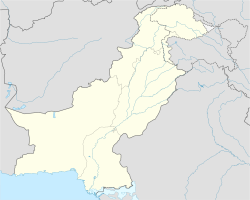
| Pakistan | Rabwa |
| Community | Ahmadian Muslim Community |
| Coordinates | |
| Established | 1947 |
| Official language | urdu |
| Buried list | more than 10 thousand graves |
| Official site | https://www.rabwah.net/ |


Content
- 1 History
- 2 Location
- 3 cadian
- 3.1 Famous Burials
- 4 See also
- 5 notes
- 6 References
History
In 1905, Mirza Gulam Ahmad , the Founder of the Ahmadiyah Muslim Community, published a book entitled Al-Wasiyyat (Testament). In it, he describes the foundation of a cemetery for members of the community who, during their lifetime, preferred spiritual things over material ones. In those days, finding a suitable piece of land around Kadian was too expensive, so Mirza Ghulam Ahmad proposed a piece of land from his own property. [3]
He also set the conditions for those who would be buried in this cemetery. They had to fulfill the following three requirements:
1. Each person who wishes to be buried in this cemetery must, as far as possible, make contributions to cover future expenses.
2. The member of the Community who will make a testament that after his death a tenth of the property left after him will be used in accordance with the direction of the Community: to spread Islam and preach the instructions of the Holy Quran will be buried in this cemetery. Every truthful and perfect person in his faith will have the right in his will to allocate for this a large, but not lesser part of his income.
3. The third condition is that a person buried in this cemetery must be righteous and God-fearing. He must shun everything forbidden and not give Allah companions. He must be a true and sincere Muslim .- Mirza Gulam Ahmad, Al-Wasiyat, pp. 23-25 [4]
Location
Currently, there are two cemeteries called “Bahishti Makbara”. One is located in Kadian , India , and the other in Rabwa, Pakistan .
Kadian
On May 26, 1908, Mirza Gulam Ahmad died in Lahore . His body was transported by train to Batalu . From there, the body was taken to Kadian, where it was buried in the Bahishti Makbar cemetery. Thousands of members of the community arrived in Kadian to perform his memorial service . At that time, all the prominent members of the Ahmadiyah Muslim Community unanimously agreed that Hakim Maulvi Nuruddin should lead the community as the first successor to Mirza Gulam Ahmad. On the same day, Hakim Maulvi Nuruddin, as the Caliph of the Promised Messiah, performed a memorial prayer for Mirza Gulam Ahmad. Rabwah
Famous Burials
- Mirza Bashiruddin Mahmoud Ahmad ( January 12, 1889 - November 7, 1965 ) - II Caliph of the Promised Messiah and Imam Mahdi , Head of the Ahmadi Muslim Community and the eldest son of Mirza Gulam Ahmad and his second wife, Nusrat Jahan Begam. He was elected as the second successor to Mirza Gulam Ahmad on March 14, 1914, at the age of 25, the day after the death of his predecessor, Hakim Nuruddin [5] . He created the organizational structure of the Ahmadi community, improved its administration, compiled 10 volumes of interpretation of the Holy Quran and developed extensive missionary activity outside the subcontinent of India (and then Pakistan ). He was a well-known speaker and an active politician, especially until the independence of India . Mirza Bashiruddin Mahmoud Ahmad is regarded by members of the Ahmadiyah Muslim Community as the “Muslim Maud” (Promised Reformer ) or “Promised Son”, according to the prophecy of Mirza Ghulam Ahmad that God will give him a son [6] .
- Hafiz Mirza Nasir Ahmad (November 16, 1909 - June 9, 1982) III Caliph of the Promised Messiah and Imam Mahdi - Head of the Ahmadi Muslim Community . He was elected the third successor to Mirza Gulam Ahmad , on November 8, 1965, immediately the day after the death of his predecessor and father, Mirza Bashiruddin Mahmoud Ahmad. Mirza Nasir Ahmad is credited with expanding the missionary work that was begun by his predecessor II Khalifa of the Promised Messiah. In June 1982, in Islamabad , Pakistan , Mirza Nasir Ahmad suffered a severe heart attack . He died on June 9, 1982 at 12:45 a.m.
- Nobel laureate Abdus Salam was buried in Bahishti Makbar, in Rabwa, next to the graves of his parents. On the epitaph of his grave was originally written “The First Muslim Nobel Prize Laureate”, but because of Abdus Salam’s commitment to the Ahmadi Muslim Community , the word “ Muslim ” was later erased [7] by order of the local bailiff in accordance with Decree XX, which declares that ahmadi are not Muslims. [8] Abdus Salama received the Nobel Prize in Physics in 1979 "for his contribution to the construction of a unified theory of weak and electromagnetic interactions between elementary particles, including for the prediction of weak neutral currents" together with S. Weinberg and S. Glashow . He was a Member The Royal Society of London (1959), a foreign member of the USSR Academy of Sciences (1971) [9] , the United States National Academy of Sciences (1979). After his death on November 21, 1996, more than 13,000 people came to take him on his last journey and more than 30,000 people attended his memorial service.
- Muhammad Zafrullah Khan is also buried in Bahishti Makbar, in Rabwa. Muhammad Zafarullah Khan In 1947 he was appointed the first Minister of Foreign Affairs of Pakistan, he held this position for 7 years. From 1948 to 1954, he represented Pakistan in the UN Security Council, advocated for the liberation of the occupied, according to the Pakistani side, territories such as Kashmir , Northern Ireland , Eritrea , Somalia , Sudan , Tunisia , Morocco and Indonesia . From 1954 to 1961, Zafrulla was a judge of the United Nations International Court of Justice in The Hague . Then, from 1961 to 1964, he was the Permanent Representative of Pakistan to the UN, and from 1962, he was President of the UN General Assembly for 2 years. In 1970, he was elected president of the United Nations International Court of Justice in The Hague; he held this position until 1973.
Muhammad Zafarullah Khan died on September 1, 1985 after a long illness. He is buried at Bahishti Makbar in Rabwa.
See also
- Wadi al-salaam
Notes
- ↑ Ahmad, Mirza Ghulam. The will. - P. 22–23.
- ↑ Valentine, Simon Ross. Islam and the Ahmadiyya jamaʻat: History, Belief, Practice. - P. 41.
- ↑ Ahmad, Mirza Ghulam. The will. - P. 22.
- ↑ http://www.alislam.org/library/books/thewill/the_will.pdf Al-Wasiyyat
- ↑ The Fadl-i-'Umar Foundation unopened (inaccessible link) . Date of treatment March 14, 2011. Archived February 17, 2015.
- ↑ Hazrat Musleh Mau'ood, Khalifatul Masih II, in the Eyes of Non-Ahmadies . Date of treatment March 14, 2011.
- ↑ Malala: the heroine of the world and a lightning rod for fellow citizens?
- ↑ Government of Pakistan - Law for Ahmadis Neopr . Date of treatment March 6, 2011.
- ↑ Profile of Abdus Salam on the official website of the RAS