The crash of Boeing 707 near Lima is a major plane crash that occurred on Monday night 26 on Tuesday November 27, 1962 in the Lima region ( Peru ) when the Boeing 707-441 passenger aircraft of the Brazilian airline Varig , flying from Rio de Janeiro , went landing, but hit the mountain a few miles from the airport. This plane crash killed 97 people, which at that time made it the largest in Peru.
| Flight 810 Varig | |
|---|---|
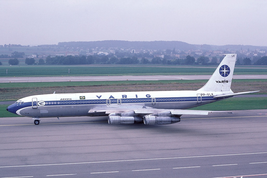 Boeing 707 airline Varig | |
| General information | |
| date | November 27, 1962 |
| Time | 03:37 (08:37 GMT ) |
| Character | Clash with mountain |
| A place |  Cruz, 25 km east of Callao airport , Lima ( Peru ) Cruz, 25 km east of Callao airport , Lima ( Peru ) |
| Dead | |
| Aircraft | |
| Model | Boeing 707-441 |
| Airline |  Varig Varig |
| Departure point | Galeão , Rio de Janeiro ( Brazil ) |
| Stops on the way |
 Mexico City ( Mexico ) Mexico City ( Mexico ) |
| Destination |  Los Angeles ( United States ) Los Angeles ( United States ) |
| Flight | RG810 |
| Board number | PP-VJB |
| Date of issue | June 2, 1960 (first flight) |
| Passengers | 80 |
| Crew | 17 |
| Dead | 97 (all) |
| Survivors | 0 |


Airplane
Boeing 707-441 with the registration number PP-VJB (factory - 17906, serial - 129) was released in 1960 and made its first flight on June 2 , after which on June 16 it arrived at the customer - the Brazilian airline Varig. Also, from December 1960 to May 1961, the airliner leased to the Israeli airline El Al , after which it returned back to Varig [1] . His four jet engines were Rolls-Royce Conway 508 models. [2] The total operating time of the airliner was 6326.41 hours. including 1.27 hours since the last check [3] .
Crew
Due to the large length of the route aboard flight 820 there was a double crew, only 17 people [4] :
- The aircraft commanders are Gilberto Salomoni ( port. Gilberto Salomoni ) and Edu Michel ( port. Edu Michel );
- Second pilots - Frederico Helmut Hirschmann ( port. Frederico Helmut Hirschmann ) and Gaspar Baltarts Ferrario ( port. Gaspar Balthazar Ferrario );
- Flight Engineers - Leonardo Nunofer ( port. Leonardo Nunhofer ) and Armindo Ferreira Masiel ( port. Armindo Ferreira Maciel );
- Airborne players - Besmar Lino-dos-Reis ( port. Besmar Lino dos Reis ) and Francisco Evangelista Oliveira ( port. Francisco Evangelista Oliveira );
- Flight attendants - Dzhoseli Eric Stein ( . Port Jocely Erica Stein), Helio Arantes Sarauta ( port. The Helio Arantes Carauta), Pindar Figueiredo Bastos ( port. Pindaro Figueiredo Bastos), Espedito Gomes Vasconcelos ( port. Espedito Gomes Vasconcelos), Hasso Grundig ( port Hasso Grundig ), José Pires Rochael ( port. José Pires Rochael ), Armando Maximiliano de Vugt ( port. Armando Maximiliano de Vooght ), Sumiko Okumura ( port. Sumiko Okumura ), and Mary Rose Frankel ( port. Marie Rose Frankel ).
With the exception of the German-steward and the French-stewardess, the crew members were mainly Brazilians [5] .
Catastrophe
Onboard PP-VJB operated the regular passenger flight RG-810 on the route Rio de Janeiro - Lima - Cali - Panama - Mexico City - Los Angeles . At 03:43 [* 1] with 80 passengers and 17 crew members, the airliner took off from Galeão Airport (Rio de Janeiro) and headed for Lima. In accordance with the plan, the flight passed through the strongholds of Pisasununga (the passage was reported at 04:30), Campogrande (05:24),Curumba (05:48), Santa Cruz (06:30), Cochabamba (06:52), Charaña (07:15) and Pisco (08:13). At 08:09 the crew contacted the dispatch center in Lima and reported that it should be at an altitude of 36,000 feet (11,000 m ), expects to pass the Pisco point at 08:13, and at 08:36 to land at Callao airport (Lima ), after which he requested permission to reduce. In response, the dispatcher reported an oncoming aircraft - Douglas DC-6 , which flew out of Lima at 07:36, followed at an altitude of 13,500 feet (4,100 m ) and also expected to pass Pisco at 08:13 [6] .
Weather conditions on the section from Pisco to Lima at this time can be described as good: the wind has 200 ° 5 knots, continuous stratus clouds at an altitude of 510 meters, and visibility is 14 kilometers [7] .
At 08:13 flight 810 passed Pisco, and then at 08:14 the crew reported on the beginning of the descent. At 08:19, the aircraft reported that it had reached an altitude of 26,000 feet (7,900 meters ), to which the controller gave permission to continue descending and perform a direct approach to strip 33. At 08:24, the crew reported to the approach controller about passing 15,000 feet ( 4600 m ) and that he is 10 minutes from the airfield. At 08:30 at an altitude of 12,000 feet (3,700 m ) [* 2] flight 810 approached Las Palmas . Since he was still high enough to carry out the approach, the approach controller advised to make a 360 ° turn with a decrease over Las Palmas, and then re-report his progress. After the turn, the plane was again returned to the course of 330 °, but in fact now followed a little to the right. Coming to the east of the airport Lumatambo , the airliner turned right, heading for Callao airport. Then the crew turned south to take a course opposite to the landing, and followed it until it passed west of Las Palmas, after which it continued flying for another three minutes before turning 180 ° north to capture the 327 ° landing course. Then at 08:37 the connection with flight 810 was suddenly interrupted. After a series of unsuccessful attempts to contact the crew at 08:55, the approach controller declared an emergency [6] .
At 18:00 GMT (13:00 local time), the Peruvian Air Force discovered the wreckage of an airplane on Mount Cruz (La Cruz, height about 750 meters [8] ) 25 kilometers east of Callao airport and 20 kilometers from Lima. At about 08:37 GMT (03:37 local time) the Boeing, flying in the dark with an actual 333 ° course, 8 miles east of the approach trajectory at an altitude of about 2000 feet (610 m ) crashed into a mountain and exploded, completely destroyed. All 97 people on board were killed [6] [5] . By the number of casualties at that time, it was the largest air crash in Peru (the third in 2015) [9] .
Investigation
A study of the wreckage showed that the collision occurred when the main chassis were released (the position of the front chassis could not be established) [7] , the engines and their nacelles were intact and operated normally. The collision speed itself was defined as 165-170 knots, which is the normal speed for approach. Although the control points on the route, flight 820 passed as planned, but it took him 23 minutes to overcome the last 113-mile segment of Pisco-Lima, while the rest of its flights took 16 minutes. However, this difference of 7 minutes can be explained by the fact that, on approaching, flight 820 was forced to stay at cruising altitude, starting to descend only after Pisco [10] .
Investigators studied the recordings from flight recorders, especially the last 23 minutes, from the moment Pisco passed. The decline from a height of 36,000 feet (11,000 m ) was started after Pisco, and the plane first changed its course from 286 ° to 338 ° and then to 330 °. The altitude at that moment was 34,000 feet (10,000 m ), and the descent was performed at a vertical speed of more than 1,500 feet (460 m ) per minute, with the result that the instrument speed, 8 minutes before the incident, reached 445 knots. After 6 minutes after passing Pisco, the crew was allowed to descend and perform a direct approach to lane 33. In this case, it was assumed that Las Palmas would be passed at an altitude of 2000 feet (610 m ), but in fact the liner approached him at an altitude of 15,000 feet ( 4600 m ) [* 2] , which is significantly greater than the height allowed for a landing approach with a straight line. At the same time, the flight data recorder did not record sharp drops or transitions to horizontal flight, that is, a sufficiently rapid decrease cannot be explained by maneuvering to avoid approaching other aircraft in the vicinity of Lima [10] .
Flying over Lima, the crew did not see the city through the clouds, but in the dark it was well noticed by its lights. Then from the plane they asked to turn on the drive radio station of Callao airport. It is possible that at this time the radio compass was mistakenly tuned to the drive radio station of the old Lumatambo airport and the crew mistakenly focused on it. By this, it is possible to explain why the airliner turned from a course of 325 ° to 342 °, after which it was a mile from the old airport. Coming out to the new airport (Callao), flight 820 turned south, with a course that was the reverse of the landing, after which, continuing to follow in a southerly direction, he caught a radio signal from the radio beacon, which he took as a signal from the beacon of the heading system [10] .
When the crew completed the last turn of 180 °, it took not a landing course of 327 °, but 012 °, that is, starting to dodge to the east. It is possible that the crew incorrectly passed the indications of the integral navigation system, otherwise it would be impossible to explain otherwise that it continued flying with a course of 012 ° for three minutes. It is also possible that they focused on the signal from the drive station of the old airport. When a few minutes later the signal from the drive station turned out to be on the left side, the crew, suspecting a malfunction of the course-glide system, stopped navigating along the radio compass, turning on a course of 333 ° [11] .
Reasons to
The commission called the plane’s dodging cause of the crash when it followed a course that was opposite to the landing board for Callao airport. What caused this evasion, the investigators could not accurately determine [11] .
Notes
Comments
- ↑ Hereinafter , the Greenwich Mean Time (GMT) is specified by default.
- ↑ 1 2 Inconsistent data is presented in different sections of the ICAO report. On page 140, it says: "12,000 above Las Palmas," and on page 143 it says: "We’ve come to Las Palmas by 15,000."
Sources
- ↑ Registration Details For PP-VJB (Varig) 707-441 (English) . Plane Logger. The appeal date is April 11, 2015.
- ↑ PP-VJB Boeing 707-441 17906 129 (English) . rzjets.net. The appeal date is April 11, 2015.
- ↑ ICAO Circular , p. 141.
- ↑ O rastro da bruxa, 2008 , p. 222.
- ↑ 1 2 Dawn Search After Peru's Air Disaster (eng.) , The Sydney Morning Herald (29 November 1962), p. 3. The date of circulation is April 11, 2015.
- ↑ 1 2 3 ICAO Circular , p. 140.
- ↑ 1 2 ICAO Circular , p. 142
- ↑ O rastro da bruxa, 2008 , p. 218.
- ↑ ASN Aircraft accident Boeing 707-441 PP-VJB Lima-Callao International Airport (LIM) (English) . Aviation Safety Network . The appeal date is April 11, 2015.
- ↑ 1 2 3 ICAO Circular , p. 143.
- ↑ 1 2 ICAO Circular , p. 144
Literature
- Silva, Carlos Ari César Germano da. Back Course // O rastro da bruxa: história da aviação comercial brasileira no século XX através de seus acidentes: 1928–1996 . - 2. - 2008. - P. 217–222. - ISBN 978-85-7430-760-2 .
- Empresa de Viagao Aerea Rio Grandense SA, (VARIG), Boeing 707, PP-VJB, La Cruz Peak, Surco District, Lima Province, Peru on 27 November 1962. Report, dated 16 October 1963. (English) / / ICAO Accident Digest No. 14, Volume II: ICAO Circular 71-AN / 63. - Montreal: International Civil Aviation Organization , 1966. - August. - P. 140-144 .