The 2nd Cavalry Regiment (also known as the 2nd Cavalry Regiment , also known as the 2nd Dragoon Regiment) is a cavalry, rifle, and then motorized infantry regiment of the U.S. Armed Forces . It leads the story since 1836 . Now a separate unit of the US Ground Forces in Europe (USAREUR) (formerly the 7th US Field Army ( Seventh United States Army )).
| 2nd Cavalry Regiment | |
|---|---|
 Regimental coat of arms | |
| Years of existence | 1836 - present |
| A country |  USA USA |
| Subordination | US Army |
| Included in | USAREUR |
| Type of | regiment |
| Function | cavalry , later motorized rifle troops |
| Dislocation | Filsiek , Germany |
| Nickname | 2nd dragoon |
| Motto | Toujours Prêt (“Always Ready!” (French)) |
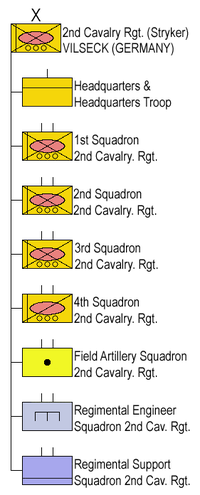
| Equipment | BBM "Striker" |
| Participation in | Mexican war Native American wars U.S. Civil War Spanish american war Philippine american war World War I The Second World War Gulf war Iraq Afghanistan |
| Marks of Excellence |   |
| Commanders | |
| Current commander | Colonel Thomas hugh |
| Famous commanders | William Hearney Henry H. Sibley David Twiggs Albert Johnston Philip Cook Joseph T. Dickman Creighton abrams David M. Maddox John H. Tilelli, Jr. Walter L. Sharp |
| Site | army.mil/2cr |
History
First Formation
It was formed on May 23, 1836 at the direction of President Jackson . It consisted of two squadrons, one of which was located in the state of Missouri in the fortified Jefferson barracks, and the second in the state of Florida , where he took part in the war against the Seminoles . His first combat clash was a shootout at Welik Pond on June 10, 1836, where company D participated. In December 1836, companies A, B, C, E, I arrived, and in January 1837 they participated in the battle at Fort Mellon. On September 9 of the same year, three Dragoon companies surrounded the village and captured one of the Seminole leaders named King Philip. The 2nd Dragoonsky mainly participated in offensive operations, preferring not to wait for the attacks of the Indians in the forts, as the other units acted.
Subsequently, the second squadron under the command of Colonel Twiggs was transferred to Texas . The regiment took part in all wars and conflicts in the Midwestern United States of the mid-19th century: the war with Mexico , the wars with the Indians , the civil war in Kansas and the war with the Mormons .
Civil War
With the outbreak of the Civil War in 1861, the regiment was sent to the eastern theater of war. For most of the war, he was a key part of the brigade of the Cavalry Corps of the Potomac Army and took part in many battles, in particular, in the Battle of Gettysburg , where he was a member of the Wesley Merritt brigade and commanded by Captain Theofilius Rodenbo.
As in the case of other cavalry units of early education, many officers from the pre-war regiment served in the armies of both the North and the South.
Native American Wars
In the second half of the 19th century, the regiment took part in conflicts with the Indians inhabiting the Midwestern United States, the so-called " Indian Wars ":
- Battle of the Wichita Village (October 1, 1858)
- The Fatterman Massacre ( War of the Red Cloud ) (December 21, 1866)
- Kidder Massacre (July 2, 1867)
- The Massacre of Marias (January 23, 1870)
- The battle of the river. Powder ( War for the Black Hills ) (March 17, 1876)
- Battle of Rosebad (June 17, 1876)
US-Spanish War
During the American-Spanish war, the regiment was sent to Cuba , where it connected with the detachment of " Brave Riders " ( English Rough Riders ) under the command of T. Roosevelt . He took part in the battles of El Canay, the battle for the height of San Juan and others. After the war ended, the regiment remained in Cuba for three years in order to maintain order.
In 1899 he was transferred to the Philippines , where he participated in the campaign in the province of Cavite , as well as in the war with the Moro people in 1911 and 1912.
World War I
On June 26, 1917, the regiment was the first of the US armed forces to arrive in France as an honorary escort to General Pershing, commander of the American Expeditionary Force. During World War I, the regiment mainly served as a military police force , which did not prevent it from participating in several major battles in the summer of 1918, including the Second Battle of the Marne . During the subsequent Mez-Argonne offensive, the regiment was used for the last time in military operations as a cavalry. After the Compiegne Armistice (November 11, 1918) and until August 1919, the regiment participated in the occupation of the Rhine region , located in the German city of Koblenz .
World War II
Returning from Europe, the regiment was stationed at Fort Riley , Kansas military base. With the outbreak of World War II, the regiment became part of the 9th Panzer Division , which included in the landing of troops in Normandy . Being in the Third US Army under the command of General J. Patton [1] , the regiment, during a general attack on the east, moved further than other units of the allies, entering Czechoslovakia , where he met with the advancing units of the Soviet army. A regiment led by Colonel C.H. Rand saved the stallions of the famous Lippitsian breed from destruction by transporting them to a safe place in Germany. At the end of the war, the regiment was renamed the 2nd Constable Regiment ( Eng. 2nd Constabulary Regiment ) and then in the 2nd Armored Cavalry Regiment ( Eng. 2nd Armored Cavalry Regiment ) (1948). His barracks until December 1990 were in Nuremberg .
Cold War
During the Cold War, the regiment was located in West Germany along the border with the Eastern Bloc , acting as a watchdog in case of an invasion of the Warsaw Pact forces in Western Europe .
After the fall of the Berlin Wall and the collapse of communist regimes in Eastern Europe, it became clear that the regiment had to solve new problems. Soon after the Iraqi invasion of Kuwait, the regiment was transferred to Saudi Arabia .
Gulf War
In February 1991, the regiment participated in a deep raid of the VII Corps on the territory of Iraq . In a major tank battle known as the Battle of 73 Easting , the regiment destroyed two brigades of the Republican Guard of Iraq from the Tavalkan mechanized division. For actions in Operation Desert Storm, the regiment was awarded the distinction For Valor .
Reformation
Upon returning from the Middle East, the regiment was transferred from Germany to Fort Lewis , Washington . Here, the regiment received Humwee SUVs, armed with 12.7 mm Browning M2 machine guns , BGM-71 TOW anti-tank missiles and Mk 19 automatic grenade launchers.
From 1995 to 1996, the regiment squadrons alternately carried out security service in Haiti as part of the 25th Infantry Division .
Service in Bosnia
In June 1997, the regiment was transferred to Germany, where it was included in the 1st Armored Division . In August of that year
The 2nd and 3rd squadrons were sent to Bosnia as part of the NATO peacekeeping force in Bosnia and Herzegovina ( SFOR ). Parts of the regiment were assigned to the 1st Infantry Division , which ensured law and order during municipal elections.
Global War on Terror
In 2003, the regiment was again sent to the Middle East to participate in the operation to overthrow the regime of Saddam Hussein . The regiment was entrusted with the task of combating insurgents in an area stretching from Baghdad to Al-Najaf and Al-Kut . The regiment was in Iraq for 16 months and, according to the results of its combat work, was awarded the thanks of the President of the United States.
Upon completion of the mission in Iraq, the regiment returned to Fort Lewis base, where it underwent a reorganization on the brigade principle . On June 1, 2006, the regiment was renamed the 2nd Striker Cavalry Regiment (2nd SCR).
In September 2006, the regiment was transferred to the Rose Barracks base in the town of Filsiek (Germany). In August 2007, the regiment was again sent to Iraq to fight al Qaeda . At the end of his fifteen-month stay in Iraq, the regiment returned to Germany.
From July 2010 to April 2014, the regiment served in the Afghan province of Kandahar as part of the forces of the International Coalition ( ISAF ), for which it was subsequently awarded commendable thanks to the army military unit .
NATO forces in Eastern Europe
Since October 2011, regiment units have regularly been involved in large-scale .
In the spring of 2015, the regiment took part in NATO exercises to repel Russia's alleged aggression against the border countries of the bloc [2] : “ Atlantic Resolve ” [3] and “ Dragoon Ride ” [4] ] . In the spring of 2016, regiment squadrons again marched through the Baltic republics ( Operation Spring Storm 2016 ) [5] , as well as through Moldova and Romania ( Dragon Pioneer 2016 maneuvers ) [6] [7] .
Since January 2017, the regiment has been sending one of its squadrons (800 people) to form a NATO combat group in Poland as part of the Enhanced Forward Presence of the Alliance countries in the Baltic.
Notes
- ↑ During this period, the regiment was called "2nd Mechanized Cavalry Group" ( Eng. 2nd Cavalry Group, Mechanized )
- ↑ “Russian Aggression: Operation Dragoon Ride Rolls Through The Czech Republic”
- ↑ “Operation“ Atlantic Resolve “”
- ↑ “American forces in Europe: Cavalry ride”, The Economist , Apr 1st 2015
- ↑ NATO exercises Kommersant newspaper take place in Estonia , May 2, 2016
- ↑ Dragon Pioneer 2016 military exercises TOPnews.ru, May 3, 2016
- ↑ American armored vehicles arrived in Chisinau Lenta.ru, May 9, 2016