Irenaeus of Lyons ( other Greek: Εἰρηναῖος Λουγδούνου ; Latin: Irenaeus Lugdunensis , c. 130 , Smyrna , Asia , Roman Empire - 202 , Lugdunum , Lugdunsky Gaul , Roman Empire) - one of the leading theologians of the 2nd century, one of the leading Fathers of the Church II apologist , second bishop of Lyon . Belonged to the Asia Minor theological school. His writings contributed to the formation of the teachings of early Christianity. It is believed that he was a pupil of Polycarp of Smyrna . The most famous work of Irenaeus of Lyons " Ἔλεγχος καὶ ἀνατροπὴ τῆς ψευδωνύμου γνώσεως " ( Against heresies ) is a polemic with Gnosticism , which became the first theological challenge for early Christianity. The Catholic Church considers Irenaeus of Lyons, along with Clement of Rome and Ignatius of Antioch, the initiator of the formation of the doctrine of the papal primacy [1] . The works of Irenaeus of Lyons are the first evidence of the recognition of the canonical nature of the four Gospels [2] .
| Irenaeus of Lyons | |
|---|---|
| Εἰρηναῖος Λουγδούνου | |
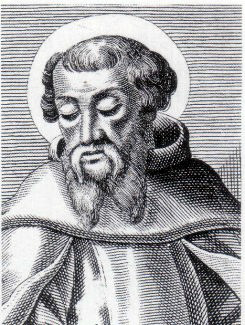 Irenaeus of Lyons on an engraving of New time. | |
| Birth | about 130 year |
| Death | 202 |
| Is revered | Orthodox Church, Catholic Church |
| In the face | |
| Day of Remembrance | |
| Asceticism | Bishop of Lyon |

Biography
Irenaeus was born in the first half of the II century in Smyrna (today - Izmir , Turkey ) in a Christian family. The exact date of his birth is disputed; according to various sources, he was born in the period from 115 to 125, or from 130 to 142. In Smyrna, he received a brilliant education, having studied poetry , philosophy , rhetoric and other sciences, which were considered necessary for a secular youth. Around 160, he was sent by his mentor Polycarp , Bishop of Smirn (who baptized the young man, and later ordained as presbyter), to Gaul , to the city of Lugdun, now Lyon in France, to the elderly Bishop Pofin to preach Christianity. During the persecution of the Roman emperor Marcus Aurelius , which lasted from 161 to 180, Irenaeus was a priest in Lyon. In 177, he was sent on behalf of the priests of Lyon with letters from the confessors to Rome to Pope Eleutherius . In addition to letters, Irenaeus carried with him a message mentioning the spread of the heresy of Montanism . While he was in Rome, persecution of Christians began in Lyon, all prominent Christians were thrown into prison. When Irenaeus returned to Lyon, he was elected the second bishop of Lyon after Pofinus , who suffered martyrdom during the persecution.
“In a short time,” St. Gregory of Tours wrote about him, “with his sermon he transformed the whole of Lugdun into a Christian city.”
During his reign at the Lyon pulpit, Irenaeus of Lyons engaged in pastoral and missionary work, criticizing Gnosticism . He wrote the antinostic essay Adversus haereses .
Reliable historical information about the reign of Irenaeus of Lyons at the department of the Lyon diocese is unknown. Eusebius of Caesarea, in his essay Historia Ecclesiastica, mentions that Irenaeus of Lyons, around 190, asked Pope Victor I not to deprive the Christian communities of Asia Minor who persisted in Quarto-Decimanism , celebrating Easter on the 14th day of the Jewish month of Nisan [3 ] .
Nothing reliable is known about the circumstances of his death; later tradition relates it to the persecution of Septimius Severus (193-211). According to his life, he was truncated with a sword for practicing faith around 202 .
The Doctrine of Irenaeus of Lyon
Controversy with the Gnostics
The central point in the teaching of Irenaeus of Lyons about the action of God in the history of salvation is God's unity. Unlike the Gnostics, who taught that God appears in the history of salvation as different eons or divine emanations , while distinguishing between the monad and the Demiurge , Irenaeus of Lyons used the doctrine of the Son and the Holy Spirit as the “two hands of God,” thereby emphasizing the indivisibility Holy Trinity. His emphasis on the unity of God was reflected in the teaching of the unity of history and the continuous continuity of the history of salvation. Using the doctrine of the Logos from the 1st chapter of the Gospel of John, Irenaeus of Lyons claimed that God, having created the world, has been continuously supervising it until now, which is part of the history of salvation. The essence of the entire history of salvation is the gradual "spiritual growth or maturation" of mankind. Irenaeus believed that mankind was originally "immature" and God creates history so that His creation acquires God's likeness. Adam and Eve were “children” who committed their fall due to their immaturity. Throughout the history of salvation, God's Providence is intended to overcome this human immaturity and achieve spiritual perfection. The world was specially designed by God as a place of suffering so that a person, making moral decisions, grows in his perfection. Irenaeus compares death with a whale that swallowed Jonah, which symbolizes humanity, so that it can turn to God and act according to the will of God.
“A perfect man ... consists of three - flesh, soul and spirit: of which one, that is, spirit. saves and forms; the other, that is, the flesh, unites and forms, and the middle between the two, that is, the soul, sometimes when it follows the spirit, rises to it, sometimes, pleasing the flesh, it falls into earthly lusts. So all those who do not have what saves and forms life will naturally be called flesh and blood. because they do not have the Spirit of God in themselves ” [4] .
The center of the entire history of salvation is the Nativity of Jesus Christ, in which Irenaeus of Lyons sees the “new Adam”, destroying everything that the first Adam did in paradise. The first Adam transgressed the commandment of God, the second Adam was obedient to death on the cross. In the matter of redemption, Irenaeus of Lyon gives greater importance to the Incarnation of the Word of God than the death of Jesus Christ, because, as he believes, in the Incarnation of Christ, human nature acquires divine immortality.
In the controversy with the Valentin Gnostics, who believed that the material world is the result of the loss of original perfection. According to the Gnostics, only in the possession of Sophia , which is a secret wisdom, and therefore redemption is made only with the possession of secret knowledge, which is achieved in the pleroma , which Ahamot lost. Irenaeus of Lyons, however, emphasized the beauty of the created world, which is called for gradual development, the goal of which will be complete perfection [1] .
Apostolic Succession
In their writings, the Gnostics claimed that the apostles possessed a secret teaching that they received from Jesus Christ. Irenaeus of Lyons wrote that bishops of various places are the successors of the apostles and their succession is an authoritative source of interpretation of the Holy Scriptures and indicates a list of bishops, explaining the episcopal succession from the apostles, denying the Gnostic thought that the truth was received from various sources. A special role in apostolic succession, as written by Irenaeus of Lyons, is unanimous agreement among the bishops, which is a criterion of truth. Irenaeus of Lyons emphasized the unique position of the Pope as the successor to the Apostle Peter [5] .
“Church tradition from the apostles and the preaching of truth have come down to us. And this serves as the most complete proof that the same life-giving faith was preserved in the Church from the apostles to this day and is faithful in its true form ” [6] .
Mariology
Irenaeus of Lyons is one of the earliest fathers of the church, who carefully developed mariology . For the first time in the history of patristic thought, Irenaeus of Lyons made a comparison between Eve and Virgin Mary, contrasting disobedience and unbelief in the first and humility and confidence in the second. It is assumed that in the development of mariology, he followed the teachings of Polycarp of Smyrnsky [7] . Irenaeus directly connects the economy of our salvation with the role of the Virgin Mary:
Eve (was) naughty, for she did not show obedience when she was still a virgin. Like she, having Adam’s husband, but still a virgin - for “they were both naked in paradise and not ashamed” [8] , since not long before they were created they had no idea about having children, but they had to mature first and then to multiply - rendered disobedience and became the cause of death for both herself and the whole human race; so Mary, having a destined husband, but remaining a Virgin, through obedience became the cause of salvation for herself and for the whole human race. [9]
According to Irenaeus, the birth of Jesus Christ created a new situation in the history of salvation. Through the Virgin Mary, a “new birth” is shown so that through this birth a person will inherit life (Against heresies. V.1.3). As the Mother of the New Man , the Virgin Mary anticipates universal renewal. According to Irenaeus, in this She leads the human race. [ten]
Compositions
The writings of Irenaeus against the Gnostics are of great importance and special authority in the history of Christian dogmas in their antiquity and especially because of his proximity to Polycarp, a direct disciple of the apostles . When Pope Victor decided to excommunicate the Asia Minor bishops from the church because they celebrated Easter on the same day as the Passover , Irenaeus defended them, pointing out that differences in formal points should not jeopardize the unity of the Church.
Most of the works of Irenaeus of Lyons have not been preserved in full. From the writings of Irenaeus of Lyons, they are known from excerpts and references from ancient historians, "The Epistle to Florin on the One-Person Command or that God is not the culprit of evil"; “About the Oscar” - about the first eight aeons, which the heretic Valentine recognized as the source of all things; “Message to Pope Victor,” regarding the heresy of Valentinian; “A message to him about the time of the celebration of Easter”; "Against the Greeks"; “On knowledge”; "The statement of the apostolic sermon" (that is, the main points of the Christian faith); "The book of various considerations."
In its entirety, although not in the Greek original, but in the ancient, still known to Tertullian , Latin translation, the main, especially important for the history of the development of Christian thought, work of Irenaeus “Five books against heresies” (the real name of the book is “Refutation and victory over knowledge,” was preserved falsely referred to as "). It was first published by Erasmus of Rotterdam , in 1526. In this book, Irenaeus gives the fullest surviving description of Gnosticism and the teachings of Marcion , in contrast to which he affirms the validity of the apostolic tradition and lists bishops, beginning with the apostles, emphasizing that among the latter did not have a single Gnostic.
The Armenian translation of The Apostolic Sermon, which was first published in 1907, was also fully preserved.
Scripture
Irenaeus uses scripture as authoritative evidence in his disputes with the Gnostics. In his writings, he emphasizes the importance of following the apostolic tradition and the canonical New Testament texts; calls not to neglect the " Jewish Bible ." The Christians of Asia Minor during the time of Irenaeus of Lyon preferred the Gospel of John . The Gospel of Matthew was used universally at that time. In his writings, he spoke of the dogmatic unity of the four Gospels, denying the opinion of Marcion, who recognized only the Gospel of Luke . St. Irenaeus rejected all the Gnostic Gospels that were used by the Gnostics in the II century, and announced 4 books - the Gospel of Matthew , Mark , Luke and John - authoritative Scripture of the Church .
The criterion for selecting those, and not other gospels, was the faith of the Church . Only those Gospels that contain certain statements regarding the Christian faith are genuine, and faith is united in a church community dating back to the apostles . Thus, the authenticity of the gospel testimony, which by virtue of its dogmatic unity is the “sign” of Truth, is inseparable from the concept of Holy Tradition , open and accessible to all. St. Irenaeus said that the Church and Holy Tradition have a universal universal character.
In his writings, Irenaeus of Lyons quotes 21 passages from New Testament books :
- Gospel of Matthew (Matthew 3.16)
- Gospel of Mark (Mark 3.10);
- The Gospel of Luke (Luke 3.14)
- Gospel of John (John 3.11)
- The Acts of the Holy Apostles (Acts 4.14);
- Romans (Rom. 3.16);
- 1 Corinthians (1 Cor. 1,3);
- 2 Corinthians (2 Cor. 3,7);
- Galatians (Gal. 3.22);
- 1 Thessalonians (1 Thess. 5,6);
- 2nd Epistle to the Thessalonians (2 Thess. 5.25);
- 1st epistle to Timothy (1 chapter);
- 2 Timothy (2 Tim. 4,14);
- Epistle to Titus (Titus 3.3);
- 1 Peter (1 Peter 4,9)
- 2nd Peter (2 Peter 5.28);
- 1 John (1 John 3.16)
- 2 John (2 John 1,16);
- James Epistle (James 4.16)
- Hebrews (Heb 2.30);
- Revelation of John the Theologian ( Apocalypse ) (Rev. 4.20).
Praise
Memorial Day in the Orthodox Church on August 23 ( September 5 ), in the Catholic on June 28 . His alleged tomb in Lyon was ravaged by the Huguenots in 1562 . However, in the local Catholic church still point to the ark with particles of the relics of the Lyons martyrs , in which are stored the relics of the saint.
See also
- Sola scriptura
Notes
- ↑ 1 2 Meyendorf, Introduction to Patristic Theology
- ↑ Brown, Raymond E. An Introduction to the New Testament, p. 14. Anchor Bible; 1st edition (October 13, 1997). ISBN 978-0-385-24767-2.
- ↑ Eusebius, Historia Ecclesiastica 5.24.1ff
- ↑ Against Heresies, V, 9: 1
- ↑ “But since it would be very long ... to list the successions of the primates of all churches, I will give the tradition that the greatest, oldest and most famous church has from the apostles, founded and built in Rome by the two most glorious apostles Peter and Paul and proclaimed to people by faith, which through the succession of the bishops has come down to us, and I will shame all those who in every possible way illegally make meetings, either by bad self-indulgence, or by vanity, or by blindness and perverse opinions. For, by necessity, every church agrees with this church, because of its primary importance ... since in it the apostolic tradition has always been preserved by believers everywhere ”, Against Heresies, III, 3: 2
- ↑ Against Heresies, III, 3: 3
- ↑ Catholic Encyclopedia
- ↑ Genesis 2:25
- ↑ Irenaeus of Lyon. Against heresies. Book III. Chapter 22. § 4.
- ↑ Prot. George Florovsky . The Virgin Virgin. . Date of treatment November 11, 2010. Archived February 22, 2012.
Literature
Russian translations:
- Irenaeus of Lyons . Five books against heresies. / Per. P. Preobrazhensky. - M., 1868 . - 716 s.
- reprint: Works. - M., 1871. - 716 p .; 2nd ed. - SPb., 1900. - 548 p.
- The newly discovered work of St. Irenaeus of Lyons . Proof of the Apostolic Sermon. / Per. N. Sagards. - SPb., 1907 .
- St. Irenaeus of Lyon . Creations. / Per. P. Preobrazhensky. - [St. Petersburg, 1900], N. Sagardy [St. Petersburg, 1907]. (Series “Library of Church Fathers and Teachers.” II); M., Blagovest, 1996 .-- 640 p.
- reprint.: St. Petersburg: Publisher Oleg Abyshko.
Research
- in Russian
- Amman A. The Way of the Fathers. A brief introduction to patristics . - M.: Propylaea, 1994 .-- 206 p.
- Isabelle de Andia Resurrection of the flesh according to Valentinians and Irenaeus of Lyon 1998
- Irenaeus of Lyons // Plasma Radiation - Islamic Salvation Front [Electronic resource]. - 2008. - P. 660. - (The Big Russian Encyclopedia : [in 35 vols.] / Ch. Ed. Yu. S. Osipov ; 2004—2017, vol. 11). - ISBN 978-5-85270-342-2 .
- Gusev D.V. Dogmatic system of St. Irenaeus of Lyons in connection with the Gnostic teachings of the second century // Orthodox interlocutor . - 1874. - No. 8-9.
- Evidence of the Apostolic Sermon // Christian Reading . - 1907. - No. 4-6.
- Karsavin L.P. Holy Fathers and Teachers of the Church 1927
- Kianovsky V., priest Eschatology St. Irenaeus of Lyons in connection with contemporary eschatological views (chiliasm and Gnosticism). Har., 1912
- Mayorov G.G. Formation of medieval philosophy (Latin patristics). - M.: Thought , 1979. - S. 70-75.
- Meyendorf I.F. Introduction to Patriotic Theology 1980
- Eugene (Sakharov-Platonov) , St. I., Bishop Lyonsky, PrTSO, t.1, pr. 4. - 1843.
- Prot. P. Preobrazhensky On Saint Irenaeus of Lyon and his writings 1900
- Sagard N. N. Newly discovered work of St. I. L. "Proof of the Apostolic Sermon." - SPb., 1907;
- Fedchenkov S. A. Saint Irenaeus of Lyons: His life and literary activity. - Sergiev Posad, 1917 .-- XX, 552 p.
- Fedchenkov S. A. Armenian fragments of the works of St. I. L. // Christian reading. - 1915. - No. 4.
- Irenaeus of Lyons // Orthodox Theological Encyclopedia . Volume 5. Edition of Petrograd. Appendix to the spiritual journal "Wanderer" for 1904 - S. 1018-22
- in other languages
- Migne. PG, t. 7; in Russian Per .: Op. St. Irenaeus, Bishop Lyonsky. - M., 1871; too, reprint. ed. - M., 1996;
- John Beh. Asceticism and anthropology in Irenaeus and Clement. - Oxford: Oxford University Press , 2000.
- Fantino J. La théologie d'Irénée. P., 1994
- Osborn E. Irenaeus of Lyons. Camb., 2001
- Poncelet A. "St. Irenaeus." // The Catholic Encyclopedia . Vol. 8. New York: Robert Appleton Company, 1910.
- foreign bibliogr. see in the journal. Connaissance des p-res de l'Eglise, 1979, No. 2 and in the book: Quasten. Patr., V. 1, p. 287;
Links
To the writings of Irenaeus
- Texts in Latin Pathology
- Proof of the Apostolic Sermon. - SPb., 1907 - survived not in the original, but in the Armenian translation
Against heresies :
About Irina
| Predecessor: Saint Potin of Lyon | Diocese of Lyon 177 - 202 | Successor: ? |