Allium lojaconoi (lat.) - a species of monocotyledonous plants of the genus Onion ( Allium ) of the Amaryllis family ( Amaryllidaceae ). It was first described by Italian botanists Salvatore Brullo, E. Lanfranco and Pietro Pavone in 1982 [2] [3] .
| Allium lojaconoi |
 |
| Scientific classification |
|---|
| The kingdom : | Green plants |
| Class: | Monocotyledonous [1] |
| Tribe : | Onion ( Allieae Dumort. , 1827 ) |
|
| International Scientific Name |
|---|
Allium lojaconoi Brullo , Lanfr. & Pavone , 1982 |
| Security status |
|---|
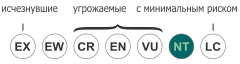
Close to VulnerabilityIUCN 3.1 Near Threatened : 172174 |
|
Relic of the Tertiary Period [4] .
Content
Maltese endemic [4] [5] [6] , known from the three largest islands of the Maltese archipelago : Malta proper, Gozo and Comino . The total area of the range is about 100 km² [4] . The type specimen is assembled at Zeytem Point [7] .
It prefers coastal areas, where it grows in crevices of rocks, on grassy and rocky places [4] .
Bulbous geophyte [5] .
It blooms in June and July [4] [6] .
The number of chromosomes - 2n = 16 [8] . The closest relative is Allium parciflorum [9] .
The population size is generally stable, but the species is considered rare. Externally, the plant is rather inconspicuous and practically of no interest for picking flowers, but is exposed to other threats from humans (for example, trampling, environmental pollution). In addition, Allium lojaconoi can be supplanted by other invasive and alien plant species [4] .
According to the International Union for Conservation of Nature, the species is close to a vulnerable position (“NT” status) [4] . The plant is also listed in the Red Book of Malta and is protected at the state level [6] .